Tom Cruise’s Digger is a commercial flop – but also the perfect climate film for our time

Digger, the new Alejandro González Iñárritu film, is bombastic, misanthropic and an epic, critically savaged flop. It is also the near-perfect climate change film for our era.
Digger Rockwell, the eponymous protagonist played by Tom Cruise, is a bluntly caricatured Texas oilman blase about the environmental ruin of his drilling, even as it triggers a disastrous splitting of the Arctic ice sheet. This causes a vast iceberg, five times the size of Washington DC, to barrel towards Europe and threaten a devastating tsunami.
Much like this impending disaster and the real-world retreat of glaciers and coral reefs, though, the mere act of watching Digger has become a forlorn race against time. The box office failure has been resounding, and Digger’s time on the big screen has been brief.
Facing a predicted $245m loss – the lavishly made film took $8m in its first weekend in the US before dropping 60% for its second – Digger was yanked from more than 2,500 theatres across the US ahead of its third week. Scrambling to find a single cinema showing Digger, I had to resort to spending a Thursday lunchtime with just two other ticket-buying patrons at a major Manhattan venue.
The critical opprobrium and dismal ticket sales shouldn’t be a shock. Fans of Cruise are used to mass appeal movies of clean-cut heroism, not him aged, balding and dressed in a Stetson and cowboy boots and little else as he howls a confected Texan drawl in a dark climate satire.
The film also, as critics have pointed out, strays into a “glib and overblown” depiction of elite cowardice and cynicism when it comes to the climate crisis.

There are heavy-handed scenes of Digger eating endangered tuna in front of his aghast chief scientist Nirav Ganesh (a harried Riz Ahmed) and of sneering indifference from a US president (played dyspeptically by John Goodman) when confronted by the looming catastrophe.
“You know what, this isn’t my problem,” the president says when confronted with ecological and societal doom. A farcically bellicose, Pete Hegseth-like general dismisses the iceberg as a snow cone and advises the president to “blow that frozen cunt up” with nuclear weapons.
At one point, Digger and Ganesh sit in a room gazing at flickering flames, as if they are in hell. It’s not a cheery message, but it is a franker one than the other, scarce attempts to depict the climate crisis on screen. Perhaps we are actually in hell, the movie suggests, and the evil oil tycoons aren’t the only ones to blame for that.
It is cathartic to see Ganesh berate Digger for being guilty of the “most heinous act of all time” by knowing, as oil companies did in reality for decades, of the consequences of global heating but then fatally obscuring this knowledge in order to rake in more cash. But Digger goes further than just unmasking a single villain.
Don’t Look Up, the 2021 climate allegory, frames the problem as frantic scientists being ignored as an asteroid heads towards Earth. Digger’s message is a more sinister but uncomfortably accurate one – that we all know of the cataclysm we are inflicting upon current and future generations but have largely acquiesced to it.
“Let’s cut the bullshit, you love oil,” as Digger tells enraged European lawmakers, all dressed in muted beige and grey, in a lengthy rant. “You want to bask in your unsustainable lives.”
The oil companies may have lied and bought off politicians, but, in the wealthy west at least, we have all been complicit by failing to punish leaders for this and we remain willing customers for the poison of fossil fuels, even as they choke, drown and fry us.
Any sort of lifestyle change – eating less meat, flying less, switching to a car that doesn’t have a petrol pump on hand at each corner – is too much hassle for most of us even as we face the biggest threat to menace humanity. There are always, as Digger points out to the Eurocrats, phones to be charged, TikToks to watch. In holding up a mirror to this, Digger might not be the climate film we want. But it may be the one we need.
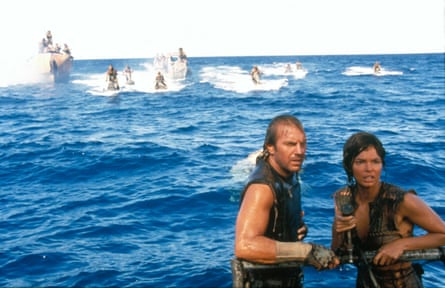
It’s striking that the possible end of a habitable planet has spawned comparatively little art with only vague nods, if at all, to our culpability. Among movies, there was Waterworld, another flop where Kevin Costner had to drink his own urine on a world flooded by the melted ice caps, and The Day After Tomorrow, where the melting ice causes a storm that plunges society into a new ice age.
Musically, the best of a meagre bunch is perhaps Smash Mouth’s 1999 hit song All Star which includes a lament of thinning ice and the line “my world’s on fire, how ‘bout yours?” The climate crisis may seem too overwhelming and gloomy to depict, but also, maybe we have so closeted and normalized our guilt that it feels shameful to bring it out into the light to be examined in public.
Digger forces us to not look away, even as we squirm at what we’ve done. “This film is a disaster movie,” Iñárritu has said. “But the disaster is us.”
The film is too nihilistic about our lack of response – Digger condemns clean energy as useless and his half-sister Emma (played by a wasted Sandra Hüller) makes endeavors in renewables that are dismissively mocked. Yet in real life the industry is growing explosively. We have everything we need to confront the climate crisis, after all, bar the necessary willpower.
Digger won’t be the last climate film. Later this year, A Statement, a dramatization of a real-life 1980 meeting of experts on what to do about global warming starring Paul Rudd and Paul Giamatti, will be released.
But Digger was the last Warner Bros’s theatrical release before it was purchased by Paramount Skydance and the Ellisons. Its commercial failure, along with the ideological leanings of the movie studio overlords, may deter further attempts to give us unvarnished tales of the climate crisis. That would be a huge, iceberg-sized mistake.
KioskNews shows a cleaned-up reading view extracted from the publisher’s page — the original always lives on their site, not ours.