US’ Taiwan policy unchanged: envoy
‘STATUS QUO’: ‘There’s no change in the Taiwan policy here,’ the US ambassador to China said, adding that the US is not changing its language or position on the issue
US policy toward Taiwan has not changed following talks between US President Donald Trump and Chinese President Xi Jinping (習近平), Washington’s top envoy to Beijing said on Friday, a day after the two leaders met at the White House.
“There’s no change in the Taiwan policy here,” US Ambassador to China David Perdue told CNBC in an interview aired on Friday morning when asked about the possibility that Xi might have tried to persuade Trump to soften his stance on Taiwan.
Trump is “fully committed to the one China policy,” Perdue said, adding that the US remains committed to the Taiwan Relations Act, the Three Joint Communiques and the Six Assurances.
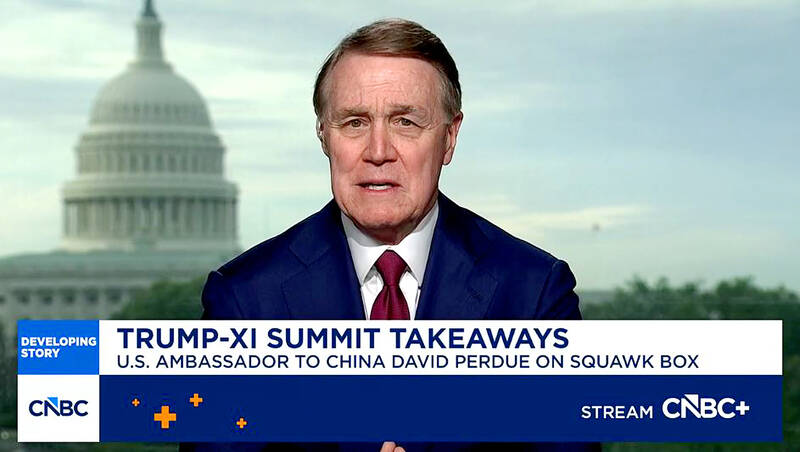
US Ambassador to China David Perdue speaks during CNBC’s Squawk Box aired yesterday.
Photo: Screen grab from CNBC Television’s YouTube channel
“Nothing has changed there,” he said. “We’re not changing the language. We’re not changing our position there. We want peace across the [Taiwan] Strait. We don’t want coercion. We don’t support independence.”
Perdue said Washington believed Xi had received that message, adding that Trump had “shown respect and listened to their side of that argument.”
Taiwan was among the closely watched issues during Thursday’s Trump-Xi meeting, and the two leaders did not respond to reporters’ questions afterward on whether the issue had been discussed.
According to the White House fact sheet on Xi’s visit, issued on Friday, the two leaders discussed bilateral trade and investment, geopolitical flashpoints, including Russia, North Korea and Iran, as well as drug control.
Taiwan is notably absent from the White House fact sheet, unlike the readout published by the Chinese Ministry of Foreign Affairs.
According to China’s readout, Xi stressed China’s “clear cut” position on safeguarding “national reunification” and “territorial integrity.”
“It is hoped that the US side will adhere to the correct position of opposing Taiwan independence, and handle the Taiwan question with caution, so as to lay a solid foundation for China-US strategic cooperation and the development of bilateral relations,” the readout said.
Trump has not publicly “opposed” Taiwanese independence, instead saying in May in an interview while visiting Beijing that he was not “looking to have somebody go independent” as he urged Beijing and Taipei to “cool down.”
According to the White House fact sheet, the two leaders “recalled that United States and China were allies in World War II and fought side by side to win the war.”
China’s readout does not mention the remark, but it was included in a report published by Xinhua on the same day. Taipei has rebuked that stance and accused Xi of distorting historical facts.
The Mainland Affairs Council and the Ministry of Foreign Affairs have stressed that it was the Republic of China, whose government relocated from China to Taiwan in 1949 after the Chinese Civil War, that fought alongside US forces in World War II.
However, Taipei has not publicly responded to the White House’s fact sheet.
Xi and his wife, Peng Liyuan (彭麗媛), on Friday concluded their three-day state visit to the US after having tea with Trump and US first lady Melania Trump at the White House and visiting the US National Archives.
After Xi’s departure, Trump said on Truth Social that the meeting was one of “Friendship, Strength, and Success” for both countries.
“We will be meeting again in November, in China, and then at the G20 in December, in Miami, Florida,” Trump wrote, adding that “much has been, and will be, accomplished.”
The APEC Economic Leaders’ Meeting is scheduled to take place in Shenzhen in November.
Trump also posted an anti-communist video on social media at 9:19pm on Friday evening.
The video vowed to defeat “communism, socialism and Marxism” and declared that “America will never be a communist country.”
The White House’s official social media account reposted the same video 38 minutes later.
The video was not newly produced after the Trump-Xi meeting.
The White House released a video with the same title, “America Will Never Be a Communist Country,” on Sept. 13, while a 30-second version has recently aired on US television.
KioskNews shows a cleaned-up reading view extracted from the publisher’s page — the original always lives on their site, not ours.