Royal crisis in Malaysia’s Negeri Sembilan eases as ruler reinstates council

“You must always understand the limits of your duties and jurisdiction,” Muhriz told the councillors, according to local media.
“I do not want the same thing to happen again,” he said, as it could jeopardise the harmony, stability and functioning of the state government.
Four councillors are from the Umno-led Barisan Nasional coalition and two belong to Perikatan Nasional, whose alliance secured 25 of the state assembly’s 36 seats in the August 1 election.
Ismail Lasim, whose position as chief minister had earlier remained under a cloud, also attended the swearing-in ceremony.
Muhriz dismissed all 10 previous executive councillors in September for endorsing the proclamation removing him from the throne, an act the palace deemed a violation of their oaths of office.
Malaysia’s Attorney General’s Chambers said the executive council had no constitutional authority to implement the decree or recognise a change of ruler.
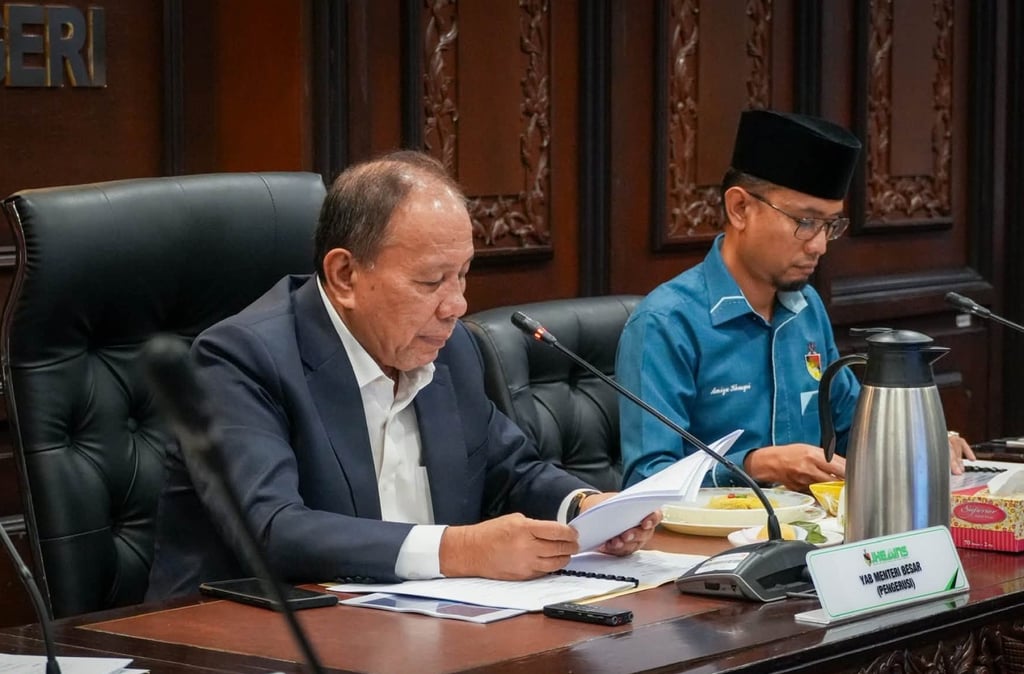
University of Malaya political analyst Awang Azman Awang Pawi said the appointments marked a “decisive turning point” in the crisis, particularly after the former councillors abandoned their legal challenge against their dismissal last week.
“Politically, the faction challenging Tuanku Muhriz has lost considerable institutional leverage,” Awang said.
“Umno also appears to have recognised that prolonging the confrontation carries greater political, economic and reputational costs than reaching an accommodation with the palace.”
Ismail and his 10 former councillors also withdrew a letter sent to Malaysia’s Conference of Rulers in September recognising Muhriz’s removal from the throne.
Friday’s ceremony came a day after Umno president Ahmad Zahid Hamidi and other senior leaders of the party met Muhriz to end the impasse.
“Let the palace’s statement serve to formalise the decision we have mutually agreed upon,” news agency Bernama cited Zahid as saying.
Umno’s retreat followed weeks of uncertainty over whether Ismail would remain chief minister after his party announced his resignation on November 16. He, however, denied authorising the submission of his resignation letter.
The palace told Ismail to prove majority support in the state legislature and unveil a new line-up of executive councillors before a date could be fixed to reconvene the assembly for presenting the 2027 budget.

Crown and court
Unlike Malaysia’s other hereditary monarchies, Negeri Sembilan’s ruler is elected by four territorial chiefs known as the undang under a centuries-old system of matrilineal customs originating from the Minangkabau community of Indonesia’s West Sumatra.
The state’s ruler is also one of nine Malay monarchs eligible to serve as Malaysia’s king under a rotating system of federal monarchy.
Meanwhile, an attempt to prosecute Mubarak Thahak – one of the chieftains at the centre of the crisis – hit a legal roadblock on Friday after a court suspended sedition proceedings against him pending a ruling on his constitutional status.
Sungai Ujong chief Mubarak was due to face a charge under Malaysia’s colonial-era Sedition Act over remarks he allegedly made about Muhriz’s removal.
Mubarak’s lawyers argued that his status as one of the four ruling chiefs entitled him to be tried exclusively by a special court established under the federal constitution.
Prosecutors disputed that assertion, citing a state government gazette issued in October which recorded Mubarak’s removal from office effective May 13 last year.
Sessions Court judge Tasnim Abu Bakar suspended proceedings pending a determination by the High Court on the constitutional questions raised by the defence, local newspaper Sinar Harian reported. The next hearing is scheduled for January 12.
In September, former Malaysian Senate president Rais Yatim pleaded not guilty to a separate sedition charge relating to the proclamation of a new ruler.
Analyst Awang said the reconstitution of the state government was seen as “political de-escalation rather than a comprehensive constitutional settlement”.
“Tuanku Muhriz emerges from this episode in a considerably stronger institutional position,” he said. “Nevertheless, this should not be interpreted as establishing absolute royal supremacy.”
The new administration’s priorities would include passing the state budget, restoring investor confidence and repairing relations between the palace and political leaders, Awang said.
“In essence, Tuanku Muhriz has prevailed institutionally, but institutional victory is not necessarily institutional reconciliation,” he added.
“Negeri Sembilan may be witnessing the end of the open confrontation, but not necessarily the end of the contest for influence.”
KioskNews shows a cleaned-up reading view extracted from the publisher’s page — the original always lives on their site, not ours.