After FAO 266, who will watch Philippine waters?

(Part 1: SC voids vessel tracking rule: What the decision means)
(Last of two parts)
MANILA, Philippines — The Supreme Court has struck down the government’s specific system for electronically monitoring commercial fishing vessels, but it did not erase the Fisheries Code’s broader requirement for vessel monitoring.
That distinction now sits at the center of a debate over what happens next.
For commercial fishing operators, the ruling removes a regulation the Supreme Court found overly intrusive and unsupported by sufficient legal and scientific basis.
For the government, fisherfolk groups and fisheries advocates, however, the decision raises a different question: How can authorities enforce fishing restrictions and protect municipal waters if they cannot continuously see where commercial vessels are operating?

Graphics by Ed Lustan/Inquirer.net
The Fisheries Code continues to prohibit commercial fishing in municipal waters except in cases allowed by law. It also gives municipal and city governments jurisdiction over municipal waters and responsibility for their management, conservation, development and protection.
So the ruling does not give commercial fishing vessels a new license to enter or fish in municipal waters.
What it changes is the specific monitoring mechanism the government had put in place through FAO No. 266.
Here’s what that means.
Does the ruling mean commercial vessels can now fish in municipal waters?
No. The Supreme Court struck down FAO No. 266, the regulation implementing the VMM and ERS requirements. It did not repeal the Fisheries Code.
The amended Fisheries Code continues to prohibit commercial fishing vessels, except in specified cases, from fishing in municipal waters. Section 86 states:
“Except in cases specified under this Code, it shall also be unlawful for any commercial fishing vessel to fish in municipal waters.”

Graphics by Ed Lustan/Inquirer.net
The law also provides:
“Preference shall be given to resource users in the local communities adjacent or nearest to the municipal waters.”
Municipal and city governments have jurisdiction over municipal waters and are responsible for their management, conservation, development and protection. They are also tasked with enforcing fishery laws, rules and regulations and valid local ordinances.
So the ruling does not create a new right for commercial vessels to enter or fish in municipal waters. What it removes is the specific FAO No. 266 mechanism requiring Philippine-flagged commercial vessels to be monitored and electronically report information under that regulation.
Why are small-scale fishers worried?
The law continues to prohibit unauthorized commercial fishing in municipal waters.
But enforcement depends on the government having ways to determine where vessels are operating and what they are doing.
Oceana argues that real-time VMM gives enforcement agencies information they would not obtain from conventional manual reporting.
In a statement, Oceana said VMM provides enforcement agencies with timely vessel-location data that can help them monitor compliance with fishing restrictions, unlike manual reporting, which it said is more vulnerable to manipulation.
“Without VMM, it will be harder for agencies to detect if commercial fishing vessels intrude into restricted areas like MPAs, municipal waters, and closed fishing areas because manual reporting can easily be manipulated,” Oceana Vice President Von Hernandez said.
READ: SC ruling on boat monitoring may harm fisheries sector
The group has also argued that VMM should be paired with proper safeguards for access to and use of the information.
Oceana said it has consistently called on BFAR to share real-time vessel data with enforcement agencies capable of protecting municipal waters from illegal commercial encroachment.
That concern was echoed by small-scale fisher Pablo Rosales, who is also a petitioner in the case.
In a statement issued through Oceana, Rosales challenged the argument that commercial fishing operations are entitled to trade-secret protection.
“What gave them the right to declare as trade secret their fishing operation and when our waters and the resources extracted from these are public good and thus be managed by the state?”
Rosales added that a commercial fishing license comes with responsibilities, including transparency in reporting required data.
Is VMM really different from manual reporting?
The Supreme Court focused on the evidence presented to it about the effectiveness of VMS compared with existing reporting mechanisms. It found that the government failed to establish that VMS was more effective, or even as effective, as manual reporting for detecting certain violations.
Oceana, however, disputes that characterization. In its briefer responding to the ruling, the organization said VMM is not the same as manual reporting because electronic data can arrive in real time, are much harder to fake and can provide vessel tracks, while manual reports do not provide the same continuous picture of vessel movements.
“Without VMM, it becomes much harder for enforcement agencies to detect if vessels enter restricted areas like the marine protected areas (MPAs), municipal waters (the zone that the law sets aside for small fishers), or fish during closed fishing seasons,” the group explained.
“Manual reports do not provide vessel tracks and only indicate general fishing grounds rather than exact locations. By the time a manual report is submitted, any illegal operation may long be over,” it added.

Graphics by Ed Lustan/Inquirer.net
Oceana’s position is supported by assistant professor Joshua Regalado of the University of the Philippines Visayas’ Institute of Fisheries Policy and Development Studies.
“A fully functioning vessel monitoring system is a key part of effective fisheries management. It allows authorities and managers to know where fishing activities are taking place, conduct enforcement efforts more efficiently, and assess the compliance to fisheries laws and regulations,” Regalado said.
This distinction matters because the Supreme Court was evaluating whether the government had established the effectiveness and necessity of the particular system required by FAO No. 266, while Oceana is arguing from the perspective of how real-time monitoring can function as a fisheries management and enforcement tool.
What does the Fisheries Code say about monitoring?
The wording of the Fisheries Code is broader than FAO No. 266.
Section 14 says the monitoring, control and surveillance system must cover “all Philippine flagged fishing vessels regardless of fishing area and final destination of catch.”
Section 119 likewise refers expressly to municipal, commercial and distant-water fishing vessels:
“No municipal, commercial or distant water fishing vessel shall engage in fishing activity without complying with the vessel monitoring measures promulgated by the Department in coordination with the LGUs.”

Graphics by Ed Lustan/Inquirer.net
That language was also discussed in the Supreme Court decision.
Some justices viewed the statutory provisions as indicating that the law contemplated a monitoring framework covering different types of fishing vessels, while others emphasized the legal distinction between municipal and commercial fishing and the separate roles of LGUs and BFAR.
The disagreement illustrates why the ruling does not simply reduce to “the Supreme Court banned vessel monitoring.”
The Fisheries Code still contains a vessel-monitoring mandate. The constitutional problem identified by the majority was with the way FAO No. 266 implemented that mandate.
Could the ruling affect seafood exports?
Oceana has also raised concerns beyond domestic fisheries enforcement.
The organization said VMM and electronic reporting are part of the traceability systems used to demonstrate that seafood is legally caught and properly documented. It pointed to the Philippines’ previous experience with the European Union’s fisheries “yellow card,” which was lifted in 2015 after the country strengthened its monitoring and traceability systems, including through measures under Republic Act No. 10654.
“With this gap created by the Supreme Court decision, our fisheries are subject to stricter scrutiny, higher costs for exporters, slower catch certification, and at worst, a possible red card that would shut Philippine seafood out of the EU entirely,” Oceana said.
“On average, a yellow card cuts a country’s EU fishery exports by about 23%, and a red card by around 83%. The Philippines exports over $225 million worth of fishery shipments to the EU annually,” it added, citing a 2024 study published in Marine Policy.
Oceana also pointed to the Philippines’ obligations under international fisheries agreements and regional fisheries management organizations, including the Western and Central Pacific Fisheries Commission, the Indian Ocean Tuna Commission and the International Commission for the Conservation of Atlantic Tunas.
The extent to which the Supreme Court ruling will affect those commitments, however, remains a matter for the government and relevant international bodies.
What about the Philippines’ fisheries crisis?
The case comes amid a reported long-running decline in the country’s fisheries.
Based on the latest fisheries assessment by Oceana, capture fisheries production in the country fell from 2.6 million metric tons in 2010 to 1.9 million metric tons in 2023. It also said 147 of 166 assessed fish stocks, or nearly 88%, were overfished across the country’s 12 Fisheries Management Areas.

Graphics by Ed Lustan/Inquirer.net
READ: Why Philippine fisheries keep losing 45 million kilos of fish a year
The decline has also been felt by municipal fishers. Their output fell to 802,770 metric tons in 2024, down 8.8% from the previous year and the lowest level recorded since 2002, according to data cited in an earlier report.

Graphics by Ed Lustan/Inquirer.net
The group said this is the broader problem that FAO No. 266 was intended to address: illegal, unreported and unregulated fishing, overfishing and weak enforcement of fisheries rules.
“IUUF is the harm that VMM is built to catch, and it is not a distant threat. It is already in the waters. Boat-detection technology has tracked commercial vessels intruding into MPAs and municipal waters year after year,” it said.
“VMM is a more efficient, transparent, honest, and time-sensitive reportage of that intrusion. Take it away and the intrusion is almost impossible to catch, and the small fishers with the least protection are the first to feel the impact of that loss,” it added.
READ: Governance gaps deepen decline of Philippine fisheries
Does the Fisheries Code still require vessel monitoring?
Yes. The Fisheries Code still requires the government to establish a monitoring, control and surveillance system and expressly says fishing vessels must comply with VMM promulgated by the DA in coordination with LGUs.
The Supreme Court did not declare those statutory provisions unconstitutional.
It struck down FAO No. 266, the specific regulation issued to implement them, because the majority found constitutional and procedural deficiencies in the regulation.

Graphics by Ed Lustan/Inquirer.net
This is also why the court ordered the DA and BFAR to take “immediate steps to rectify deficiencies in Fisheries Administrative Order No. 266.”
The decision therefore leaves room for the government to pursue vessel monitoring through a framework that addresses the defects identified by the court.
What happens next?
The Supreme Court’s ruling is not necessarily the last word on the vessel monitoring system.
The DA, through BFAR, is seeking reconsideration of the decision. The government argues that commercial fishing is a privilege subject to regulation and that VMS remains an important enforcement tool against illegal, unreported and unregulated (IUU) fishing.
Agriculture Secretary Francisco Tiu Laurel Jr. said the government was confident the court would reconsider the ruling and allow the use of VMS, which relies on electronic data rather than manual reports.
“BFAR respects the Decision of the Supreme Court and we are filing a Motion for Reconsideration (MR),” the bureau said, adding that any future monitoring framework would be aligned with constitutional safeguards.
READ: DA to contest SC ruling voiding vessel monitoring rule
For its part, Oceana has backed BFAR’s appeal, warning that removing FAO No. 266 would leave the problem it was intended to address unresolved.
“With the FAO 266 removed, the systemic problem it meant to solve remains,” Hernandez said.
“How can the enforcement agencies protect what they cannot see? We support the move of the BFAR to defend vessel monitoring now because it is our most effective tool to enforce the law, protect our marine resources and ensure that our children inherit a living and abundant ocean,” he added.
Oceana also reiterated its call for VMM data to be shared in real time with enforcement agencies tasked with protecting municipal waters, particularly against possible commercial encroachment. It argued that without VMM, authorities would have a harder time detecting vessels entering restricted areas because they would have to rely on manual reports.
Municipal fisherfolk have also asked the court to reconsider the ruling. Rosales and Ronaldo Reyes argued that removing effective vessel monitoring could affect the rights of small-scale fishers whose access to municipal waters is protected under the Constitution and the Fisheries Code.
“When commercial fishing vessels possess substantially greater capital, vessel capacity, fishing gear, mobility and technological capability, the absence of effective monitoring does not produce a neutral regulatory environment. It may reproduce an existing asymmetry. For Rosales and Reyes, it would mean empty nets,” they stated in a 29-page motion for reconsideration filed Aug. 14.
Rosales and Reyes said in their motion that the high court “focuse[d] exclusively on the asserted privacy interests of Royal Fishing et al. without considering the corresponding constitutional rights of municipal fisherfolk whose legally protected access to municipal waters depends upon the effective enforcement of the Fisheries Code.”
READ: 2 fishers ask SC to reconsider ruling on commercial vessels
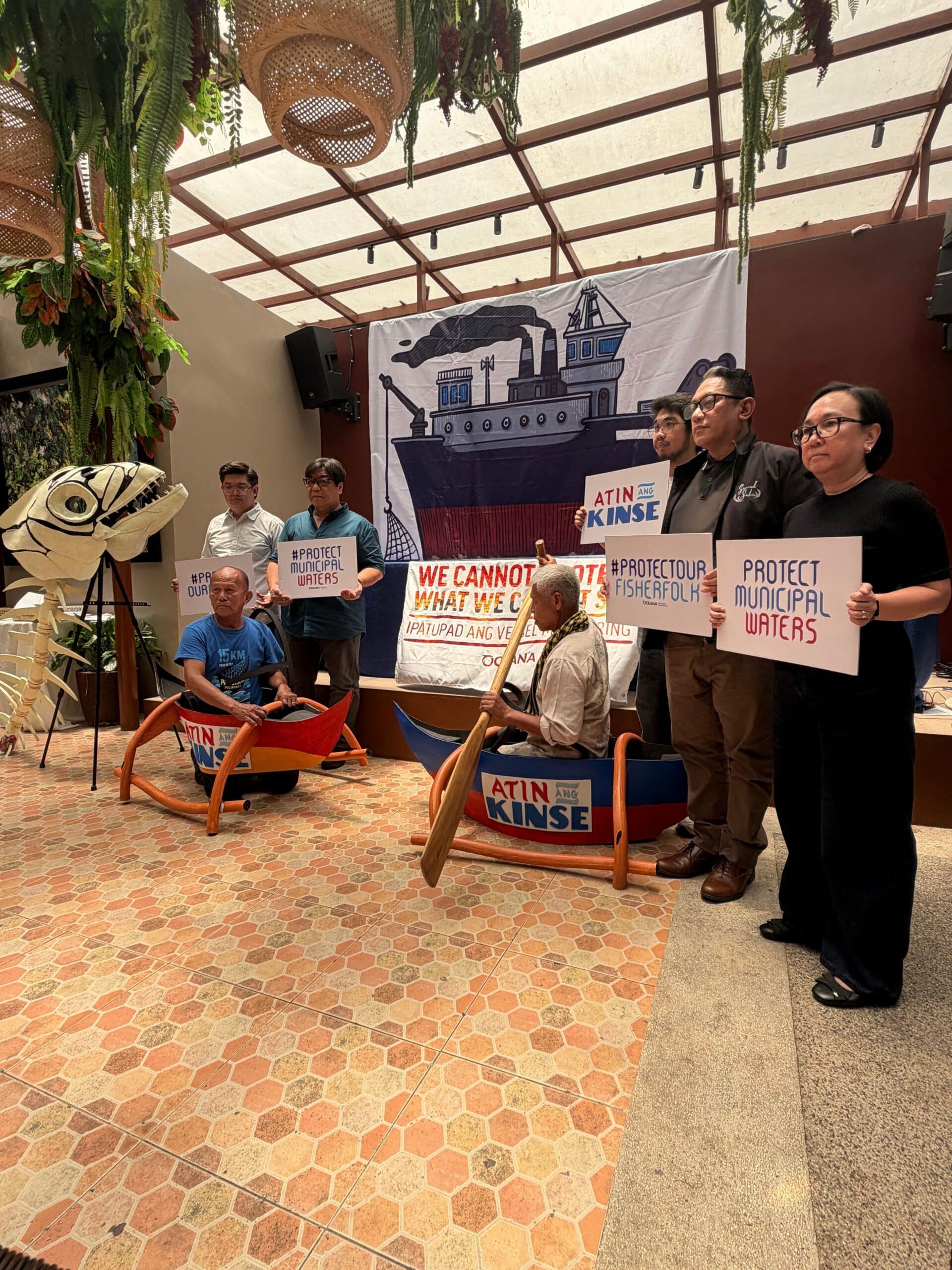
Fisherfolk, fisheries experts and local government representatives join a press forum on Aug. 11 to discuss the Supreme Court ruling declaring Fisheries Administrative Order No. 266 unconstitutional and its implications for municipal fisheries and coastal communities.
The international fisheries transparency community has also thrown its support behind the appeals.
The Coalition for Fisheries Transparency (CFT) said the absence of a clear legal framework requiring vessel monitoring could weaken the Philippines’ ability to enforce fisheries laws, meet regional commitments and satisfy documentation requirements in major seafood markets.
“Without a clear legal framework requiring vessel monitoring, the country’s ability to combat illegal fishing, meet regional fisheries commitments, and provide the assurances increasingly demanded by seafood markets is weakened,” CFT Director Ryan Orgera said.
READ: Global coalition backs appeal to restore fishing vessel tracking
The coalition also warned that the European Union requires VMS data for flag-state verification under its rules on illegal, unreported and unregulated fishing and may request raw VMS records for seafood shipments entering the European market.
“Continuous, open, and transparent vessel tracking is an essential foundation for sustainable ocean governance—it provides all stakeholders with the objective data needed to protect a country’s exclusive economic zone (EEZ), supporting compliance, and safeguarding marine resources,” Global Fishing Watch similarly said.
Meanwhile, the DA has continued investing in vessel-monitoring infrastructure. On July 27, the department and BFAR turned over new VMS workstations at the National Maritime Center as part of efforts to strengthen digital monitoring of fishing vessels.
The department said the system can provide authorities with real-time information on the location, speed and direction of registered fishing vessels and help detect IUU fishing and enforce closed fishing seasons.
The new equipment, however, does not by itself restore FAO No. 266. The legal question remains before the Supreme Court.
For now, the central question is no longer whether the Philippines can monitor its fishing vessels. The Fisheries Code says it can and must. The question is how the government can do so in a way that protects fisheries, gives enforcement agencies the information they need and, at the same time, satisfies the constitutional limits laid down by the Supreme Court.
KioskNews shows a cleaned-up reading view extracted from the publisher’s page — the original always lives on their site, not ours.