What keeps your bus rides safe and on time? A look at technologies behind the wheel
Deanna Lim stood at a bus stop near Chinese Garden MRT station, sweat beading at her hairline.
It was a weekday afternoon in May. The heat was unrelenting, Lim recalls. The 32-year-old financial consultant was due to meet a client in Tengah.
The bus was supposed to arrive in five minutes. It took 20 – and it did not arrive alone. A second bus of the same service was right behind it, nose to tail.
This is bus bunching, where two or more buses of the same service route arrive at a bus stop together, causing longer waiting times between bus arrivals.
“It was so frustrating,” recalls Lim, who was 15 minutes late for her appointment. “I don’t encounter (bus bunching) often, but when it happens, my schedule tends to get thrown off.”
Lim mainly gets around with public transport. She explains that with back-to-back client meetings planned on most days, the delay meant her subsequent appointments risk getting pushed back too.
Bus bunching is a common commuter frustration, acknowledges Tan Peng Kuan, managing director of SMRT Buses.
He explains that bus bunching happens when a bus falls behind schedule due to traffic, roadworks, or longer passenger boarding times.
It is one of the areas that SMRT Buses aims to address through its Bus 4.0 transformation initiative, Tan, 57, says. (See box below)
Currently, an AI-powered system that detects bus bunching has been rolled out to across 20 bus service routes operated by SMRT Buses.
The overall goal of Bus 4.0 is to deliver safer, smoother and more reliable bus journeys for commuters, says Tan.
What is Bus 4.0?
Launched on Aug 28 at the Gali Batu bus depot, the Bus 4.0 initiative aims to transform the way SMRT Buses operates and maintains its 1,200-strong fleet and depots while improving workforce productivity and commuter experiences.
Through Bus 4.0, SMRT Buses uses technology, data and artificial intelligence to identify and resolve emerging safety, reliability and operational issues faster.
SMRT Buses invested $6 million in total in Bus 4.0. The foundation was laid in 2024, when SMRT Buses installed telematics – costing more than $4 million – across its entire fleet.
Via GPS and on-board sensors, the telematics system tracks driving performance of bus captains, health condition of buses and road conditions.
At the heart of Bus 4.0 is the Intelligent Operations Control Centre (iOCC) located at Gali Batu, says Tan Peng Kuan, managing director of SMRT Buses.
Data from the telematics system is fed into the iOCC – the nerve centre where SMRT bus service controllers have real-time visibility over the operator’s entire fleet from a single room, he explains.
SMRT bus service controllers regulate the intervals of the buses on the road, handle incidents and accidents cases, and provide support for bridging bus services during train disruptions. With Bus 4.0’s AI and analytics features, he says, they can spot risks earlier, coordinate responses faster, and intervene before issues affect commuters.
Beyond the iOCC, Bus 4.0 rests on three other pillars:
A fleet-wide telematics system to collect vehicle health, operational and safety data such as signs of fatigue in bus captains;
Automation and predictive monitoring capabilities to enable safer, more efficient operations at the Gali Batu bus depot; and
Training, tools and incentives to uplift the productivity and future-readiness of SMRT Buses’ workforce, which includes over 2,000 bus captains.
For example, if consecutive signs of fatigue are detected in bus captains, alerts will be sent to the iOCC.
Service controllers will step in to give safety reminders, or ask bus captains to stop the vehicle safely and step away from the driver’s seat to regain alertness before resuming their journey. If the situation persists, bus captains may be asked to stop their driving duties for the day.
When AI-powered fatigue monitoring was first implemented in February 2025, the system triggered 281 alerts a month. This year, between Jan to August, that number has fallen to an average of 36 a month.
Beyond the driver’s seat, an AI-powered platform monitors over 200 vehicle parameters on every SMRT bus – including braking systems, electrical systems and battery health. This helps to catch system faults before the buses fail on the road.
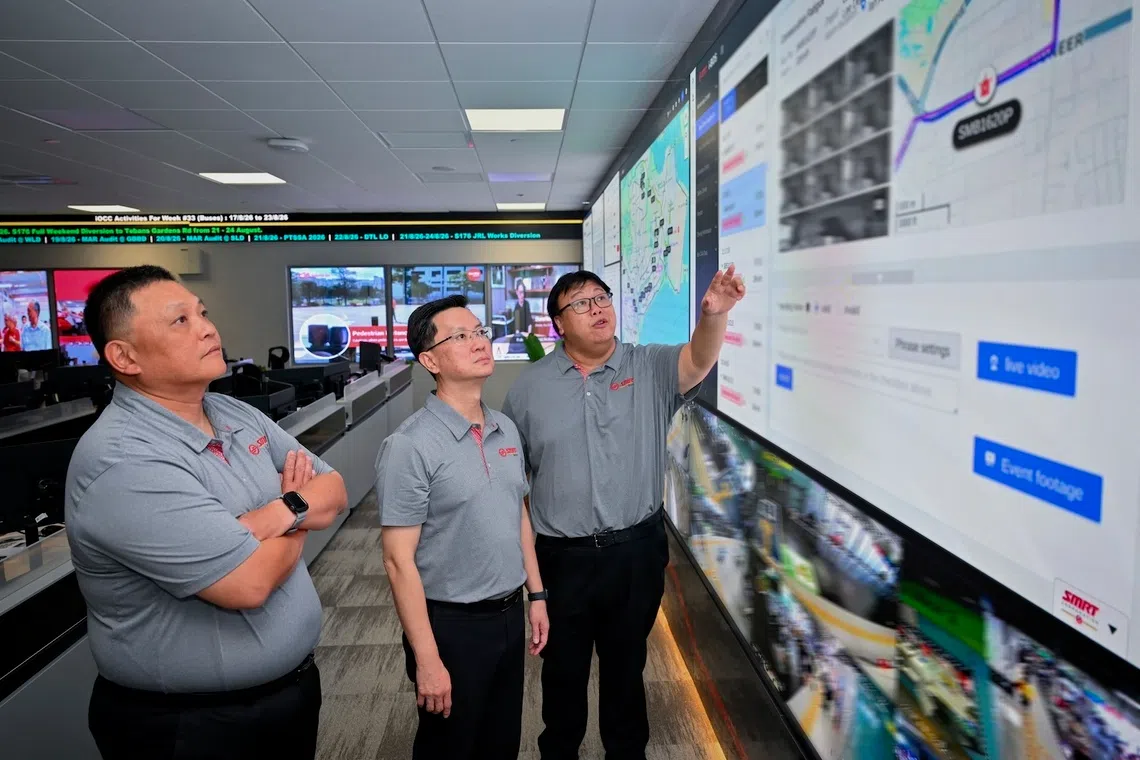
At the Intelligent Operations Control Centre (iOCC) located at Gali Batu, SMRT bus service controllers have real-time visibility over the operator’s entire fleet from a single room, says Tan Peng Kuan, managing director of SMRT Buses. (middle)
PHOTO: CAROLINE CHIA
Safer
On his first day of work in 2022, SMRT bus captain Saifulnizam bin Kasim, 42, was both nervous and excited.
“Before, I thought (being a bus captain) was just about driving,” Saifulnizam says. But he quickly realised there was more to it – landmarks to memorise for every route, fares to track, and passengers to look out for: wheelchair users, elderly, families with prams.
Saifulnizam’s priority is safety for his passengers.
He checks his blind spots, keeps a safe distance from the vehicle in front, and when there are elderly passengers, “I wait for them to be seated before I move off”, Saifulnizam says.
This attentiveness is rooted in something personal: Saifulnizam’s mother, who is in her 60s, and his father, in his 70s, take buses regularly. “(I know) other bus captains will take good care of them and I want to do the same for the other (elderly passengers),” Saifulnizam explains.
Because of these habits, Saifulnizam has consistently posted some of the highest scores since July 2026, when SMRT Buses rolled out its gamification programme to encourage safer driving.
Through an internal mobile app, bus captains can review their daily driving performance. They start off with a daily score of 100. Points are deducted for behaviours like harsh braking, harsh acceleration and fatigue-related alerts – tracked using a fleet-wide telematics system.
Bus captains can accumulate points and redeem rewards, earning up to $600 in vouchers annually.
SMRT Buses funds rewards using savings in repair costs, compensation and lost operating time when accidents do not happen. “We channel (our savings) back to our people as an incentive,” says Tan.
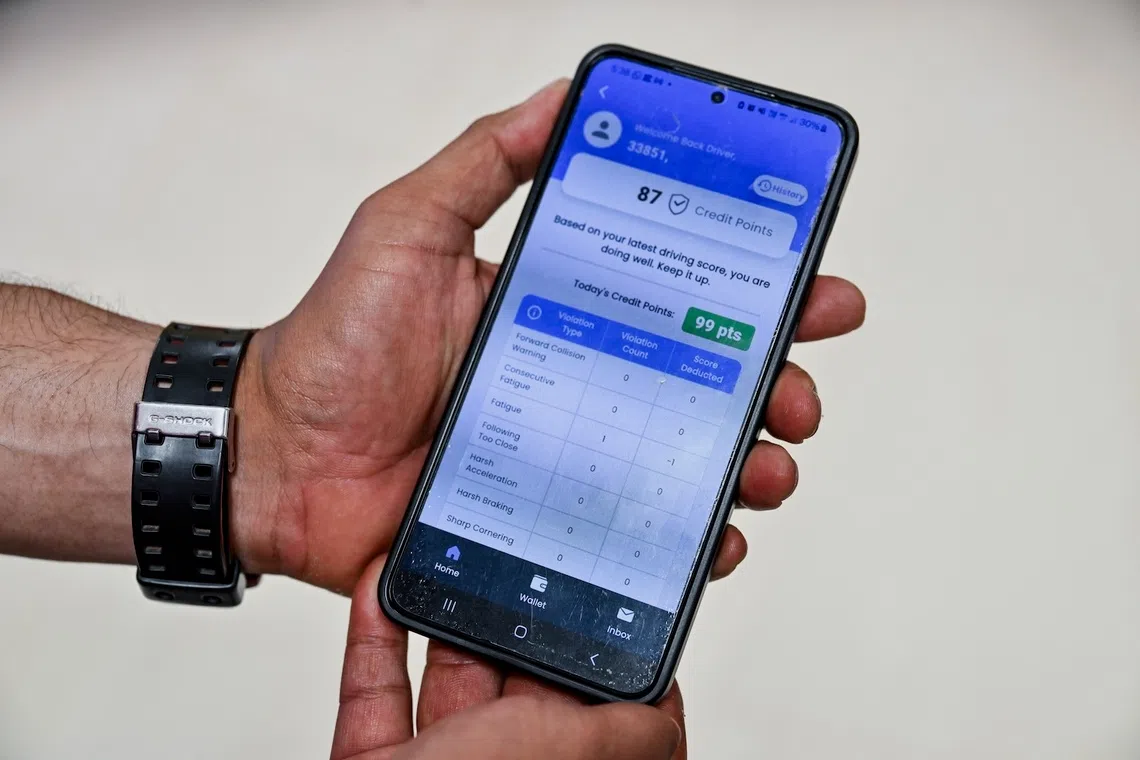
SMRT bus captain Saifulnizam has consistently posted some of the highest scores in SMRT Buses’ gamification programme to encourage safer driving.
PHOTO: CAROLINE CHIA
By the numbers
20%
Reduction in bus breakdowns since the implementation of AI-powered vehicle condition monitoring system across SMRT Buses’ fleet>1,500
Number of interventions carried out by SMRT Buses’ service controllers since they started looking out for signs of fatigue in bus captains from February 2025Up to 80
Number of buses each service controller at Gali Batu bus depot monitors on a 10-hour shift; SMRT has around 40 service controllers, with 13 on duty at any one time
Smoother
The gamification also nudges bus captains towards gentler driving – resulting in smoother rides for everyone on board.
With these alerts, harsh driving behaviours are flagged and corrected before they become habits, says Tan. Soon, the alerts will include instances where bus captains follow other vehicles too closely.
Over time, he says, “(the bus captains) will become safer drivers, and provide better service to commuters.”
Currently, SMRT Buses is trialling AI-enabled cameras to watch out for more vulnerable passengers, such as wheelchair users.
When a wheelchair user boards, the AI system sends a video clip to the Intelligent Operations Control Centre (iOCC) at Gali Batu, so service controllers can check that the wheelchair user is properly secured before the bus moves off.
This helps to reduce the risk of wheelchairs toppling over when the bus is in motion, such as during turns, says Tan.
More reliable
In the new iOCC at Gali Batu, a 13-metre wall of screens stretches across the room – displaying the locations and status of SMRT’s buses in real time.
Rows of controllers are on duty, tracking the fleet and responding to alerts. One of them is Jason Chong, 29, who was among the 40 service controllers who relocated from Woodlands and Soon Lee bus depots to the new iOCC in July.
They were joined by teams from Strides Digital, which manages SMRT’s digital panels at bus stops and its taxi and private-hire vehicle operations.
Tan explains that this enables teams to respond faster during service disruptions and reduce inconvenience to commuters.
The move expanded the original job scope of service controllers.
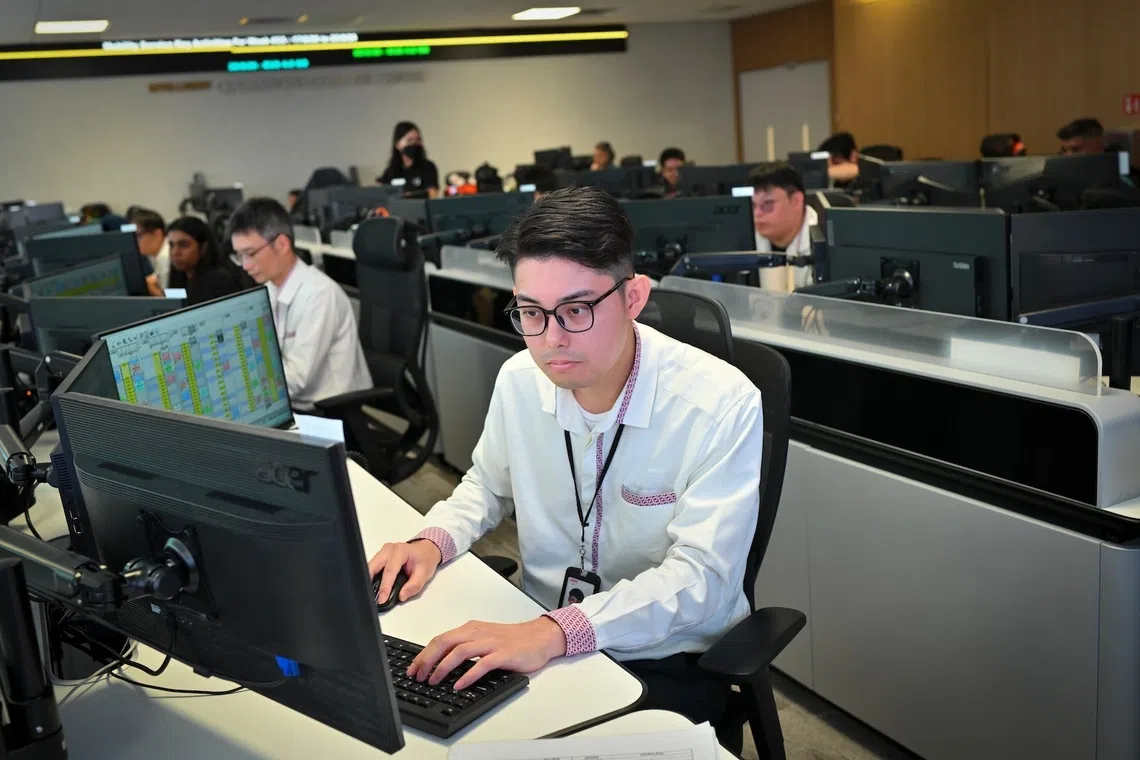
Jason Chong, 29, is one of the 40 SMRT bus service controllers stationed at the Intelligent Operations Control Centre (iOCC) at Gali Batu bus depot.
PHOTO: CAROLINE CHIA
Chong explains that at Woodlands, his role was mostly reactive. He monitored screens to spot where buses were bunching, and waited for bus captains to report incidents.
Chong studied IT before joining SMRT Buses as a service controller, his first job out of university in 2017.
Now, at the iOCC, he intervenes directly – acting on emerging issues before they reach commuters.
One of his tasks: figuring out why buses bunch, not just reacting when they have. When an alert flags two buses closing in on each other, Chong checks live camera feeds to confirm the cause.
If it is due to buses running ahead of or behind schedule, Chong will guide the bus captains to adjust their speed and establish a more even interval.
But if it is due to heavy traffic or an accident, then there is nothing to be done, he explains.
As someone who studied IT systems, Chong finds it “exciting” to be learning about and working with AI in his job. “New systems keep appearing, so (I will get to) learn a lot and the job keeps evolving.”
Ultimately, adds Tan, Bus 4.0 is not just about technology. “It’s (also) about bringing our people along,” he says, be it helping bus captains on the roads deliver better service, or growing the skills of the service controllers.
He points to fatigue monitoring as an example. It was not an easy thing to introduce, Tan admits, as it could feel intrusive.
But that is not the intent, and there is no penalty for bus captains who get a fatigue alert, Tan says. SMRT Buses worked closely with the National Transport Workers’ Union and bus captains to assure them that the AI system is used to assist – not monitor – them, he adds.
“It’s about making sure our bus captains (are safe), understanding what difficulty (they are) going through on the ground, and how we can help.”
KioskNews shows a cleaned-up reading view extracted from the publisher’s page — the original always lives on their site, not ours.