What’s the message for China as Japan weighs US$500 billion defence surge?
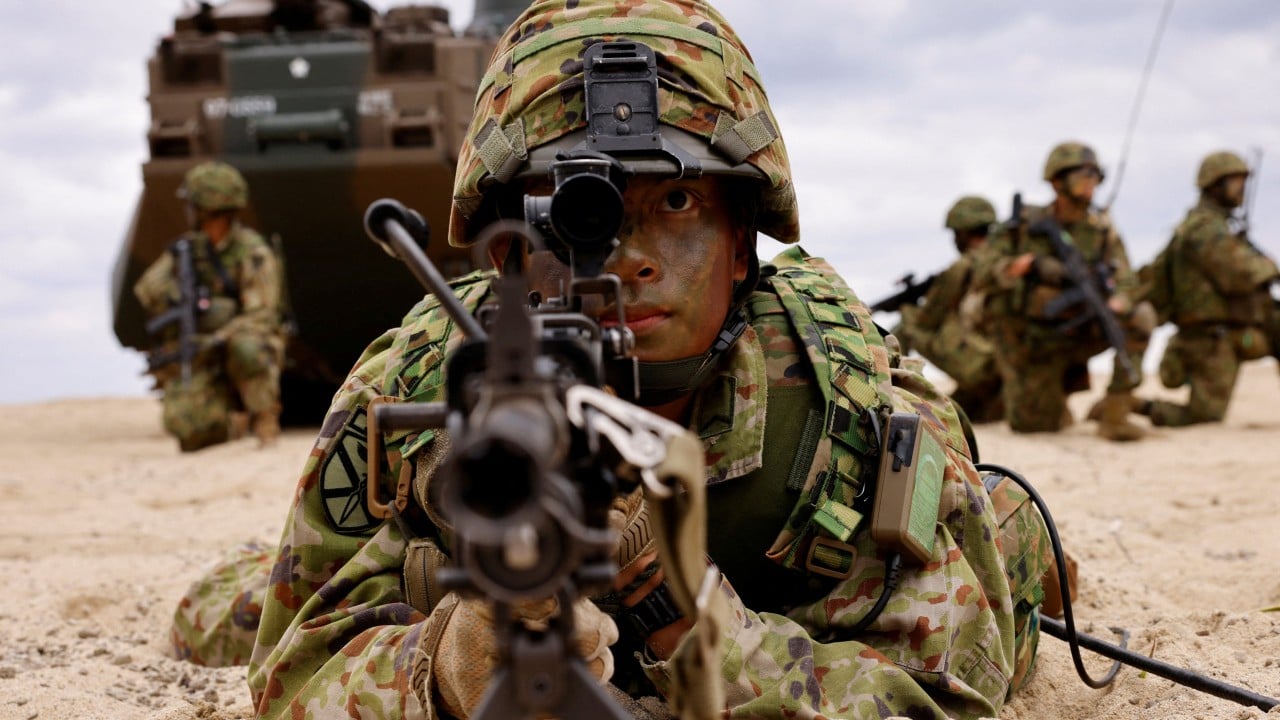
China could face a substantially more capable Japanese military over the coming years as Tokyo considers nearly doubling its five-year defence spending to as much as 80 trillion yen (US$508 billion), according to media reports in Japan.
Observers said such a build-up could strengthen Japan’s ability to deter or respond to People’s Liberation Army operations around Taiwan and the East China Sea, as well as withstand attacks and sustain prolonged operations in a regional conflict.
The reported increase from roughly 43 trillion yen under the existing programme remains subject to government negotiations as Japan prepares to revise its three key national security documents by the end of the year.
Japan’s defence ministry had estimated the cost at about 80 trillion yen, around 1.8 times the present plan, the Sankei Shimbun reported on Monday, citing government officials.
Negotiations were expected to aim for the upper 70 trillion yen range, with the total potentially reduced after scrutiny of procurement plans, the report said.
A preliminary draft reported by Kyodo News in September projected Tokyo acquiring about 52,000 unmanned systems, including some 10,000 long-range drones for land strikes and 1,300 for anti-ship attacks.
Misato Matsuoka, an associate professor at Teikyo University, said the reported increase would represent “a significant acceleration of the trajectory set in motion in 2022, rather than an entirely new direction”.
In December 2022, Japan adopted a major security policy overhaul that included plans to acquire counterstrike capabilities and increase five-year defence spending by nearly 60 per cent, while targeting defence-related expenditure of 2 per cent of gross domestic product by the 2027 financial year.
She said that for Beijing, the bigger concern was likely to be not only the capabilities developed by Tokyo but also “how they are integrated into the US-led regional security architecture”. Expanded long-range missiles, surveillance and military infrastructure on Japan’s southwestern islands could make Beijing’s operations around Taiwan more difficult, she noted.
The proximity of Japan’s southwestern islands to Taiwan means military facilities there could become strategically significant even if Tokyo did not initially intend to join a conflict, Matsuoka added. Stronger surveillance could also improve Japan’s response to Chinese activity around the disputed Senkaku Islands, which Beijing calls the Diaoyus.
William Chou, deputy director of the Hudson Institute’s Japan Chair, identified drones, “AI battlefield management” and “multi-domain warfare including cyber and space” as key elements of Japan’s coming military build-up. Together, these capabilities could allow Japan to challenge the PLA from “numerous dimensions and directions”, he said.
Malcolm Davis, a senior analyst at the Australian Strategic Policy Institute, said Japan’s military build-up reflected the need to prepare for the possibility of “major-power protracted war with China, either in the context of a Taiwan Strait crisis or in a post-Taiwan context”.
Elaborating on the latter scenario, Davis cited uncertainty over whether Washington would support Taiwan in a crisis. If Beijing took control of the island rapidly, potentially without fighting, Japan could face “an even greater longer-term threat” from PLA forces redirected towards its southwestern islands, he warned.
Still, he stressed that the goal was deterrence, “to convince Beijing that aggression in the region, whether directed against Taiwan or indeed beyond, is not worth the cost”.
Drones could enter potentially dangerous areas while keeping crewed aircraft and warships further from PLA weapons, Davis said. But they would need sufficient numbers: the goal was “the cheap and the many”. Greater ammunition production and logistics capacity could also help Japan sustain prolonged operations, he added.
But building these capabilities would take time. Chou said Japan’s defence industry could produce and sustain the systems at scale, although “they’re not there yet” and some technologies would require long-term research. He also warned of “a great deal of fiscal pressure”.
Darren Tay, head of Asia country risk research at BMI, a unit of Fitch Solutions, said Japan could implement an 80 trillion yen programme, but it would require much harder fiscal choices, including potentially higher taxes and additional borrowing.
He said a weaker yen and rising equipment, personnel and maintenance costs meant the increase in actual military capabilities would be “materially smaller” than the proposed spending increase might suggest.
Beijing sees Taiwan as part of China and does not rule out the use of force to achieve reunification. Most countries, including the United States and its treaty ally Japan, do not recognise Taiwan as an independent state. But Washington – Taiwan’s main international backer – is opposed to any attempt to take the self-governed island by force and is committed to supplying it with weapons.
Beijing has repeatedly criticised Japan’s rising defence spending and development of offensive capabilities, warning of growing “neo-militarism” and risks to regional security.
01:36
China slams Japan’s first overseas missile launch in 80 years
Beyond Japan’s own capabilities, Matsuoka said Beijing could view Tokyo’s growing defence cooperation with Australia and the Philippines as part of a wider security network directed against China – even though regional countries maintained strong economic ties with Beijing and did not necessarily wish to join an anti-China coalition.
If Beijing viewed Tokyo’s build-up as preparation for involvement in a Taiwan conflict, it could adjust its deployments, reinforcing a security dilemma in which each side regarded the other’s defensive preparations as a potential offensive threat, Matsuoka said.
“Efforts to strengthen deterrence do not necessarily lead to greater stability,” she warned.
“Ultimately, the purpose of Japan’s security policy should be to prevent war, not merely to prepare for one.”
KioskNews shows a cleaned-up reading view extracted from the publisher’s page — the original always lives on their site, not ours.