Australia 24-22 New Zealand: men’s Rugby League World Cup – live reaction
-
The 2026 men’s RLWC features ten teams. Eight of these qualified via their performances at the last world cup, back in 2022. That is: Australia, New Zealand, England, Samoa, Tonga, Fiji, PNG, and Lebanon. The first seven countries in that list also happen to be the top seven on the IRL rankings; Lebanon are a lowly 23rd.
-
The remaining qualifiers, France and Cook Islands, won regional playoffs. Cook Islands are ranked eighth in the world, by the way, France recently held that position but have slipped to 11th. In other words, the cream of the crop will be on display.
Rules:
-
The tournament will be played under NRL rules, including six players on the interchange bench with up to four to be used.
Group phase:
-
The ten teams have been distributed into three pools.
-
Pool A contains Australia, New Zealand, Fiji, and Cook Islands. The top two from this group qualify for the semi-finals.
-
The teams in Pool B (England, Samoa, Lebanon) play the teams in Pool C (Tonga, PNG, France) with the top two on a combined group table qualifying for the semi-finals.
Knockouts:
-
The winner of Pool A takes on the runner-up from Pool B&C in Sydney.
-
The winner of Pool B&C takes on the runner-up from Pool A in Newcastle.
-
The world cup final is in Brisbane on 15 November.
Schedule:
-
The group phase will take place over the following three weekends. After tonight, remaining matches will be staged only on a Friday, Saturday or Sunday.
-
The fourth weekend will feature the semi-finals, with the final wrapping up proceedings the following Sunday.
Venues:
-
10 locations will host matches. Eight of these are in Australia: Sydney (Allianz Arena), Sydney (Commbank Arena), Brisbane, Newcastle, Gold Coast, Townsville, Wollongong, and Perth; while Port Moresby will host two Papua New Guinea matches, and Christchurch will stage one New Zealand fixture.
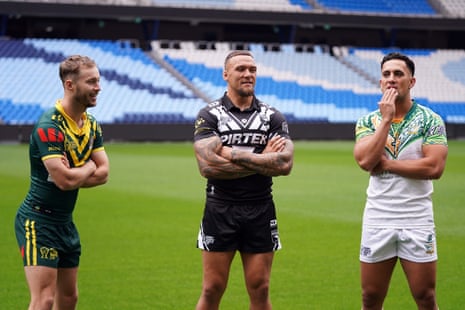
There are mouthwatering match-ups all over the park. In the backs we’ve got Storm playmakers Cameron Munster and Jahrome Hughes going head-to-head, Queensland fullbacks Reece Walsh and Kalyn Ponga facing off, and fierce rivals Latrell Mitchell and Dane Gagai coming together once more in the centres.
Further forward the battle promises to be brutal. The New Zealand pack is among the most intimidating ever listed and will put the all-Maroon front row under immense pressure.
Team News
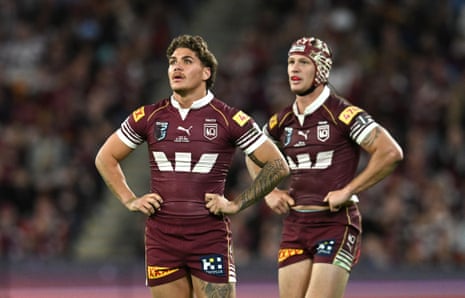
Kangaroos coach Kevin Walters has the most enviable array of talent at his disposal. What makes his side newsworthy is never the players selected, but those missing out.
The most notable of those is fullback James Tedesco, with Reece Walsh selected in the No 1 jersey despite a modest season with the Broncos and Tedesco excelling during State of Origin then winning the Clive Churchill Medal in the NRL grand final. It has been suggested the Rooster is carrying a niggle and will have the opportunity to stake his claim later in the pool phase.
Nathan Cleary’s gruesome injury opened the door for a new halfback partner for Cameron Munster with Mitchell Moses winning the race. Tom Dearden will wear the No 14 jersey while Sam Walker misses out entirely.
Isaah Yeo captains the side after delaying surgery to feature int he tournament.
How strong are the Kiwis? Strong enough to start Erin Clark and Naufahu Whyte on the pine, despite each having strong claims to being the NRL player of the season in their respective positions. However, a middle three of James Fisher-Harris, Moses Leota, and Joseph Tapine is up there with the most intimidating trio of big men in the sport.
Newcastle Knights and Queensland star Kalyn Ponga starts at fullback and he is the pick of many experts to be named the player of the tournament.
1. Kalyn Ponga 2. Jamayne Isaako 3. Dane Gagai 4. Casey McLean 5. Ronaldo Mulitalo 6. Kodi Nikorima 7. Jahrome Hughes 8. James Fisher-Harris (c) 9. Jeremy Marshall-King 10. Moses Leota 11. Isaiah Papali’i 12. Briton Nikora 13. Joseph Tapine
Interchange: 14. Te Maire Martin 15. Naufahu Whyte 16. Erin Clark 17. Xavier Willison 18. Charnze Nicoll-Klokstad 19. Keano Kini
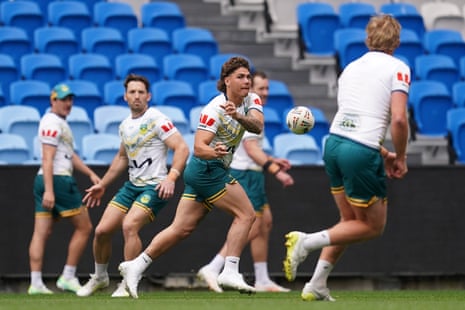
1. Reece Walsh 2. Jack Bostock 3. Latrell Mitchell 4. Kotoni Staggs 5. Tom Trbojevic 6. Cameron Munster 7. Mitchell Moses 8. Patrick Carrigan 9. Harry Grant 10. Tino Fa’asuamaleaui 11. Jacob Preston 12. Liam Martin 13. Isaah Yeo (c).
Interchange: 14. Tom Dearden 15. Cameron Murray 16. Reuben Cotter 17. Keaon Koloamatangi 18. David Fifita 19. Bradman Best
As Jack Snape reports, it is the growth of historical “tier two nations” that has transformed the RLWC into something deserving of the name.
The passionate support for these increasingly competitive “tier two” nations provides the lifeblood for this 10-team tournament, supported by loosening eligibility laws that have helped spread around the depth of the NRL. Sell-outs are expected for the match between Tonga and Samoa, the Port Moresby contests and the only match in New Zealand – in Christchurch on 25 October – even if tickets remain available for all of the hosts’ fixtures.
Reassuringly for tournament organisers, tonight’s match is a sell-out, so Allianz Stadium should be in full voice.
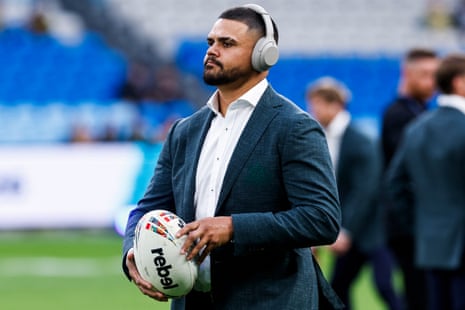
Tonight’s protagonists begin the tournament as favourites but Tonga and Samoa are packed with NRL talent and England have no shortage of quality. This is potentially the most open rugby league world cup in history.
The Kiwis face the difficult task of the defending champions first up – but they look like a side who could grow into the tournament. Stacey Jones has arguably the best forward pack of the whole field, and with the likes of Kalyn Ponga and Jahrome Hughes causing chaos behind their middle unit, there is an argument that New Zealand could be favourites.
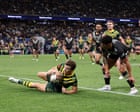
Hello everybody and welcome to live coverage of the opening match of the 2026 men’s Rugby League World Cup. It’s the two favourites to kick us off with Australia meeting New Zealand at Allianz Stadium in Sydney from 8.05pm local time (10.05am BST / 10.05pm NZDT).
Skills have never been sharper, play has never been faster, and the strength in depth of Super League and the NRL makes for compelling sport on a weekly basis. The Vegas experiment has come up trumps. Expansion into Papua New Guinea is imminent. By almost every metric rugby league is flying.
One obvious exception is on the international front. This World Cup should have been staged in France last year but the hosts pulled out after the French government withdrew funding. The solution to push the competition back a year and shift it down under was accompanied by a reduction in competing nations from 16 to 10, and the total number of matches from 31 to 18.
Since the inaugural tournament in 1954 the RLWC has not followed the traditional quadrennial cycle. It has a history of being cobbled together on an ad hoc basis. There has never been a glut of international teams demanding of such an exercise to prove their status, illustrated by Australia winning three-quarters of all World Cups, including nine of the past 10.
But the fluid nature of national identity is beginning to test the status quo. The proliferation of first-grade footballers with Pacific Island heritage, and their readiness to represent the nations of their ancestry has allowed genuine contenders to emerge in the form of Tonga and 2022 runners-up Samoa, while Cook Islands, Fiji, and Papua New Guinea all boast high profile coaches and plenty of top-level experience among their ranks.
Domestic rugby league is thriving and State of Origin has raised the bar, now it’s time for the international scene to make a statement.
I’ll be back with final team lists and more shortly. Please send me your emails and keep me company throughout the evening. The address is jonathan.howcroft.freelance@theguardian.com.
KioskNews shows a cleaned-up reading view extracted from the publisher’s page — the original always lives on their site, not ours.