The Yellow Tie review – John Malkovich gives major hauteur as legendary record-hating maestro
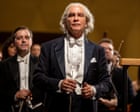
Here is an old-fashioned biopic from central Europe that is also a labour of love on the part of its director: a little stolid and stately, yes, but robustly made, heartfelt and high-minded, with workmanlike performances and decent visual effects work. It is the story of the Romanian conductor and composer Sergiu Celibidache, a brilliant musician who became renowned among musical connoisseurs in the years following the second world war for his unique and uncompromisingly purist belief – derived from his Zen Buddhist studies – that music should never be recorded. He believed that LPs and CDs were inert and dead, and that music had to be experienced live, in the passionately authentic present.
The director is the musician’s son, Serge Ioan Celebidachi, and as an older man in his rural French retirement, he is played with unsubtly querulous hauteur by John Malkovich, especially in the misjudged opening scene where he yells at Japanese executives for presuming to offer him a recording deal. Ben Schnetzer is the younger Celibidache, a prodigy whose musical ambition infuriates his old-fashioned father (Sean Bean), a well-regarded functionary who assumed that his son would follow him into public office. Celebidache Sr therefore demands the return of his birthday gift, a certain type of yellow tie that had been favoured by generations of the family’s menfolk, and which here becomes a fetish of the heartbroken young Sergiu’s need to please his father but also break away from him.
Celibidache studies in Berlin in the 1930s as the Nazis take power, and is menaced and bullied as a Jew, but escapes the ultimate fate; he is sensationally installed as principal conductor of the newly denazified Berlin Philharmonic in 1945, where he astonishes the authorities with his no-recording views. He is finally forced out and begins a kind of wandering musical odyssey through Europe and Latin America.
It is not easy to see what point exactly has been made by Celebidache’s stand; he did not appear to accumulate many followers, and the music world was filled with musicians at least as talented and principled as him who believed the exact opposite about recorded music. But there is a kind of lonely heroism here, and who can tell if, in this digitised world where recordings are so easily available, that his views might not come into fashion? A strong, unassuming picture.
KioskNews shows a cleaned-up reading view extracted from the publisher’s page — the original always lives on their site, not ours.