Our detection dogs are helping protect one of Australia’s most imperiled lizards
Many of the Australian animals most at risk of extinction are extremely tough to track down. That’s because they live in small pockets of disappearing nature, such as rare grasslands or ancient forests, in worryingly low numbers.
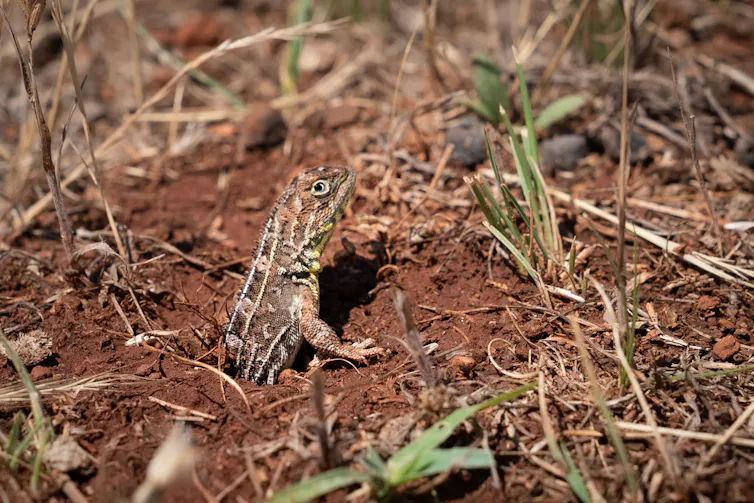
One of the most obscure is the Victorian grassland earless dragon (Tympanocryptis pinguicolla). These lizards can be identified by the three white stripes that run along their light brown bodies. But their minuscule size, with a body about the length of your pinky finger, makes them difficult to spot. This allows them to be creative with where they sleep – their favourite location being the wolf spider’s tiny burrows.
The Victorian grassland earless dragon currently wears the heavy crown of Australia’s most imperiled reptile. The destruction of their native grasslands is a major reason why.
But after evading detection for more than 50 years, this lizard was rediscovered in a west Victorian sheep paddock in 2023. This remains the only known population in the world.
This new study, led by La Toya Jamieson from Zoos Victoria, investigated whether wildlife detection dogs could help us protect these little dragons – by first finding their poo.
Conservation’s best friend
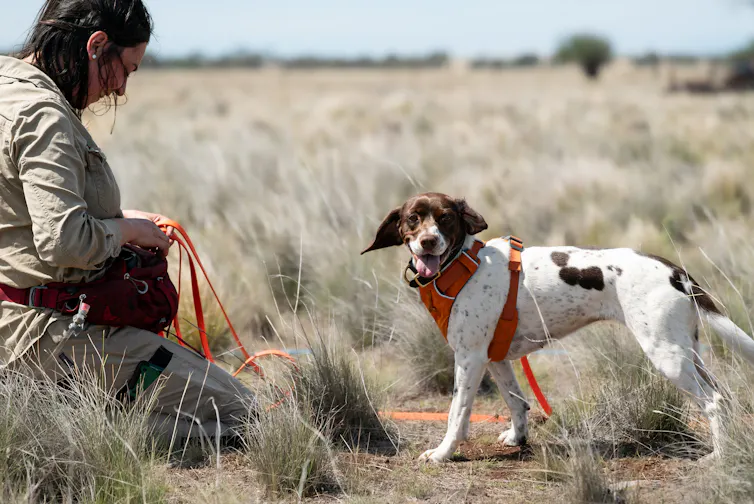
Wildlife detection dogs use their sense of smell to locate plants, animals and fungi in their natural environment. These dogs play a pivotal role in conservation efforts across the globe – all for the reward of a toy, cuddle or handful of treats.
But to detect a critically endangered animal species, you don’t always need to find the actual animal. Sometimes, just their poo will do.
Samples of animal poo – also known as scat – can provide valuable information about the health, diet and distribution of a specific animal or an entire population. They can also confirm whether a species is present in a certain area.
Detection dog teams search for the signs of various animals such as quoll poo on rocky slopes and cliffs, orca scat floating in the ocean and even the tiny droppings of the Oregon silverwing butterfly.
Read more: Meet Moss, the detection dog helping Tassie devils find love
Meet our ‘dragon dogs’
Since 2023, Zoos Victoria’s Wildlife Detection Dog Squad has worked with specialist herpetologists – scientists who study reptiles and amphibians – to train a team of “dragon dogs”.
To date, seven dragon dogs have been trained and deployed to detect grassland earless dragons. They come from a variety of backgrounds and breeds, including border collies, labradors, kelpies and even a lagotto romagnolo.
Each has its unique strengths, but all were chosen because they had personality traits that made them ideal dragon detectors. These include being motivated to search in exchange for rewards and work safely around animals.
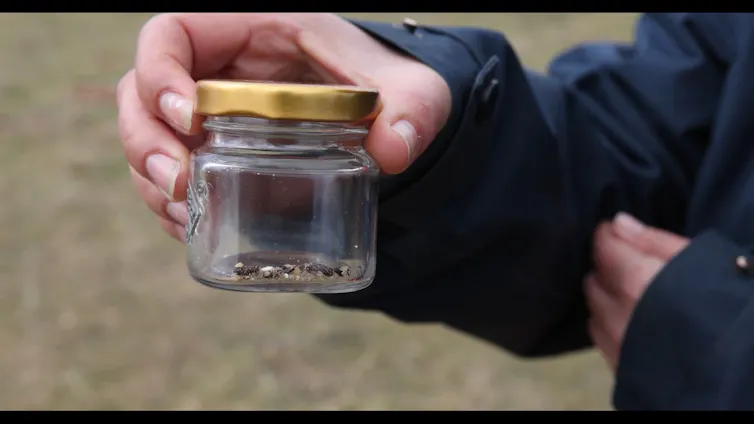
Our latest research spotlights the work of two dragon dogs, a German shorthaired pointer cross named Sugar and Moss, a labrador retriever. Both were given the job of finding dragon poo, which resembles a brown, crumbly grain of rice. In many ways, finding a needle in a haystack is an easier ask.
Both Sugar and Moss were able to reliably smell the differences between Victorian grassland earless dragon poo and other similar-sized reptile scat. The dogs’ noses were so sensitive they even distinguished between the scat of captive and wild dragons.
The real challenge was finding scats in grassland environments. But the reason may surprise you.
Poo pinchers
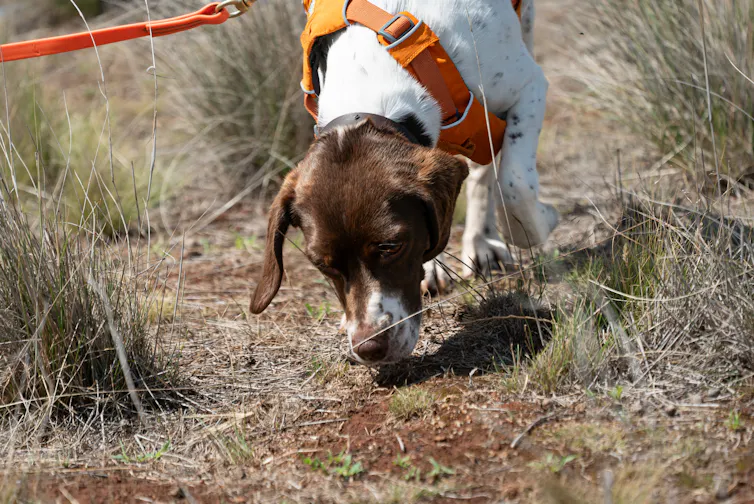
Before tracking down scat, Sugar and Moss don their orange search vests and get the cue to search – their handler saying the word “dracarys”, inspired by the Game of Thrones TV series.
However, our dragon dogs encountered a problem: scats often disappeared before the dogs even started looking. After conducting more than 100 field surveys in areas known to have dragons, they detected only one scat. So where was all the poo?
To solve the mystery of the vanishing scats, we developed a study to measure how long these samples persist in grasslands. We also investigated what factors may cause scat to disappear, such as weather.
We collected 44 scat samples from captive dragons at Melbourne Zoo. But even before we placed them in the grassland where the species was rediscovered, we noticed some being carried away by ants. In the next 24 hours, more than a third of available scats were scavenged, likely by ants and other insects.
This poo pinching, combined with an overall low density of dragons, means very few tiny dragon scats remained long enough for detection dogs to find them.
Not just about the nose
The success of detection dogs depends not only on how well they recognise and detect their target, but also how long poo remains available to be detected. After all, dogs can’t find scat that isn’t there.
In light of this research, we now train our dragon dogs to safely locate the dragons themselves, including in wolf spider burrows and grassy tussocks. Their efforts are vital to protecting these elusive lizards and the grasslands where they live.
This article was co-written with La Toya Jamieson from Zoos Victoria, who was the lead author of the study.
Read more: Australia’s lizards and snakes are in far more trouble than we thought. It’s time to act
KioskNews shows a cleaned-up reading view extracted from the publisher’s page — the original always lives on their site, not ours.