Berlin Conference 1884-85: How Europe’s colonial ambitions shaped the partition of Africa
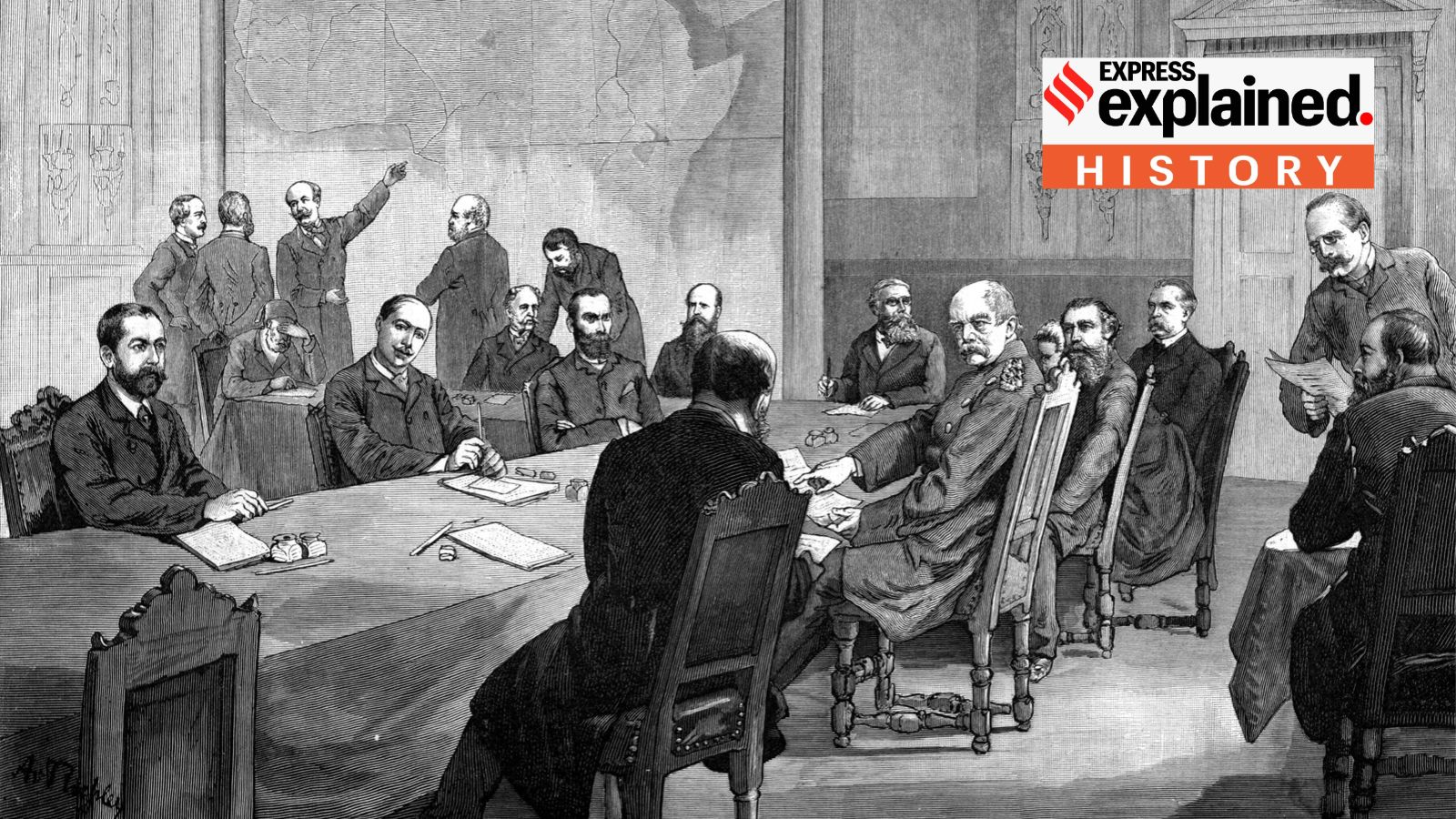
On this day 142 years ago, a conference got underway in Berlin seeking to ‘manage’ the ongoing colonisation of Africa and prevent armed conflict between rival European powers.
The Berlin West Africa Conference, held from November 15, 1884, to February 26, 1885, resulted in the adoption of the General Act, which set rules governing European expansion on the continent.
Among other things, the Act established conditions under which European powers could acquire territory along the African coast, internationalised navigation on the Congo and Niger rivers, called for a renewed campaign against the overland slave trade, and declared a vast area of Central Africa, designated the ‘conventional basin of the Congo’, neutral.
The conference has since been interpreted in vastly different ways. While some scholars emphasise its stated objectives of philanthropy, free trade and international cooperation, others see it as an instrument of colonisation, exploitation and the subordination of African populations.
Why did European powers convene the Berlin Conference?
In his 2015 research paper, Between Law and History: The Berlin Conference of 1884-1885 and the Logic of Free Trade, academic Matthew Craven traces its origins to a series of exchanges between German Chancellor Otto von Bismarck and French Foreign Minister Jules Ferry between April and October 1884. The two leaders discussed a possible Franco-German alliance to counter the expansion of Britain’s informal empire.
“The French were anxious about the supervisory role that had been assumed by Britain in Egypt in the aftermath of the Urabi rebellion of 1882 (particularly insofar as it could endanger access to the Suez Canal). Germany, for its part, was concerned that Britain was hampering the pursuit of its interests in Cameroon, Angra Pequena, Fiji and New Guinea,” noted Craven.
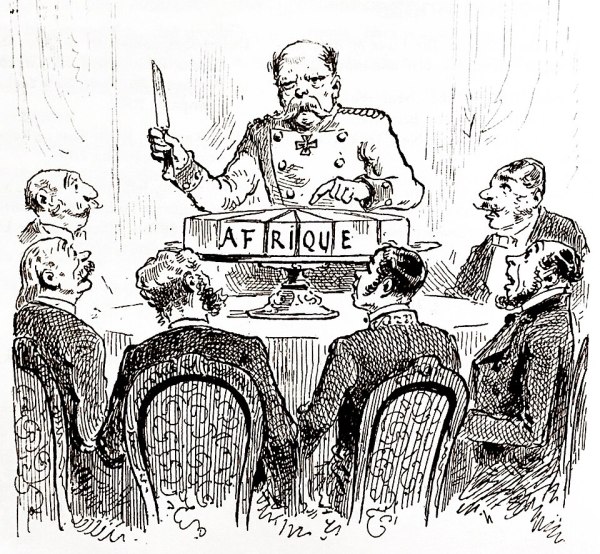 An 1885 cartoon in French magazine L’Illustration depicts German Chancellor Otto von Bismarck cutting a cake labelled ‘Africa’, symbolising the continent’s partition, as other delegates look on. (Wikimedia Commons)
However, at least two other developments prompted the need for a multilateral conference.
Story continues below this ad
One was an Anglo-Portuguese agreement concluded in 1883, which, if implemented, would have recognised Portuguese sovereignty over the mouth of the Congo River. This would potentially shut out traders and commercial establishments from other European states from the vast interior of Central Africa.
The second was the growing influence of King Leopold II’s Association internationale du Congo (AIC), which had already begun acquiring territory in the Congo. The US recognised its flag on April 22, 1884.
The conference brought together the major colonial powers, including Great Britain, France, Germany, Portugal, Belgium, the Netherlands, Spain and the United States. Other countries in attendance included Austria-Hungary, Sweden-Norway, Denmark, Italy, Turkey and Russia.
HL Wesseling wrote in Divide and Rule: The Partition of Africa 1880-1914 (1996), “The rest were invited purely for show, or, as the letter of invitation more elegantly put it, ‘to ensure general agreement on the conference resolutions.’”
Story continues below this ad
Bismarck and Ferry eventually agreed on a three-point agenda for the conference: Freedom of commerce in the basin and at the mouths of the Congo; applying to the Congo and Niger the principles adopted at the Congress of Vienna (1814-15) to preserve freedom of navigation on international rivers; and finally, establishing the formalities necessary for new occupations of territory along the African coast to be recognised as effective.
What happened at the Berlin Conference?
The conference met for just over three months, from November 15, 1884, to February 26, 1885. Notably, no African representatives were invited. It concluded with the adoption of the General Act.
Broadly, the conference recognised King Leopold II’s claims over the Congo, acknowledged certain existing territorial claims in Africa, and, most significantly, established rules governing European powers’ acquisition of new territories.
According to Craven, the Act was signed by the participating powers, barring the US, which did not ratify it. Its stated objectives were to secure “the development of trade and civilization in certain regions in Africa”, prevent “the misunderstanding and disputes which might in future arise from new acts of occupation (‘prises de possession’) on the coast of Africa” and further “the moral and material well-being of the native populations”.
Story continues below this ad
The participating powers also made a series of commitments. They agreed to “watch over the preservation of the native tribes and to care for the improvement of the conditions of their moral and material well-being”, while assisting in the suppression of slavery, “and especially the Slave Trade”.
The Act also committed the powers to respect the neutrality of the Congo basin. In the event of war, they agreed to use their good offices to ensure the territory would be treated as belonging to a non-belligerent state.
Another important provision concerned territory acquisition. Any power claiming coastal territory in Africa was required to notify the other signatories and establish sufficient authority to protect existing rights and, wherever applicable, guarantee free trade.
Did the Berlin Conference actually divide Africa?
Historians have long debated the Berlin Conference’s role in causing the continent’s partition. “In one sense at least, historians… were entirely right: the General Act of the Berlin Conference did not, on the face of it, partition Africa,” Craven wrote, adding that the Act did not survive as a formal instrument beyond 1919. By then, the Act had already been supplemented by the Brussels General Act of 1890, which sought to suppress the slave trade across Africa and imposed restrictions on the trade in firearms and liquor.
Story continues below this ad
That the General Act did not explicitly provide for the partition of Africa, however, does not mean the conference was irrelevant to the process. Craven argues that the very prospect of the conference encouraged European powers to extend their territorial claims ahead of the meeting, thus strengthening their positions in negotiations.
France had arguably led the way with its controversial ratification of the Brazza-Makoko treaty in 1882. Other powers soon followed. Germany proclaimed protectorates over Togoland on July 5, 1884, and Cameroon on July 14, 1884, while also establishing its authority in Angra Pequena. Britain, meanwhile, dispatched Colonel Hewitt on a treaty-making mission to the Niger Delta.
Academic Trevor Getz offers a counterview of understanding the conference’s significance: by comparing maps of Africa before and after the Scramble for Africa, the late 19th-century European race to colonise and control African territories.
By 1880, several European powers had already established a presence on the continent, even before the Berlin Conference. France had conquered Algeria, Italy had established a presence in parts of Libya, and Britain exercised considerable influence over Egypt. West Africa had smaller colonies such as French Senegal, the British Gold Coast and Sierra Leone. Further south, Portugal controlled Angola and Mozambique, while Britain ruled the Cape Colony. In other words, European colonisation was already underway well before 1884.
Story continues below this ad
“Yet these colonies were still quite small. Contrast this with the map of Africa in 1913, two decades after the conference. In this second map, all of Africa’s nearly twelve million square miles is colonized by European states, except for Ethiopia and the tiny state of Liberia. Clearly this vast territory was acquired after the conference,” Getz wrote in his research paper, The Berlin Conference.
The Berlin Conference may not have formally partitioned Africa or assigned the continent’s territories to individual European powers. However, it established rules that made further territorial expansion easier and provided a framework for European powers to manage their competing ambitions without resorting to conflict among themselves.
KioskNews shows a cleaned-up reading view extracted from the publisher’s page — the original always lives on their site, not ours.