Ministry boosts irrigation infrastructure synergy for food security
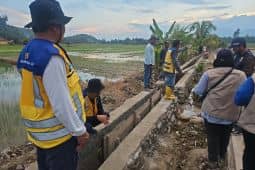
Jakarta (ANTARA) - The Ministry of Public Works (PU) continues to strengthen support for water resources and irrigation infrastructure to sustain national food self-sufficiency.
Public Works Minister Dody Hanggodo said that since the start of the administration, the Ministry has continued to coordinate with the Ministry of Agriculture to identify infrastructure needs that can support higher national food production.
"From the beginning we have kept coordinating on how to make the food self-sufficiency declared by President Prabowo a success. Dams that do not yet have irrigation networks are also a concern. We want the infrastructure that has been built to provide optimal benefits to support agriculture," Dody said in a statement in Jakarta on Saturday.
One important focus is optimizing dams that have already been built, especially those that still need irrigation network support so that farmers can directly benefit from them.
The support is directed at ensuring water availability for farmland, optimizing dam utilization, and increasing productivity and planted area by strengthening irrigation networks.
According to Dody, the success of food self-sufficiency must be sustained and should not be oriented only toward production achievements in a single year.
Therefore, infrastructure support needs to be strengthened further so that farmers have certainty of water availability and the chance to increase planting frequency according to land conditions and regional characteristics.
"What we want is for this food self-sufficiency not to exist only in 2026 and then disappear the following year. It must continue in 2027 and beyond. The Ministry of Public Works supports it through the infrastructure needed so that farmers can increase their planting frequency and productivity," he said.
To support this, the Ministry is pushing for optimization of water resources infrastructure, from dams to primary, secondary, and tertiary irrigation networks, according to authority and handling needs.
Connectivity among these infrastructures is important so that available water can be channeled effectively to rice fields and used to support farming.
Besides optimizing existing irrigation networks, support is also directed at farming areas that still rely on rainwater, or rain-fed land.
Alternative water sources and pumping can be optimized according to local conditions to expand planting opportunities. This step needs to be synchronized with cropping pattern arrangements and the readiness of supporting farm facilities.
Going forward, the Ministry of Public Works and the Ministry of Agriculture will strengthen collaboration through intensification and extensification strategies. The intensification, or quick win, strategy is directed at optimizing the use of available farmland and agricultural infrastructure, including raising land productivity.
Meanwhile, the extensification strategy is carried out by increasing the area of rice fields and developing the potential of new farming areas.
Through this synergy, the Ministry of Public Works is committed to ensuring that the construction and optimization of water resources infrastructure delivers real benefits for the agricultural sector.
With better water availability and irrigation networks, efforts to increase planted area, planting frequency, and agricultural productivity are expected to strengthen food security while sustaining national food self-sufficiency in the years ahead.
Translator: Suharsana A, Fauzul Azhim Bin Fakhrurazi
Editor: Primayanti
Copyright © ANTARA 2026
KioskNews shows a cleaned-up reading view extracted from the publisher’s page — the original always lives on their site, not ours.