INTERVIEW: Techman positive about robots’ long-term prospects
By Meryl Kao / Staff reporter


Techman Robot Inc (達明機器人) remains positive about humanoid robots over the long term, despite near-term hurdles that lie in technological maturity and real-world application capability, company vice president William Wang (王偉霖) said in an interview with the Taipei Times last week.
“I believe the long-term prospects for humanoid robots are very good, but there are still many challenges that need to be overcome at this stage,” Wang said at the company’s headquarters in Taoyuan’s Guishan District (龜山) on Wednesday last week.
The challenges include safety, precision, stability, cycle time, quality and payload capacity, while costs remain significantly higher than those of conventional robotic arms, he said.
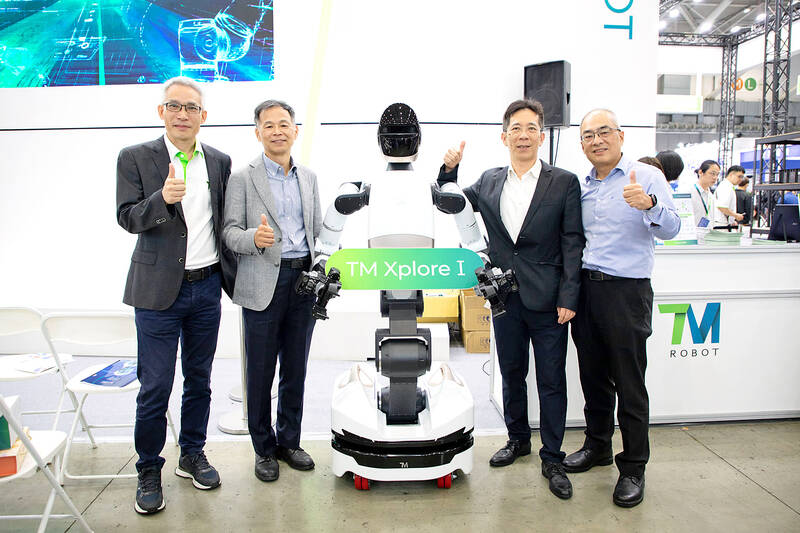
From left, Techman Robot Inc president Haw Chen, chairman Ho Shih-chih, chief operating officer Scott Huang and vice president William Wang gesture next to the company’s TM Xplore I humanoid robot at the Taiwan Automation Intelligence and Robot Show in Taipei on Aug. 19.
Photo courtesy of Techman Robot Inc
Humanoid robots also need to be integrated with higher-level factory systems, such as manufacturing execution systems or warehouse control systems, to receive instructions on where to go and what tasks to perform, Wang said.
The company’s TM Xplore I humanoid robot, first showcased last year, can perform material handling and picking tasks, he said.
Techman plans to provide its second-generation model to some research institutions by the end of this year, Wang said.
The company looks to begin on-site trials with partners as early as the first quarter of next year, while also testing the robot at its own factories, he said.
Several semiconductor, automotive components, consumer electronics and logistics companies have expressed interest in the robot, he added.
For Techman, a robotic arm partner of Nvidia Corp, technologies developed for humanoid robots can be applied to and enhance its existing single-arm and dual-arm robotic systems, Wang said.
The company aims to use learning-based technologies to enable humanoid robots to adjust their grasping methods and trajectories according to changing environments, he said.
“After we build up these technological capabilities, we will look back and consider whether they can also be applied to certain single-arm collaborative robot applications to make them perform better,” he said.
Techman expects its collaborative robot business to grow by at least 20 percent this year from last year, supported by rising automation demand and solid market momentum, Wang said.
With continued collaborative robot demand from the semiconductor, electronics manufacturing, automotive and warehousing sectors, Techman expects revenue this year to exceed last year’s NT$1.82 billion (US$56.7 million) and is targeting double-digit growth next year, he said.
Besides strong interest from the semiconductor sector, the company is also targeting growing robot demand for artificial intelligence (AI) server assembly and inspection, Wang said.
Robot applications in AI servers include loading and unloading for surface-mount technology processes, back-end assembly and inspection, Wang said.
The company plans to start deliveries of its TM45S heavy-payload dual-arm collaborative robot unveiled in August for AI server assembly and semiconductor handling in the first quarter of next year, he said.
As the number of inspection items and quality requirements in AI server assembly processes increases, the company expects more opportunities to deploy its machine vision and AI recognition technologies, he said.
The company’s robot and vision inspection solutions are already deployed at Quanta Computer Inc’s (廣達) factories, Wang said.
It also supplies solutions to Kinpo Electronics Inc (金寶) for rack-related operations and Accton Technology Corp (智邦) for assembly, inspection and surface-mount technology-related production processes, he said.
China accounts for about 30 percent of Techman’s total sales, followed by Taiwan and Europe at about 20 percent each, while Japan and Southeast Asia each account for about 10 percent, Wang said.
Beyond robot sales, Techman is also upbeat about the growth prospects of its in-house system integration business over the next few years, as the business provides production-line and factory-wide automation solutions, he said.
KioskNews shows a cleaned-up reading view extracted from the publisher’s page — the original always lives on their site, not ours.