Elon Musk pledges to give two SpaceX shares to every child in the US
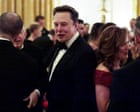
Elon Musk, the world’s richest person, has pledged to give every child in the US two shares in SpaceX, the space and AI company he runs, worth a total of almost $18bn.
In a brief post on X, the social media platform that he owns, Musk said children will receive one share from the company itself, and one from him personally. SpaceX announced earlier on Wednesday that it would contribute one newly issued share of its Class A common stock to every currently active Trump Account, and that Musk will match the number of shares it donates.
The Trump account program was designed to give every American under 18 a stake in the stock market, to help build wealth from an early age. The White House said last month that it had opened almost 70 million accounts. SpaceX shares closed at $127.44 on Wednesday, valuing the pledge at nearly $18bn.
SpaceX did not immediately respond to a request for comment on whether Musk’s own donations would also be linked to Trump accounts.
In a separate post, Musk said the company shares will be transferred next month, with his own to follow later. “The share directly from me will be transferred when my lockup expires in June next year,” he wrote.
In October, Musk, whose net worth is around $824bn, announced his intention to give one of his SpaceX shares to every child in America. “This will be the first of many,” he said in a post on X at the time. As of June, he held about 6.42bn shares in the company.
Most of Musk’s philanthropic efforts have been conducted via the Musk Foundation, which reportedly holds around $16bn in assets.
In October, SpaceX president Gwynne Shotwell and her husband pledged a share of their SpaceX stock to each of more than 2 million children under the Trump account initiative.
Musk and rival AI company Anthropic have recently detailed their sharply different approaches for sharing the spoils of the AI boom. Anthropic, which went public earlier this month, said it would commit 5% of its shares to a new fund for the “public good”. The company said this initiative, worth around $54bn at current prices, would give it more flexibility and scale to make donations for the benefit of humanity.
Other major, long-running philanthropy ventures include those of Berkshire Hathaway chair emeritus Warren Buffett, who is reported to have given away $60bn, with the intention of doing the same with most of the rest of his $150bn fortune.
The Gates Foundation has distributed more than $100bn since its founding in 2000, with some of that fuelled by donations from Buffett.
Year-end fundraiser
$0 of $2,000,000 goal
A moment full of possibility – and risk
We hope you appreciated this article. Before you close this tab, can we ask you to support the Guardian at this crucial time for democracy in the US? With Black Friday approaching, our most impactful monthly support option is just $7.50 a month for six months.
In the last two years alone, Donald Trump has eroded many of the pillars of US democracy – slashing funds for universities, undermining science, shutting down arts institutions, and attacking the free press as an “enemy of the American people” and “a threat to our national security”. While he and his allies have enriched themselves and spread lies, federal forces have harassed and imprisoned innocent people and violated the constitutional rights of many Americans.
Now, in a sweeping change election, the American people have spoken: Donald Trump, Pete Hegseth, RFK Jr, Elon Musk and the tech oligarchs may finally be held to account. A majority of American voters have demanded an end to the costly and immoral wars, the flagrant profiteering, and the corrosive attacks on communities and democratic institutions.
It’s a moment full of possibility, with more stories than we can possibly cover. New leaders are emerging from Texas and Michigan to Iowa and South Carolina – and heading to Washington to fight for affordability, against wealth inequality, and for human survival in the face of AI and the climate crisis.
These new leaders will be facing a cornered Trump and his hardline chief of staff, Stephen Miller, who have nothing left to lose. The next few years are critical for the future of the country. Journalism that covers the epic clash between these forces has a vital role to play right now.
Investigative journalism provides a fact-based paper trail for an emboldened Congress to follow. Members of Congress – and the American public – often rely on our in-depth reporting to inform the tough questions, to connect the dots and to pursue accountability for wrongdoing.
At the Guardian, our newsroom is devoted to uncovering the truth and conveying it to as many people as possible. We’re not alone in this mission, but this kind of journalism faces unprecedented hurdles: big tech threatening our financial stability and stealing our work for AI, billionaire owners telling journalists what to publish, and a hostile executive branch intent on suppressing our reporting.
The Guardian is free to dig deep without fear because we’re funded by our readers. Our readers hold us to account, and we hold the powerful to account.
However, this only works when enough of our readers contribute. Against the advice of most industry analysts, we’ve refused to put up a paywall – we believe good journalism should be freely available to all people, regardless of ability to pay. If you’re counting on our reporting, and you can’t afford to pay, please stop reading this message and go back to our articles.
If you can afford to contribute, please know that your support is not only helping yourself – from voters in Kansas to immigrants in Minnesota and families in Gaza, your generosity is bringing factual news to people around the globe.
Today is among our most important fundraising days of the year. To sustain our unique financial model, our goal is to raise $2,000,000 before the new Congress is seated on 3 January. More than 19,000 people have contributed already. All gifts are gratefully received, but for the next several days only, our most impactful monthly support option is $7.50 a month for the first six months. If you can afford 37 seconds, please join our ranks – and show your support for the rekindling of democracy in the US and around the world.
KioskNews shows a cleaned-up reading view extracted from the publisher’s page — the original always lives on their site, not ours.