Improved asteroid deflection model runs faster, reveals more doomsday worries
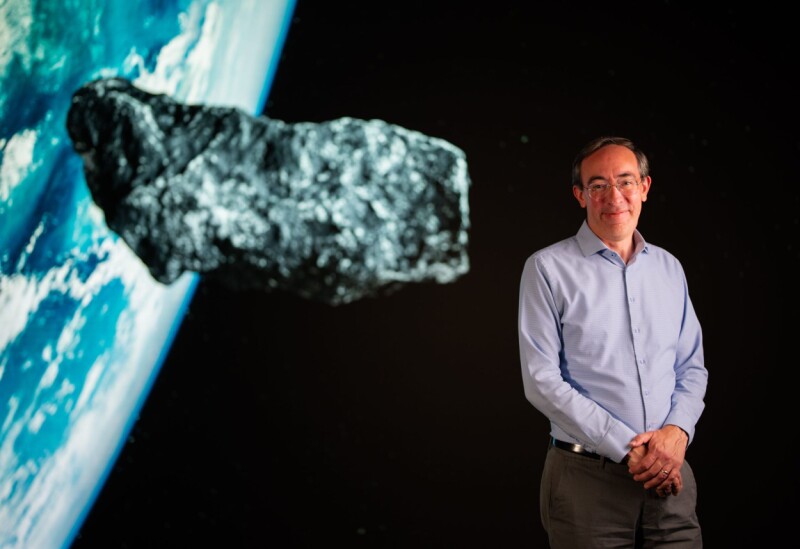
“We expected aim to matter ... What surprised us was how much,' says Sandia physicist Nathan Moore
Researchers at Sandia National Laboratories have developed a method to make asteroid deflection modeling faster and more detailed. Their simulations also demonstrated just how much asteroid shape and orientation can complicate efforts to deflect a threatening space rock.
Sandia researchers, led by staff physicist Nathan Moore, were looking for a way to better model how X-rays from a nuclear detonation near an asteroid can change its trajectory, as explained in a recently published research paper.
“Before, the calculations were so time-consuming, one could not do very many of them,” Moore told The Register. “So it was very difficult to explore different scenarios, different asteroids, or different mission concepts.”
REG AD
The complexity of those calculations forced earlier researchers to make compromises, often modeling asteroids as spheres or simplifying the physics involved.
REG AD
Perfectly spherical asteroids are rare, and their irregular shapes present an additional challenge for those keeping an eye on the skies to avert a potential asteroid apocalypse.
To overcome the computational problem and enable better modeling of irregular asteroid shapes, Moore and his team combined two high-fidelity simulation codes already in use at Sandia: ALEGRA, which models radiation heating and high-energy material dynamics, and SPARTA, which simulates the behavior of low-density gases.
As Moore explained to us in an email, both codes are good at one particular part of asteroid impact modeling, but bad at the other.
“ALEGRA … can very accurately simulate the vaporization of the rocky surface, but the calculation becomes more inefficient for matter at low densities,” Moore told us. “This is a problem for asteroid deflection simulations, because as the gas expands around the asteroid, the calculation time goes up.”
Earlier asteroid simulations using ALEGRA typically modeled asteroids as spheres to reduce calculation times.
“SPARTA is more efficient at low gas densities,” Moore said. “The problem is, conversely, SPARTA gets more difficult to run at high gas densities. So the key here was using both codes.”
In Moore’s model, ALEGRA handles regions of high gas density, while SPARTA tackles the more dilute regions of an irregular shape. The result is two codes handling the parts of the problem they're best suited to solve, reducing the overall computational burden.
The combined approach is more than 1,600 times faster than earlier methods, Moore said in a Sandia press release, while retaining sufficient accuracy to predict deflection in irregularly shaped asteroids.
REG AD
Moore data, more problems
The improved simulations reveal just how much asteroid shape and orientation can complicate attempts to calculate the outcome of a nuclear deflection.
“We expected aim to matter,” Moore said. “What surprised us was how much.”
Deflection simulations using detailed models of three well-studied asteroids – Golevka, Bennu, and Itokawa – found that irradiating different sides of the same asteroid with X-rays from a nearby nuclear detonation could produce as much as a fivefold difference in the resulting velocity change. Bennu, the most symmetrical of the three, still showed nearly twofold differences in deflection velocity depending on which side faced the blast.
In other words, we need to be incredibly precise about where we detonate a nuclear device near an asteroid, or we risk giving it a much smaller shove than intended.
With that in mind, the paper points out that we might know little about an incoming asteroid, and might not have enough time to get a good picture of it before attempting to deflect it and prevent life as we know it from ending in a planet-wide conflagration. We also can’t be quite sure an asteroid’s orientation will cooperate once our deflecto-bomb arrives. The team also pointed out that it’s tricky to get an accurate prediction without knowing the composition and internal structure of an asteroid.
One small step for asteroid deflection, one giant heap of new things to worry about, in other words. But hey – at least we’re no longer limited to deflection models that treat asteroids as perfect spheres, even though the real threats are likely to be considerably lumpier.
Let’s just hope we spot an asteroid threat from far enough away that we get a chance to study it first. ®
KioskNews shows a cleaned-up reading view extracted from the publisher’s page — the original always lives on their site, not ours.