Gov't outlines six steps toward national energy self-reliance
Jakarta (ANTARA) - Cabinet Secretary Teddy Indra Wijaya has revealed six steps taken by President Prabowo Subianto toward national energy self-reliance by optimizing the country's domestic energy resources.
"President Prabowo Subianto stressed the importance of achieving energy self-sufficiency and reducing dependence on energy supplies from abroad," Wijaya said in a written statement here on Friday.
The Cabinet Secretary conveyed the President's directive that national energy self-reliance must be built on Indonesia's own strengths and resources.
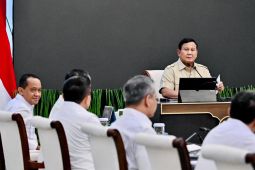
President Prabowo previously led a National Energy Council (DEN) session together with several Red and White Cabinet ministers and DEN members at the State Palace on Thursday (September 17).
Citing Energy and Mineral Resources Minister and DEN Daily Chairman Bahlil Lahadalia, Wijaya said the first step is to accelerate the development of various domestic energy sources, including palm oil, corn, cassava, sugarcane, coal, geothermal, and solar energy.
The next step involves developing B50 and E50 fuel blends to reduce dependence on imported fuel oil.
The government is also strengthening renewable energy by accelerating the development of solar power plants (PLTS) to reach 100 gigawatts peak (GWp) within three years.
This is followed by boosting national oil production by optimizing existing oil fields and wells, as well as accelerating exploration activities to increase domestic energy production.
Next, the government discussed follow-up plans for the construction of a nuclear power plant (PLTN), in line with studies and stages that have been prepared as part of strengthening the national energy mix.
The government will also draw up a comprehensive and measurable energy roadmap as the next step, covering annual targets, investment needs, implementation schedules, and the division of tasks in its execution.
"The President stressed that energy self-reliance is not only about meeting domestic energy needs, but is also an important part of strengthening economic resilience and giving Indonesia greater room to determine its development direction amid dynamic global geopolitics," Wijaya said.
Related news: Food, energy self-reliance anchor Indonesia's 2027 state budget
Related news: President targets 30 GW of solar power in 2026
Related news: Indonesia to boost energy self-reliance and economic growth in 2026
Translator: Aditya, Kenzu
Editor: Azis Kurmala
Copyright © ANTARA 2026
KioskNews shows a cleaned-up reading view extracted from the publisher’s page — the original always lives on their site, not ours.