INVESTIGATION: Endangered monkeys on death row — the multibillion-rand industry that profits from primate pain
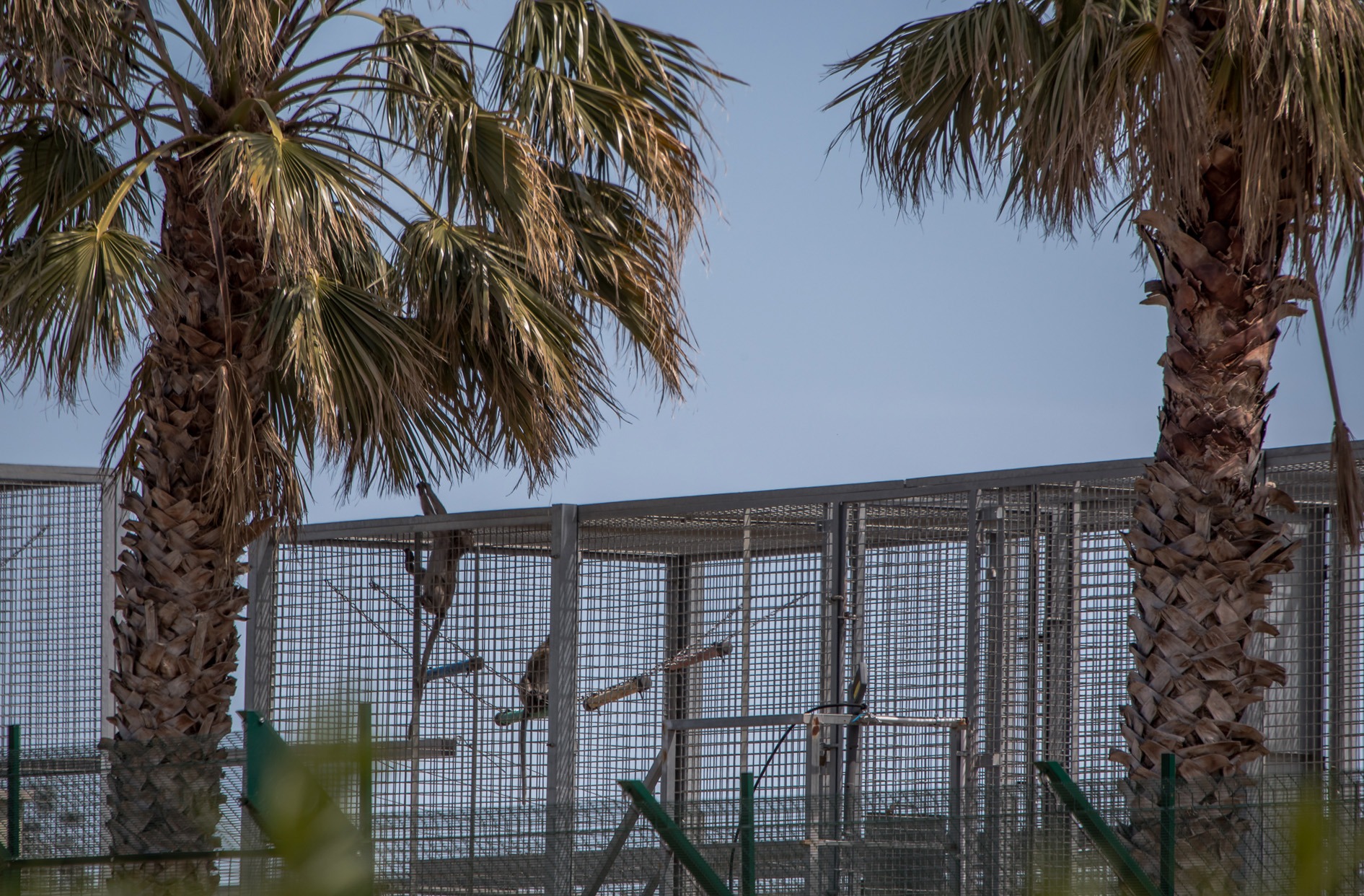
The cages are isolated deep inside the countryside of Catalonia, Spain. Groves of olive trees, criss-crossed with generations of stone walls, surround the large fenced-off enclosure. The sound of machinery humming mixes with primate screeching. A monkey – a long-tailed macaque – reaches out of one of the many cages, vainly trying to grasp a palm frond.
A female security guard and three male workers approach. You can’t take photos, she says; give us all your memory cards. No. We’ll call the police. Fine, call the police and goodbye.
The Camarney facility and all of the endangered long-tailed macaques in it belong to a massive US corporation that is a major player in the animal testing industry, Charles River Laboratories International. The company’s average annual net income over the last five years was $236.6-million (about R3.9-billion). A significant part of its business involves importing long-tailed macaques from Mauritius, where some macaques are bred in cages and others are wild-caught.
Between 2022 and 2023, Charles River acquired the Mauritian macaque breeding company Noveprim, which then owned the Camarney facility in Spain, for $392.4-million (about R6.49-billion).
But Camarney, accessible by a narrow, potholed road, isn’t just a testing centre. It’s also a warehouse with space for 3,600 macaques. The macaques will be sold to pharmaceutical labs and research institutions across Europe.
/file/attachments/orphans/Spain_4725_524792.jpg "The Camarney distribution and testing center in Camarles, about 150 kilometers south of Barcelona. It houses 3,600 macaques, making it the largest monkey farm in Europe. (Photo: Nathalie Bertrams)")
In the end, none of the imported Mauritian macaques gets out alive. After being painfully experimented on and despite there being alternatives that don’t require animal testing, the macaques will be incinerated.
No wonder Charles River didn’t want Daily Maverick taking photographs. There’s a heck of a lot of money at stake in monkeys on death row.
Older than us – a lot older
Long-tailed macaques, also called crab-eating macaques, are omnivorous Old World monkeys weighing between 2.5kg and 8.3kg, with the males being larger than females. The species’ tails are as long as their body and head combined. Long-tailed macaques typically inhabit forest edges and disturbed land. While their traditional range is throughout tropical Southeast Asia, they also adapt to urban environments. And they are not just a social species living in matrilineal groups of 10 to 85 individuals; they are intelligent.
Out of all the Old World monkeys – as opposed to monkeys in the Americas, ie, New World monkeys – they are the only species that uses stone tools as part of routine foraging. In Thailand, they use axe-shaped stones to crack open rock oysters, crabs and, in abandoned plantations, palm nuts. In Bali, they steal objects from humans and will return them if offered food.
Jack Fooden outlines in Systematic Review of Southeast Asian Longtail Macaques, perhaps the definitive academic work on the species, the evolution and dispersal of the species. The story starts with the first known long-tailed macaque fossil, dated to about one million years ago. In the same deposit, located on the Indonesian island of Java, were the fossilised remains of a Homo erectus, the hominoid from which we evolved.
Long-tailed macaques have, as Fooden puts it, an “intrinsic ability” to disperse, a trait they share with human beings. About 160,000 years ago, long-tailed macaques reached the Nicobar Islands, which are about 200km off the coast of Sumatra. Fooden states that “at this early date, dispersal by natural rafting would be more likely than dispersal by human introduction”.
Around the same time, the macaques crossed deeper waters to reach additional islands in the Indonesian Archipelago and the Philippines. Over the next 155,000 years, long-tailed macaques spread to other islands, went up mainland Southeast Asia and over to the southern part of the Philippines.
The long-tailed macaques were still not finished with island hopping. About 4,500 years ago, they arrived on deep-water islands in the south of Indonesia, with a bit of help. Fooden writes that the archaeological evidence strongly suggests that the dispersal was “the result of human introduction”.
In the first decade of the 1600s, along with a fellow island-hopping species, the long-tailed macaque made its greatest sea journey. Dutch sailors brought long-tailed macaques, probably as pets, from Southeast Asia to the uninhabited island of Mauritius.
/file/attachments/orphans/Mauritius_3518-BIOCULTURE_911563.jpg "In this colony, young macaques are kept after being separated from their mothers until they are prepared for export. (Photo: Nathalie Bertrams)")
The most recent milestone in the macaque’s evolution occurred in 2022 and was reaffirmed in 2024 when the International Union for Conservation of Nature (IUCN) declared long-tailed macaques an endangered species. The precipitous decline in the total population of between 50-70% over the last 30 years is due to habitat destruction and over-exploitation.
According to the IUCN, long-tailed macaques “are the most highly traded species of primate and are heavily demanded for biomedical and toxicology research”. Cites’ export figures for 2024 indicate that 40,646 long-tailed macaques were traded worldwide.
Over the next 30 years, the IUCN predicts that the long-tailed macaque global population will fall by another 50% to 70%.
A US lobby group, the National Association for Biomedical Research (NABR), bitterly opposed the IUCN ruling. A Charles River executive sits on NABR’s board of directors. Another US biomedical testing company, Labcorp, is also represented on the board: Labcorp’s revenue in 2025 was $13.9-billion (about R231-billion).
The long-tailed macaque market has changed considerably over the last six years. China ceased the export of macaques in 2020, and a smuggling scandal stopped exports from Cambodia to the US in 2022. But demand for the creatures as subjects for biological and pharmacological testing remains high.
Mauritius has stepped into the lucrative gap. In 2017, according to Statistics Mauritius, the country exported 6,563 long-tailed macaques. Last year, the export increased to 14,913, with 23.8% of the animals going to Europe and 74.6% going to the US.
A single long-tailed macaque can be sold to a US lab for R1-million.
/file/attachments/orphans/Mauritius_3044_100103.jpg "Lush landscape in Crève Coeur, a mountain village in northern Mauritius. The company Bioculture pays small-scale farmers to place cages used to catch macaques living in the surrounding mountains. (Photo: Nathalie Bertrams)")
30,000 macaques in cages
Mauritius’s long-tailed macaque industry basically consists of five companies: Charles River Laboratories International (US), Biosphere Trading (China), Biolink Ltd, LCL Cynologics Ltd and Bioculture Mauritius. The only company willing to grant Daily Maverick access to its operations or even to be interviewed was Bioculture. Last year, Bioculture’s after-tax profit was R121.1-million.
The road to Bioculture’s breeding facility, located in the south of Mauritius, goes through the inevitable unfenced fields of sugar cane. While the conference room in the main administrative building looks normal, the company’s operations manager, Nada Padayatchy, and his team use some downright strange terminology.
/file/attachments/orphans/Mauritius_3497-BIOCULTURE_804924.jpg "One of Bioculture’s twelve sites in Mauritius. According to the company, around 30,000 long-tailed macaques are kept here. About 1,500 animals per year are taken from the wild, while roughly 7,000 young are born annually. (Photo: Nathalie Bertrams)")
Macaques are called “NHPs”, which stands for non-human primates. There are “breeding colonies” where baby macaques are separated from their mothers at 10 to 12 months and are then moved to “growing sites”. The macaques themselves are called “growers”. From these new blocks of cages, they will be exported according to client product specifications. Some clients want big ones, others need the product to be comfortable with hand-feeding and so on.
About 7,000 macaques are born every year in Bioculture’s facilities, and it traps around 1,500 wild long-tailed macaques a year. The company has 2,400 traps spread across the island. If the trap is on private land and macaques are caught, the company pays the landowner ten thousand Mauritian rupees (R3,520) per female.
Padayatchy explains that they rarely take males and instead release them into the wild. They do, however, take the baby males with their mothers and, when necessary, take “alpha males, good breeders”.
/file/attachments/orphans/Mauritius_3505_PADAYATCHY_513525.jpg "Nada Padayatchy, responsible for trapping and sustainability at Bioculture in Mauritius. The company is one of the island’s main breeders and exporters of long-tailed macaques used in biomedical research. (Photo: Nathalie Bertrams)")
The industry, according to Bioculture, currently traps about 3,500 long-tailed macaques a year. But this has been occurring in an informational vacuum. Up until this year, the last study on the population size of the species was in 1986.
Raphaël Reinegger, a postdoctoral researcher at the University of Bristol, finally rectified this knowledge gap. Using drone flights and thermal imaging, Reinegger estimates the wild population of long-tailed macaques at about 45,000.
The Bioculture team is at pains to point out biodiversity projects it has funded, that “animal welfare is in our DNA, it’s in our philosophy, it’s in our way of thinking” and that the company’s founder decided that Mauritius is one of the “three places on Earth where it would be most ethical in a way to take the monkeys for biomedical research”.
All across the industrial board, from breeders to pharmaceutical companies, the public messaging is the same: Mauritian long-tailed macaques are an invasive species, a threatening pest, and the industry is benefiting nature by using them. This message has become a moral justification for subjecting Mauritian macaques to regimes of painful and traumatic biomedical testing and, ultimately, death in captivity.
The message is a lie.
To eradicate or not?
The human and ecological history of Mauritius, when compared to mainland Africa, is unique. Arab sailors might have visited the island in the 10th century, and the Portuguese certainly did visit in 1507. But neither had an interest in staying.
When the Dutch landed in 1598, the island had no indigenous human population, and the island’s ecology was isolated with a high degree of endemism: there were many species unique to the island. One of these species, a flightless bird called the dodo, became extinct by the end of the 17th century.
/file/dailymaverick/wp-content/uploads/2023/03/GettyImages-160755124-1.jpg "GettyImages-160755124")
The Dutch left the island in 1710 after failing to establish a viable community; the long-tailed macaques stayed. The French arrived in Mauritius five years later and, since no humans lived on the island, they claimed any land they wanted. The French then brought in slaves and planted sugar cane. As the human presence on the island increased, the native ecology decreased. Today, native forest accounts for only 4% of the land, and even that is highly fragmented.
The University of Mauritius is located in the capital, Port Louis; its grounds are immaculate. Daily Maverick has come to see Vincent Florens. In both the scientific literature and in the long-tailed macaque industry, his name dominates. Florens is the leading Mauritian ecologist when it comes to long-tailed macaques.
/file/attachments/orphans/Mauritius_3221-FLORENS_167945.jpg "Dr. Vincent Florens, ecologist at the University of Mauritius, advocates a drastic reduction of the macaque population, which he considers an invasive species. (Photo: Nathalie Bertrams)")
To get to the meeting venue, itself cluttered in academic style, you have to pass through a room filled with biological specimens in glass jars. For Florens, macaques, rats, and weeds such as the Brazilian strawberry guava are the worst invasive species, threatening what remains of Mauritius’s native ecosystem.
“The macaques,” Florens states, “are, well, they’re very adaptable. They can eat many different things. Ebony [tree] fruits before they ripen. They chew on orchids; they chew on young shoots of plants. So they deliver a lot of predation. Herbivory is a form of predation but in ways that these [native] plants and animals were not used to or not adapted to, so therefore driving the decline of these species.”
The number one priority in terms of conservation in Mauritius, in Florens’ assessment, is to remove invasive weeds and then the macaques and rats.
Regarding the macaques, Florens says, “If you eradicate them, you will basically get rid of that threat. Forever. If you don’t eradicate them, the threat will be like a Damocles sword over your head all the time. The population can grow at any time.”
When Daily Maverick asked Bioculture if it was in favour of the eradication of a species that the company routinely labels a grave threat to biodiversity and an invasive pest, the answer was: “We’re not here to pass a judgement or to have a position.”
Moreover, when it came to discussing the industry’s trapping of the macaques for export and genetic stock as a method of population control, Bioculture stated that “if there was a deliberate policy to utilise this industry as a means of controlling the monkey population, there would have to be a coordinated policy. You would have to have measurements and baselines. You would need to sort it. And that is not happening. That is clear. There is no policy to do that.”
/file/attachments/orphans/Mauritius_3574-BIOCULTURE_385304.jpg "Animal caretaker Amrita feeds young macaques with fruit and orange juice. Close contact with caretakers is intended to accustom the animals to human interaction before they are exported. (Photo: Nathalie Bertrams)")
Reinegger’s mapping of the long-tailed macaque population has thrown up some interesting points regarding macaque population densities, which are heaviest around sugar cane plantations and where non-native deer, a staple of Mauritius’s hunting industry, are fed. Essentially, these human commercial activities are feeding the macaque population.
Reinegger believes that installing electric fences and ropes coated with chilli paste around agricultural areas, in addition to changing the deer feed to something macaques don’t like, could have a significant impact on controlling macaque population densities.
As for trapping, Reinegger says, “If you really want to have an impact on macaque density numbers, I don’t think trapping is the best method in the first place. Macaques, eventually, start avoiding traps. I mean, they’re not stupid animals. So you get this shyness; they call it ‘trap-shy’ among the macaque breeders. So [trapping] would probably be effective for a short while, and then at some point it doesn’t help any more.”
/file/attachments/orphans/Mauritius_3075_216682.jpg "A monkey trap operated by Bioculture in Crève Coeur, northern Mauritius. Long-tailed macaques are attracted with fruit and captured in cages placed on private farmland. The animals are later collected for breeding or export. (Photo: Nathalie Bertrams")
While he has not been able to quantify the island-wide impact of the breeding industry’s trapping, Reinegger says “it’s in the interest of macaque breeders to keep the population as constant as possible”.
The truth is that the industry needs a wild population to draw off. Even with 30,000 macaques within fenced-off enclosures, by its own admission, Bioculture is not self-sustaining. The company states it hasn’t worked on a plan to have a self-sustainable breeding colony “because that’s not a reality right now for us. Like, we’re still able to trap monkeys when we have to.”
Long-tailed macaques are highly unlikely to be eradicated from Mauritius and not just because the industry wants to continue making vast profits.
Crève Cœur is a small village at the foot of the Island of Mauritius’s second-highest mountain, and Ayra has been living there for the past 20 years. One of her neighbours has a big trap, and when the macaques are caught, Ayra says the macaques cry like babies. But it’s not just the emotional torment that drives arguments in the village over the trapping of macaques; it is also religion.
There’s a small outdoor shrine at the base of the village, and the deity Hanuman is on display with his characteristic simian face and tail. Hanuman plays a pivotal role in the Ramayana, one of the key texts of Hinduism, and statues of the god abound across the Hindu world.
/file/attachments/orphans/Mauritius_3186_432276.jpg "A Hanuman shrine in Crève Coeur, northern Mauritius. A resident says macaques are considered connected to the Hindu god Hanuman and that capturing them for sale or experiments is not accepted. (Photo: Nathalie Bertrams)")
At Mauritius’s most important Hindu festival, Maha Shivaratri, people pull floats with representations of Hanuman. A local animal rights organisation, Monkey Massacre in Mauritius (MMiM), operates a stall and conducts outreach throughout the five-day festival.
/file/attachments/orphans/Mauritius_3395_974943.jpg "Pilgrims carry a statue of Hanuman during the Maha Shivaratri pilgrimage in Mauritius. Hanuman, the monkey-shaped god, is a central figure in Hinduism. During the island’s largest Hindu festival, hundreds of thousands of devotees walk to the sacred crater lake Ganga Talao (Grand Bassin). (Photo: Nathalie Bertrams)")
Ayra stands near the Hanuman idol and says, “This is our Hanumanji, which the resemblance is like a monkey. So for us, it is like God. We pray [to] Hanumanji, which is our god. And for us, these monkeys are related with him. So we don’t appreciate it when people catch them and sell them for experiments. Monkeys were born before human beings on the Earth. So the planet belongs to them first, not us.”
To illustrate the importance of the deity, a devotional Hindu hymn called the Hanuman Chalisa goes in part “Victory to thee, O Hanuman! Ocean of Wisdom! All hail to you, O Kapisa! [Fountainhead of power and wisdom]. You illuminate all the three worlds (entire cosmos) with your glory.”
According to Statistics Mauritius, about half of Mauritius’s population of 1.22 million practises Hinduism. So, any programme to eradicate the long-tailed macaques would encounter insurmountable societal resistance.
/file/attachments/orphans/Mauritius_3349_734100.jpg "MMiM posters line the Maha Shivaratri pilgrimage route in Mauritius. Carrying the slogan “Stop monkey business,” the campaign protests against macaque exports and animal experimentation. (Photo: Nathalie Bertrams)")
Conservation in Mauritius has a challenge. Since human beings have, over the last 400 years, destroyed almost all of the native habitat and the land under cultivation for sugar cane accounts for around 18% of the total surface area of Mauritius Island – in effect a nightmare of an invasive plant – the possibility of more indigenous species going extinct is very real. Yet there doesn’t seem to be a comprehensive plan or the political will to protect and restore these species in a social and ecological context that includes the macaques.
For the sake of the island’s entire ecology, macaques included, Mauritius needs to find a win-win solution and fast.
We are not 70kg macaques
Vincent Florens is not an uncaring man. He converted to vegetarianism a long time ago for animal welfare reasons. When asked if the breeding and biomedical testing of macaques is cruel, he says, “Yes. From a point of view, it would be cruel. If you could avoid it, you would avoid it. Definitely.”
He goes on to say something that corporations like Charles River repeat constantly, which is their last moral justification for the misery to which endangered long-tailed macaques are subjected: research on macaques is necessary for the development of new drugs and vaccines to save and improve human lives.
The argument is vaguely utilitarian: the overall good for millions of humans is increased when macaques are used in biomedical testing. While the macaques certainly aren’t having fun, the good for humans outweighs the pain of the macaques and therefore testing on macaques is morally justified, goes the argument.
But what if the use of macaques in biomedical testing isn’t necessary?
Thomas Hartung, who holds six professorships, has been looking into non-animal testing for almost four decades. He teaches toxicology at Johns Hopkins University in Baltimore and heads the university’s Center for Alternatives to Animal Testing. Thirty years ago, he developed a non-animal test for pyrogenicity, the scientific term for fever-inducing substances. Today, his test is replacing assays on 170,000 rabbits per year in Europe.
For Hartung, the advances in non-animal testing over the last few years have been enormous: for example, experiments on long-tailed macaques require a control group – macaques that are not tested on. AI can now make virtual macaques for the control group, as many as are needed. Organ-on-a-chip technology can grow brain, liver, heart and other human cells that can be used to understand the effects of drugs on entire organs and organ systems.
One of the advantages of these kinds of tests is that they examine the impacts on human biological systems. As Hartung points out, “We are not 70-kilogram macaques.”
Hartung says the reason biomedical companies are still using animals is outdated regulatory rules. “General safety studies in mice and rats were introduced when I was not yet born or in kindergarten, and I’m now 62 years old. You have to understand it’s a very unusual thing that something is done in science the very same way for 60 years, but safety toxicology is just like this.”
He also points out that the rules on testing macaques came in 20 years ago, back when Windows XP was a thing.
/file/attachments/orphans/cAnimalRightsBE-2024_630976.jpg "Monkeys are transported in small wooden boxes. Flights can take up to 36 hours. Photo taken by Belgium animal welfare inspections during transport through Brussels airport Zaventem. (Photo: Animal Rights Belgium)")
Regulators are beginning to change. In April 2025, the US Food and Drug Administration, the most important regulator in the world, set out a plan for phasing out animal testing, starting with monoclonal antibodies, the area in which macaques are most intensively used. A typical antibody development project consumes 144 primates. Within the next three to five years, animal testing for drug safety is set to be the exception rather than the rule.
While the UK and the European Union have similar plans, India is already there. In 2023, the Indian government amended the law on drug testing. Animal testing is no longer mandatory, and tests such as cell-based assays, organ chips and sophisticated computer modelling are now accepted.
“The trend is very clear,” states Hartung. “The science is there, the political wish is there, because people don’t want animal testing. So I see it really as something where we have to accelerate.”
Upon examination, the moral arguments supporting the long-tailed macaque industry crumble under both societal and scientific scrutiny, an outcome that is hardly surprising. After all, the father of utilitarianism, Jeremy Bentham, wrote in 1828 of animals: “The question is not Can they reason? or Can they talk? but Can they suffer?” DM
Note: Charles River International and Noveprim were approached for comment, but none was forthcoming. Bioculture Mauritius was open to a site visit and an initial interview but did not respond to requests for additional comment.
The research for this article was supported by Netzwerk Recherche/Olin gGmbH and Journalismfund Europe.
KioskNews shows a cleaned-up reading view extracted from the publisher’s page — the original always lives on their site, not ours.