Seed preservation system helps cultivate legumes
By Esme Yeh / Staff reporter


The Taiwan Seed Improvement and Propagation Station assisted an indigenous village in developing a seed preservation system to cultivate healthy germplasm of indigenous legume varieties and stabilize production.
Indigenous villages in Taiwan have abundant germplasm of legumes, Station Deputy Director Liu Ming-tsung (劉明宗) said.
However, such resources have been decreasing due to climate change and the out-migration of young people from indigenous communities, he said.
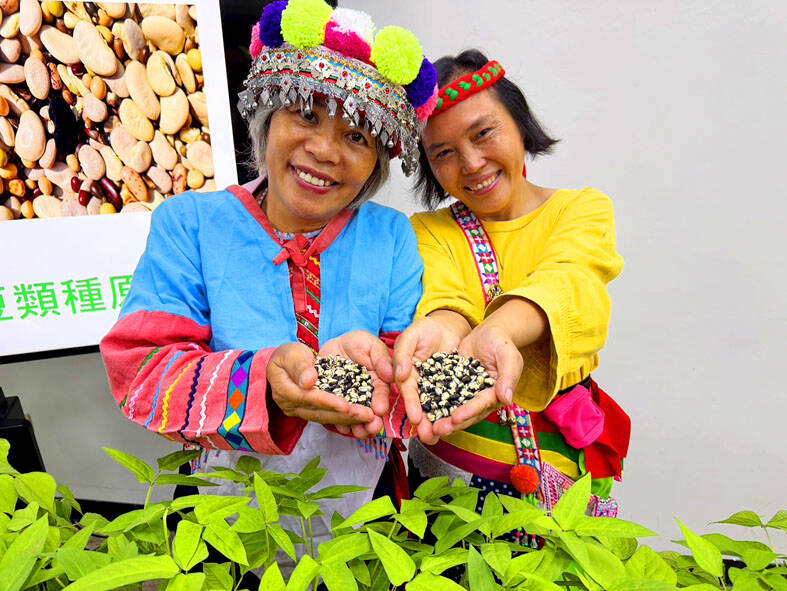
Taiwan Seed Improvement and Propagation Station associate researcher Lo Ying-fei, right, and a resident of Sinvi Village hold indigenous legume at a news conference in Taipei yesterday.
Photo: Yang Yuan-ting, Taipei Times
To preserve the abundant legume germplasm of indigenous villages, the station began to collaborate with Sinvi Village (新美部落) in Chiayi County’s Alishan Township (阿里山) two years ago, Liu said.
The station’s researchers identified and collected important legume varieties stored in the village and picked those without viruses or diseases for cultivation, he said.
Once the healthy legume varieties are propagated in large quantities, about 80 percent of the germplasm would be returned to the village for cultivation, while the remaining 20 percent would be stored at the station, Liu said.
Station associate researcher Lo Ying-fei (羅英妃) said the station has helped preserve 57 germplasm items of eight different legume varieties from 2021 to last year, including winged beans, cowpeas, lima beans, hyacinth beans, pigeon peas, speckled beans, peanuts, and adzuki beans.
Legume germplasm from indigenous villages used to be difficult to store, as they had low germination rates and tended to carry viruses, she said.
There also used to be a lack of research on pest and disease control and sufficient value-added applications due to such legumes’ limited consumer market, Lo said.
Therefore, the station built a germplasm preservation system to propagate healthy seeds and promote them back in indigenous farming communities, she said.
It has successfully renewed and propagated three cultivars of hyacinth beans and adzuki beans, Lo said, adding that future research would center on developing healthy germplasm of cowpeas and speckled beans.
The station said it has in the past few years established a conservation system for indigenous legume germplasm, labor-saving cultivation methods, and pest and disease management guidelines.
It said it also held workshops for indigenous communities to promote the idea of preserving legume germplasm and growing healthy seedlings.
The station said it would continue to establish a safe and healthy germplasm production environment to support sustainable crop production and ensure that seeds of indigenous legumes can be preserved in indigenous villages.
KioskNews shows a cleaned-up reading view extracted from the publisher’s page — the original always lives on their site, not ours.