Filmmakers behind controversial Gaza doco defiant despite death threats and protests
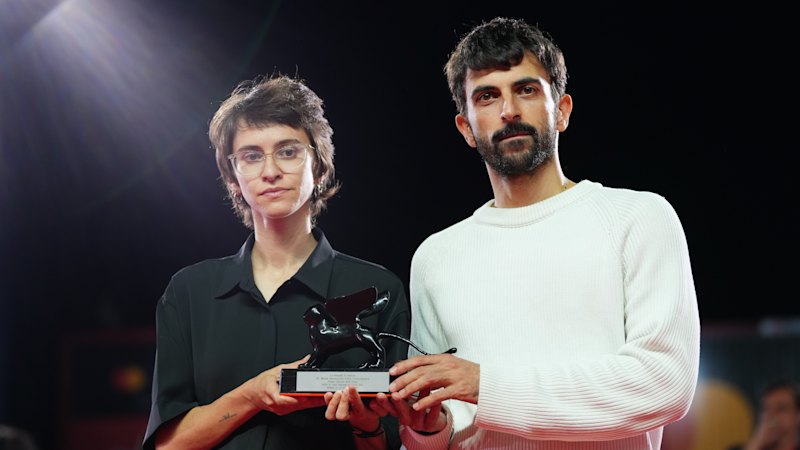
Oscar-winning Israeli directors Yuval Abraham and Rachel Szor have been at the centre of a raging controversy since their documentary NAZA debuted at the Venice Film Festival last month, receiving a 25-minute standing ovation, winning the special jury prize, being acclaimed by critics and selling to more than 50 territories around the world.
But their chilling film, which has Israeli military intelligence officers and soldiers outlining the AI-powered systems behind the mass killing of Palestinian civilians as they targeted Hamas members in Gaza, has sparked a furious reaction from Israeli Prime Minister Benjamin Netanyahu.
“It feels a little bit like we’re in the middle of a storm,” Abraham said on a Zoom call from London. “On the one hand, we hope the storm will pass because it’s overwhelming and it can be scary at times.
“But on the other hand, because of this film’s subject matter and because the killing in Gaza which it describes is ongoing, there is also an importance for the storm to happen ... It’s [part of what] could be an important process of reckoning and accountability for what the film is showing.”
NAZA, a military acronym for collateral damage, has its subjects talking at night on Tel Aviv rooftops about Israel’s military response to the Hamas attacks in Israel on October 7, 2023, that killed 1200 people.
Szor said she and Abraham planned to return to Israel soon but they have been subject to death threats and there had been a demonstration next to her parents’ home.
“There’s also a risk from the government [taking action],” she said. “But we feel like we’ve done the right thing. We feel that this was our responsibility as Israelis.”
In a series of attacks, Netanyahu and his ministers have accused the directors of treason, threatened to have their citizenship revoked and called for the military whistleblowers to be found and prosecuted.
“The film presents a false, misleading, and biased narrative that defames the State of Israel and the [Israeli military] internationally,” Netanyu said.
Abraham said he understood why Netanyahu was so unhappy about a film that damned the actions of his government.
“There are elections in Israel so I think he’s trying to get a quick political profit by making very populist statements and inciting against us and against the film,” he said. “We were surprised by the intensity.
“We expected a backlash but to have Netanyahu speak about the film I think it’s already maybe five or six times has been a little bit surprising ... It’s a film which is very damning to what Netanyahu has done, to what the Israeli army has done, and I trust in the intelligence of audiences to judge for themselves.”
Three Israelis who describe themselves as private citizens have posted online a quickly made counter documentary, NAZA The Real Story, which has Israeli military commanders and intelligence officers talking about “how the terrorist organisation Hamas fought from among civilians” in Gaza.
Abraham said he was not upset about the alternative documentary but called it “a bit shady” for mimicking NAZA with its title and interviewing its subjects on rooftops at night.
“I think it’s manipulative and you know people will search for our documentary and they will watch that other counter, giving the narrative of the military spokesperson,” he said. “But in terms of Israeli soldiers feeling a need to speak and share their experiences, I think that’s all right.
“I’ve certainly received messages from Israeli soldiers in recent weeks, writing to me that it’s important that we made this film ... It would be better if the Israeli government, instead of promoting these, in my view, propaganda movies that serve their own agenda, if they would allow the international media to enter Gaza …
“If you are so confident that everything is OK, why are you attacking our film so ferociously? Why are you preventing international journalists from entering Gaza? Why have you killed so many Palestinian journalists? It just doesn’t make sense.”
The quietly spoken Abraham and Szor are members of a Palestinian-Israeli activist collective who won an Oscar for the documentary No Other Land last year. They teamed up with The Guardian newspaper to make NAZA, with English director Jonathan Glazer, who won an Oscar for The Zone of Interest, as executive producer.
So how did they find 24 Israeli military intelligence officers and soldiers who were willing to risk being interviewed on camera?
“It was a long process,” Abraham said. “It entailed approaching a lot of people and hearing a lot of nos.”
What helped was that after Hamas’ October 7 attacks, many Israelis joined the military and reserve force.
“The pool of potential sources was very big and I think that really helped,” Abraham said. “It became our main centre of focus for many years: how do we find these people and how do we ask them these questions about the harm to civilians?
“These are questions that the mainstream Israeli media, much of it, not all of it ... ignored, so there was a vacuum that was created where sometimes all it took was just asking the questions and you get the answers.”
Abraham said many of their interview subjects - it is not revealed if they are still serving in military intelligence or the army - felt a responsibility to speak out.
“They felt that – many of them, not all of them – what they had [taken] part in was wrong. Some went as far as calling it a genocide. Others spoke about war crimes.”
Abraham hoped the film would inspire further sanctions by the Australian government.
“As an Israeli who cares deeply about Israelis and about Palestinians, when my country’s government is clearly violating international law, I expect friends of Israelis and of Palestinians to take action, including sanctions and arm embargoes until the government respects international law,” he said.
NAZA is in cinemas from Thursday.
Must-see movies, interviews and all the latest from the world of film delivered to your inbox. Sign up for our Screening Room newsletter.
KioskNews shows a cleaned-up reading view extracted from the publisher’s page — the original always lives on their site, not ours.