'Voices From The Last Days Of Freedom': Showcasing the pre-communist Cuba we lost - review

Cuban American Genie Milgrom is a researcher, historian, and author who has published extensively about her family’s connections to Medieval Spain. In The Cuba We Lost: Voices From The Last Days Of Freedom, she revisits the period from January 1, 1959, when president Fulgencio Batista fled the island, to the 1962 Bay of Pigs invasion.
Below are some excerpts from her book, which showcases the personal accounts of those who were young children when they fled with – or without – their parents and families as Communism took over. And while, as Milgrom notes, the Cuban exiles went on to thrive and contribute vastly to the United States, I am reminded of a 1967 Spanish-language song by singer-songwriter Luis Aguilé that expresses the feelings this book lovingly revisits: “When I left Cuba, I lost my life, I lost my love... I left my heart buried.”
From the introduction
This is not an easy book to write, as I find myself reading and recalling events and emotions that had been kept hidden deep inside me for more than six decades. As I recount my own history and read and listen to the stories of the contributors to this book, I do so with tears in my eyes...
I read the accounts of dolls’ heads being yanked off, of a soldier taking the doll away from a toddler, or of witnessing a bombing in a department store in Cuba, and the pain is palpable.
January 1, 1959, at 3 a.m., Fulgencio Batista fled Cuba after having been in power for seven years.
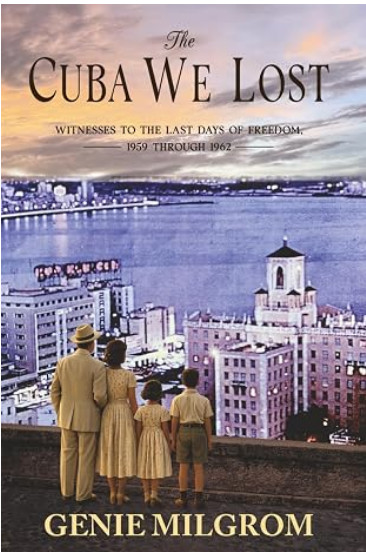
At the exact moment that the wheels lifted off the ground toward the Dominican Republic, the Communist regime of Fidel Castro claimed victory over the island nation. Rebel forces quickly entered major cities, including Havana. Fidel Castro began a triumphal journey across Cuba and entered Havana on January 8. A provisional government headed by president Manuel Urrutia was established, while revolutionary leaders began to gain control of the military, police, and government institutions. The first trials and investigations of former Batista officials also began during this same period.
The dominant mood across much of Cuba was one of celebration, hope, and expectation. Large crowds welcomed the rebel leaders, believing that democratic elections, along with a constitutional government, as well as political freedoms, would soon be restored.
At the same time, families connected to the previous government, the military, and especially the business sector experienced major anxiety about the future. While optimism remained widespread, the first signs of political division and uncertainty were beginning to emerge underneath the revolutionary enthusiasm.
Perla Abrams, nee Ziegenhirt, recalls
My uncle was ministro de gobernación, a member of Batista’s cabinet; we have translated it as “secretary of state” in the past. His name was Santiago Rey Perna. My dad was a captain of police but served as my uncle’s assistant.
We left Cuba and went to Santiago de Chile, where we stayed for a few months; then we traveled to Mexico City before settling in Miami. I was five years old in 1959 when my family had to flee Havana.
The revolution was successful, and the barbudos [“bearded ones”] wanted to apprehend my uncle. My uncle was part of Batista’s regime and, with my aunt and father, took refuge in the Chilean embassy. The ambassador was extremely brave and risked a great deal by not giving them access to my relatives seeking asylum. They did manage to escape and reach Chile, where the rest of the family soon followed.
There were beautiful memories... My pretty cousin turning 15 and having the party of the season. It was very glamorous, with all the debutantes of that time attending. A platform was constructed over the swimming pool which connected all our family homes in Santa Fe to serve as the dance floor. The beauty of this remains with me still.
... my father surprising me with a “chemis” dress in my size, which was all the rage in Havana, and high-heeled shoes also in my size to go with it. That was a good memory that I cherish.
I remember my aunt’s breakfast room, which had a tree with a little real monkey that I found fascinating, and I also recall my uncle’s collection of cat statues... beautiful cats made of all kinds of materials. We subsequently heard that the collection had been sent to Russia after the revolution.
Little did I know that this beautiful life would soon end.
My mother, brothers, and I flew to Nassau... until we were able to reunite in Chile with the rest of the family. Our lives would never be the same.
I recall my mother telling me that our house staff were the people ransacking our home after the revolution, and how they removed all my beautiful dresses. I have a mental image of this happening, but it materialized from my mother’s story and not from witnessing it.
The rest of the memories of that glorious golden age arise from family stories: My father saying how no fruit was ever sweeter than our Cuban fruit and how our sugar was so superior to others that you only needed a fraction of what you use now to sweeten your coffee. How there were no better mangos or avocados; and so much more.
My father would tell me how lucky we were and proudly describe the high modern standard of living enjoyed by Cubans in Havana in the 1950s... He would explain how generous the US was in its negotiations with us for the purchase of our sugar, for example.
My parents so loved their country, and they could never fully accept that they would not be returning. My father and two cousins all fought in the Bay of Pigs invasion and spent two years in prison until the Kennedy administration traded farm equipment for their freedom. That was an especially dark period in my childhood. My mom was left alone with three small children, with only the support of my dad’s family.
It must have been extremely hard for him to do, but he felt it was his duty to fight for Cuba’s freedom. The day the men returned, we picked my dad up at Dinner Key Auditorium [in Miami, where 10,000 Cuban exiles gathered on December 23-24, 1962, to welcome home the freed prisoners of Brigade 2506 following the Bay of Pigs invasion], and this was the day of the greatest joy in our family history. ■
KioskNews shows a cleaned-up reading view extracted from the publisher’s page — the original always lives on their site, not ours.