Disenfranchised queer grief at the heart of David Corpuz’s Cinemalaya return
- David Corpuz, originally from San Jose del Monte, Bulacan, discovered his passion for filmmaking while studying information technology at Don Bosco Technical College, leading to his involvement in experimental cinema.
- His film 'Tayo Lang Ang Nakakaalam' explores themes of grief and the queer experience, particularly in relation to HIV, and aims to shed light on societal perceptions of disenfranchised grief.
- Corpuz emphasizes the importance of creating socially relevant films and hopes his work contributes to discussions on the legal recognition of same-sex relationships in the Philippines.
This is AI-generated. Read the article for full context. Report any errors.
Growing up in San Jose del Monte, Bulacan in the 1990s, David Corpuz’s exposure to cinema would only begin in the early aughts, upon entering Don Bosco Technical College in Mandaluyong. Then studying information technology, he discovered filmmaking through a course unrelated to cinema.
“From there, I was fascinated with the act of recording,” Corpuz told Rappler over Zoom. “Video recording was our term then, not filmmaking.”
Corpuz soon developed a penchant for movies outside the mainstream. Because San Jose del Monte had yet to be declared a city at the time, movie houses were practically non-existent. Corpuz would then pay a regular visit to the University of the Philippines Diliman’s Cine Adarna, which screened arthouse films for free.
Shortly after graduating from college, Corpuz enrolled in UP for a master’s in media studies. Though it took him seven years to finish the program, it also emboldened his passion for experimental and world cinema, leading to his 2014 experimental short The Ordinary Things We Do, which premiered and won the Special Jury Prize at that year’s edition of the Cinemalaya Philippine Independent Film Festival.
Two years later, Corpuz and co-director Cenon Palomares made their full-length feature debut at Cinemalaya with the Judy Ann Santos-starrer Kusina. Corpuz’s follow-up and solo feature, though, would take a decade to realize.
In the interim, while pursuing a career as an educator, he co-directed the anthology film Anatomiya ng Pag-ibig (2015) and the Gawad Alternatibo short Read-Only Memory (2022).
Corpuz considers Ang Lee’s Brokeback Mountain (2005) and Maryo J. de los Reyes’s Magnifico (2003) as formative — two movies about the queer experience and grief that somehow found their way into what would become Tayo Lang Ang Nakakaalam, a sort of accidental return to Cinemalaya following 2020’s Seperate/Separate, a main competition concept intended to be his solo feature debut at the festival that was shelved due to the COVID-19 pandemic.
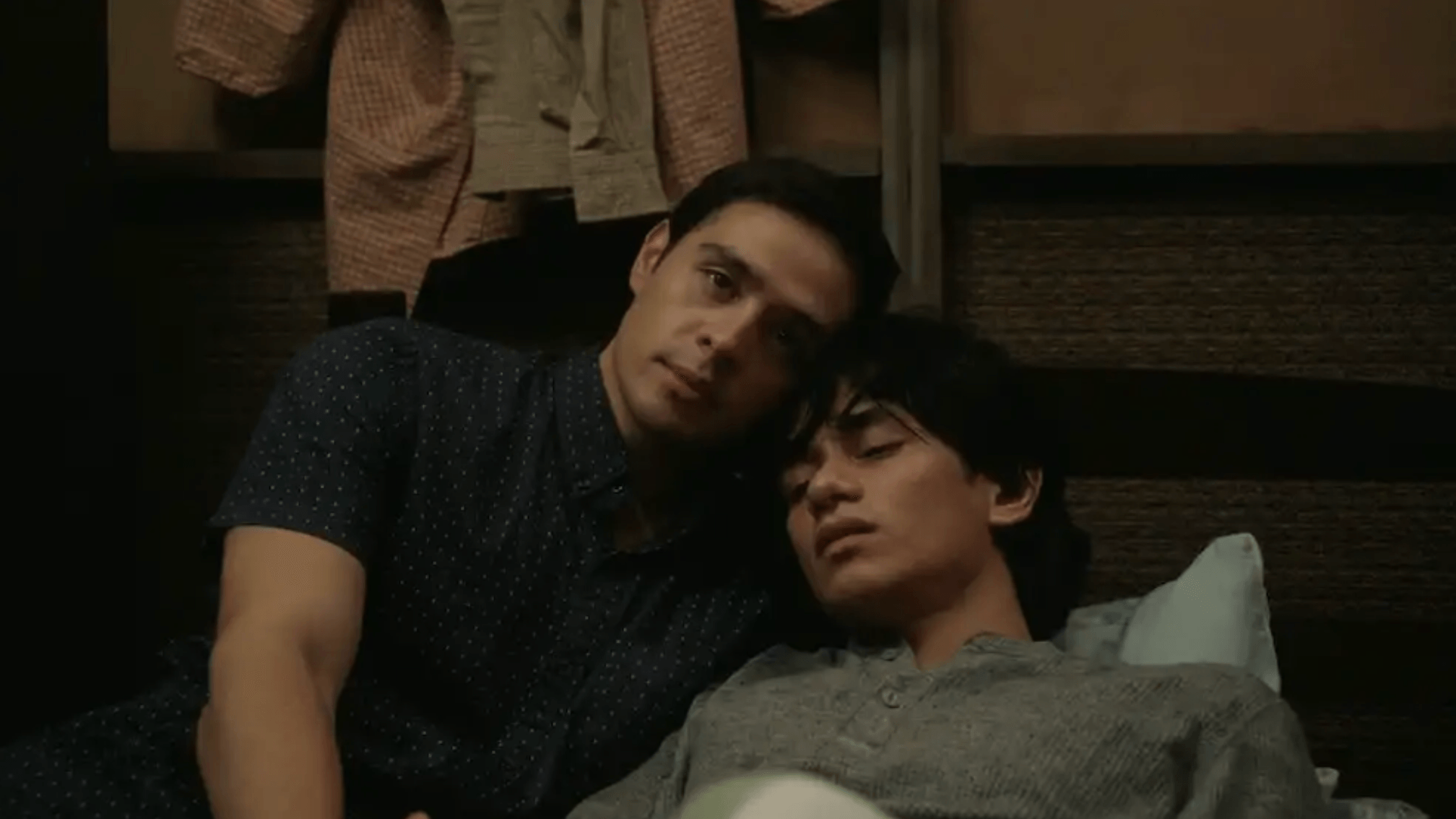
The contemporaries of Pepe Diokno, Ice Idanan, and JP Habac, Corpuz hasn’t shot a film in years. Even Read-Only Memory was filmed pre-pandemic. “I really waited for this moment to happen wherein I will have full control of the vision,” said the director, recalling the gestation period of Tayo Lang Ang Nakakaalam, now led by the ensemble of Martin del Rosario, Miguel Odron, Yayo Aguila, and Epy Quizon.
The material was first written in 2017 and shopped around to several film festivals, including Cinemalaya 2019, but was only shortlisted at best, at which point Corpuz decided to shelve it. Producer Kristine Camille Sulit, who co-directed Read-Only Memory, approached him last year to revisit the script and submit it to Cinemalaya’s latest edition.
Upon making it to the final cut, Corpuz and co-writer Iar Arondaing addressed some anachronisms in the initial material, locating the story further back in time, from 2017 to 2012.
The picture loosely takes its cue from Corpuz’s Palanca prize-winning essay “Autoetnograpiya ng Luksa,” which reflects on the demise of his partner and the idea of “disenfranchised grief.”
“This is the kind of grief that the society doesn’t understand (or recognize) because they have no idea about it or because it’s frowned upon,” he explained. “They have no idea that it’s really painful.”
In the film, Corpuz recontextualizes such immense personal loss in the experience of queer people living with human immunodeficiency virus (HIV), leaning on an after-the-fact temperament to examine the profound weight of grieving and loving in secret.
Whether it works or otherwise is between you and the extent to which you relish all the narrative blue-balling, this seeming refusal to give it all up to the audience. What is hard to mistake, though, is that Corpuz gestures toward a readily empathetic cinema.
The filmmaker explains it’s intentional. “The creative choice is to put the film in medias res,” he said. “I’m coming from the lens of secrecy. And what is being kept under wraps here is knowledge. We, as an audience, are just peeking through the characters’ experiences. What if we look at them, without any prior knowledge of who they are, and all you have is the information that this set of people know about Bong (Miguel Odron) or the situation?”
“I want the audience to feel that seeming inconclusiveness,” Corpuz continued. “In a way, what I am trying to achieve is to put the role of society that we are not actually seeing in the film. It is society that kind of produces the conditions why the characters behave the way they do.”
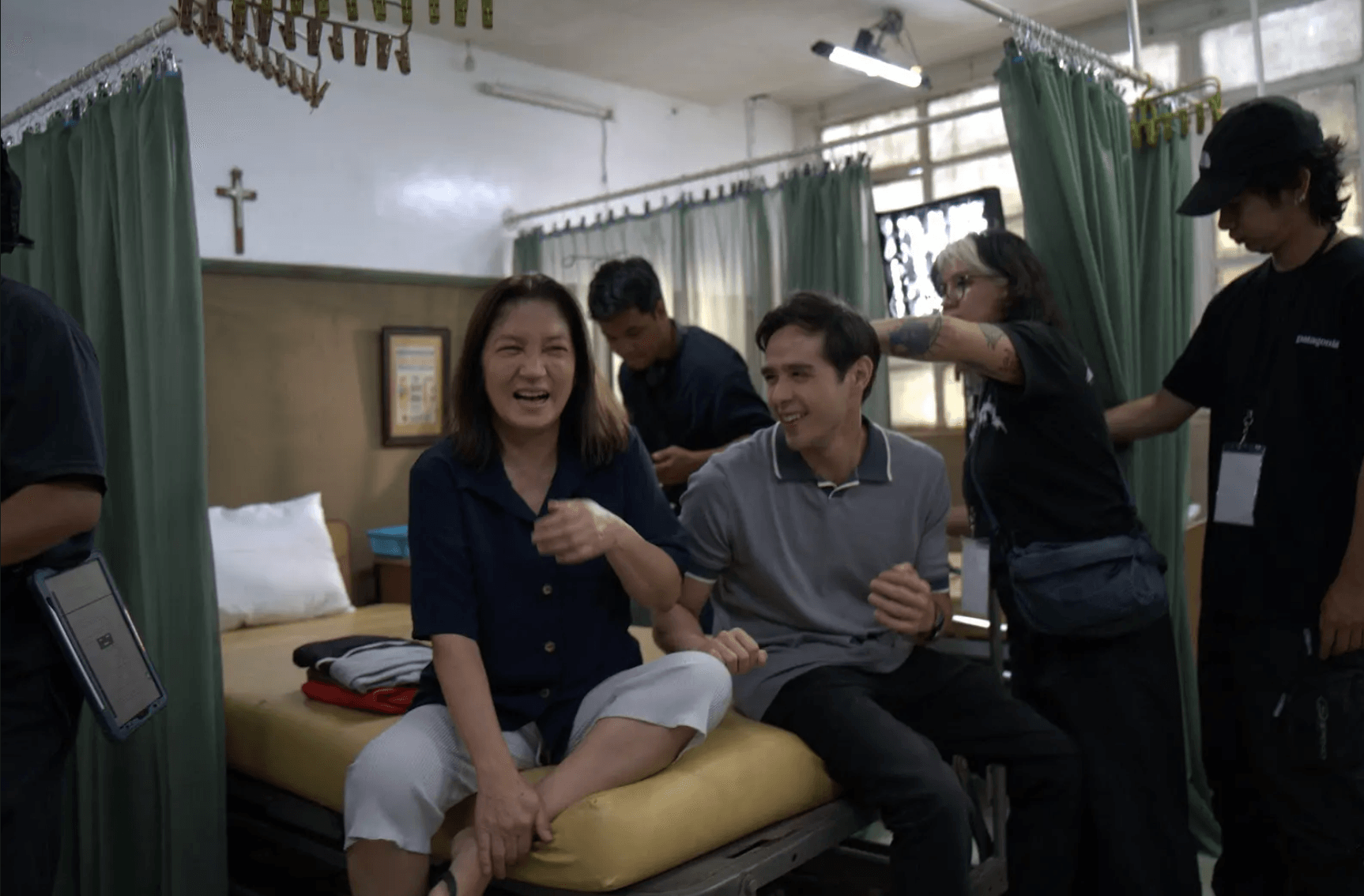
Given his unintended hiatus from filmmaking, Corpuz had to recalibrate his previous mode of production during the shooting proper, taking intimacy coordination and the Eddie Garcia Law into account. “I found out that filming 11 sequences in 14 hours is manageable,” he shared.
At the same time, especially given the film’s social message, the production collaborated with HIV/AIDS health care organization LoveYourself Inc. “It’s hard to represent this subject matter without [a legitimate group] backing us up,” said Corpuz. “A lot of the historical aspects of the film were made in consultation with LoveYourself.”
Corpuz added that his practice as an educator plays an integral role in exploring new vistas when approaching subject matters as sensitive as HIV.
“It gives me the courage to break the rules when it comes to filmmaking,” he said. “I had this teacher in film school who once told us that film is not always meant to be beautiful and pleasurable, and that stuck with me.”
The 99-minute movie evokes that sensibility through tight shots and handheld camerawork. Corpuz was acutely aware of the possible response to that visual lexicon, but argues that he’s connecting the camera movement to the suffocating atmosphere he’s striving for in the film.
In many ways, Corpuz insists on “telling stories of social relevance, the importance of films that are not just entertainment but are also interested in tackling difficult topics.”
“We have very few films that tackle the subject matter,” he argued, listing the likes of Laurice Guillen’s Dahil Mahal Kita: The Dolzura Cortez Story (1993), Maryo J. de los Reyes’s The Secrets of Sarah Jane: Sana’y Mapatawad Mo (1994), and Jun Robles Lana’s Kalel, 15 (2019).
Indeed, Tayo Lang Ang Nakakaalam becomes the latest addition to this very limited local canon of movies shedding light on HIV and the textures of living with it. At the heart of the film is a rather common yet deeply poignant story of finding and nurturing caring systems in a world that rejects it.
It is Corpuz’s hope that such gestures of care materially translate in real life. “Actually, if my film would be part of the discussion on [the legal] recognition of same-sex relationships, then it would be a good route,” he said.
“I started the film with characters who are fully accepted by their parents, but if you are not recognized by the law, then basically that sense of acceptance you enjoy will also crumble.”
Corpuz added, “If we remain on the level of the symbolic, then it would be much more difficult for us, because there is a possibility for the relationship to be erased.” – Rappler.com
Note: Some quotes in Filipino have been translated into English for brevity.
KioskNews shows a cleaned-up reading view extracted from the publisher’s page — the original always lives on their site, not ours.