From W-M to the No 10, shirt numbers tell a story of football’s tactical evolution
Numbers have a fascination. The No 10 is revered almost everywhere, but perhaps most especially in Argentina, where it denotes the playmaker, the enganche, the quasi-mythical figure who links the front and back of the team. Liverpool and Manchester United have reasons to celebrate their No 7. Ajax retired No 14 for Johan Cruyff, Milan their No 3 and No 6 for Paolo Maldini and Franco Baresi respectively and Birmingham their 22 for Jude Bellingham as gestures of respect for their abilities. Other numbers have been retired to mark premature deaths: the No 20 at Liverpool for Diogo Jota, the No 23 at Manchester City for Marc-Vivian Foé, the 21 at Espanyol for Daniel Jarque.
But numbers are not just about individuals. In the days before squad numbers, the number on a shirt was an indicator of position, and the expectations of particular numbers in particular cultures, as well as the attributes a player in that shirt was supposed to demonstrate, themselves tell a story of tactical evolution.
The earliest evidence of teams wearing numbered shirts seems to be in a game between the Australian sides Sydney Leichhardt and HSM Powerful in 1911. The University of Chicago’s American football team wore squad numbers in 1913. There were experiments with numbers on sleeves in baseball from 1916. There were isolated efforts with numbered shirts in the American Soccer League, which began in 1923, and, especially, in the USA’s Challenge Cup. Various touring sides began to experiment with numbered shirts through the 1920s and, in August 1928, on the opening day of the English league season, two games featured numbers. Chelsea’s outfielders wore 2-11 in their Second Division game against Swansea, while Sheffield Wednesday wore 1-11 and Arsenal 12-22 in a First Division clash at Hillsborough.
Similarly, 1-22 numbering was used in the 1933 FA Cup final, in part because Everton and Manchester City were forced to wear change kits due to a colour clash, although the presence of the touring West Indies cricket side, who were not expected to be familiar with the individual players, was also cited. It wasn’t until June 1939, though, that the Football League took a vote to introduce squad numbers. It passed 24-20, and it was decided both teams should wear 1-11, but in strict order, as though the formation had been laid out on a page with the goalkeeper at the top.
This was complicated by the fact that, although almost every team by that stage had responded to the 1925 change in the offside law by adopting the W-M formation (a 3-2-2-3), there was still a belief that the “right” way to play was a 2-3-5. Thus the goalkeeper wore No 1, the right-back No 2, the left-back No 3, the right-half No 4, the centre-half No 5 and so on up to the centre-forward in No 9, the inside-left in No 10 and the left-winger in No 11. In practice, though, the centre-half (5), played between the full-backs (2 and 3) while the inside-forwards (8 and 10) played deeper than the wingers and centre-forward (7, 9 and 11).
Numbers rapidly became sacrosanct. When Hungary came to Wembley in 1953 and became the first foreign side to beat England at the national stadium, they provoked consternation because they were “incorrectly” numbered. The centre-back Mihaly Lantos wore No 4. The midfield creator Jozsef Bozsik wore No 5. Most bafflingly of all, Nandor Hidegkuti, the No 9, didn’t play as a centre-forward but created from midfield. What was Harry Johnston, England’s hapless centre-half, to do? Convention said he, the No 5, should pick up the No 9, but if he did that he left a huge hole in the back line. And if he did not, Hidegkuti was free to pick England apart.
The introspection provoked by that defeat led within a decade or so to a number of leading English teams adopting a back four, usually by withdrawing the left-half (the No 6) into the defensive line. As Alf Ramsey’s 1966 World Cup winners showed the value of packing midfield, so the wingers dropped back, leaving a 4-4-2 that lined up: 1; 2, 5, 6, 3; 7, 4, 8, 11; 9, 10. Within that, the No 4 would usually be the more defensive of the two central midfielders, while the No 10 retained some of the qualities of the inside-left, which is to say he tended to be the smaller, more creative forward alongside a big, physical number No 9.
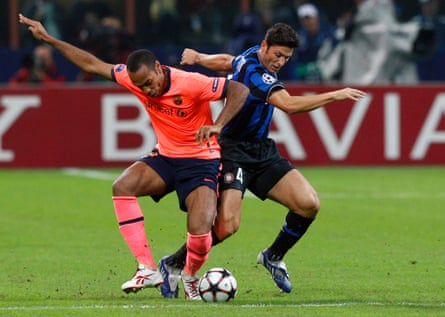
Other countries, though, followed a different path. In Argentina, for instance, there had been no sudden shift to W-M in the late 1920s but, at River Plate in the late 1930s, the right-half Norberto Yácono, nicknamed “the Stamp” for his tight marking, would pick up the opposing creator. As other teams followed the principle, the number No 4 became a de facto third back, but operating on the right. No 4 remains the standard number for an Argentinian right-back, as exemplified by Javier Zanetti, for whom Inter retired the shirt. When Argentina switched to a back four after the humiliation of the 6-1 defeat to Czechoslovakia at the 1958 World Cup, the left-half fell into the back line, so a standard Argentinian back four would read: 4, 2, 6, 3. The No 5 remained as the caudillo in midfield, almost as venerated as the No 10 in the form of Antonio Rattín, Américo Gallego and Javier Mascherano.
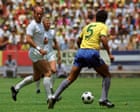
In Brazil, though, there had been no widespread conversion of the right-half into a right-back, and so when the back four was adopted, the wing-halves simply dropped either side of the full-backs, leaving a standard back four as: 4, 2, 3, 6. The great right-back Carlos Alberto, for instance, wore No 4 at the 1970 World Cup, while the left-back Roberto Carlos tended to wear No 6. When, at Flamengo in the 1940s, Flávio Costa tipped the midfield square of Dori Kürschner’s W-M to create his diagonal, a major step towards 4-2-4, the No 5 became the more defensive central midfielder – leading to players such as Clodoaldo, Mauro Silva and Casemiro wearing the shirt for the national team – while the inside-left, the No 10, became the most creative midfielder.
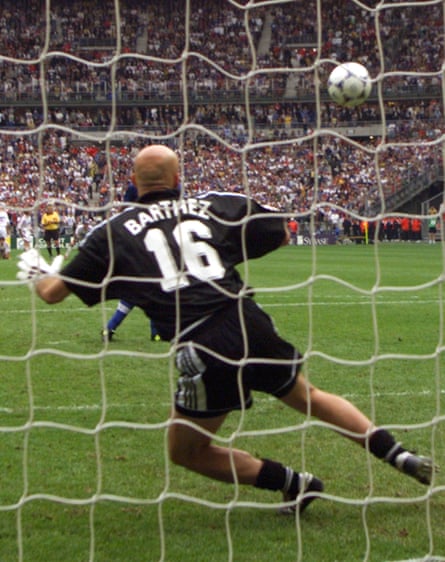
In other countries, other conventions emerged. It was in the Netherlands and West Germany that the standard delineations of the expectations on midfielders in a 4-3-3 emerged. The No 6 would be the deep-lying player, the No 10 would be the creator, and the No 8 would be a box-to-box player shuttling between them. Or in France, where a five-man bench from which a manger could use two substitutes was adopted in 1976, it became standard for the reserve goalkeeper to wear No 16. Many goalkeepers in the Francophone world gained their first experience wearing No 16 and so favoured it when squad numbers were introduced: that’s why Fabian Barthez wore No 16 at the 1998 World Cup and Cameroon’s Thomas N’Kono wore it in 1990.
Numbers now are often a matter of personal choice and of brand-building. In a squad system, players can take on a familiar number and hope to embody its spirit, or try to make a more obscure number their own, as Johan Cruyff did with the No 14 more than half a century ago.
Numbers have a past, and they tell a story. Nobody on the Football League committee that narrowly voted to mandate squad numbers in 1939 would have considered the possibility, but in numbers are written the deep history of a country’s tactical development.
KioskNews shows a cleaned-up reading view extracted from the publisher’s page — the original always lives on their site, not ours.