Small towns, big memories: Michael Robotham on his first Australian novel
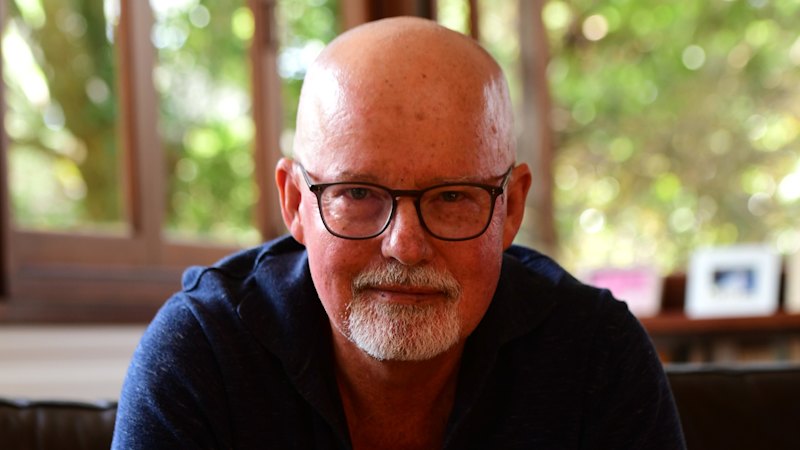
Michael Robotham is sitting in what he calls The Cabana Of Cruelty. But from where I sit, it looks idyllic – a writing cabin with big windows, a comfy couch and a number of bookshelves, in the backyard of Robotham’s home in Avalon on Sydney’s northern beaches.
The author’s 20th crime novel is about to take up space on those bookshelves. And it has an unusual backstory. Robotham, who is 65, wrote an early version of it in his twenties. Back then he was a journalist, initially on The Sun in Sydney, where he was one of 16 teenagers out of 10,000 applicants to land a cadetship, then The Sydney Morning Herald, before moving to England in the mid-80s to write for The Mail On Sunday.
“It was one of the most successful newspapers in the UK, and they had the money to send you anywhere in the world,” he says. “I remember a time where I was away from home for three months because they were bouncing me between countries doing different stories. I was there when Nelson Mandela was released, and the fall of the Berlin Wall, and I was the first Western journalist to get access to the Moscow State Archives. I count myself very lucky.”
When he was 28, an agent contacted him to gauge his interest in writing a book, and Robotham told him about the novel he’d been working on since he was 22. It had the working title Blessed Are The Meek. The agent tried to sell it, and it was almost picked up by esteemed English publishing house Heinemann, but lost out by a single vote at the acquisitions meeting.
“They told us that if it had been set in England, Ireland, Scotland or Wales, they would have said yes, but because it was set in a small town in Australia, it was very difficult for them to market. This was in 1988, and obviously now authors such as Jane Harper and Liane Moriarty have completely changed that situation.”
So he put the book in the bottom drawer, and that’s where it stayed for almost four decades. He had other fish to fry, leaving journalism to become a successful ghostwriter of celebrity memoirs, including books by Geri Halliwell, Lulu, actor Ricky Tomlinson, forensic psychologist Paul Britton and yachtsman Tony Bullimore. He also wrote Rolf Harris’s autobiography, before the revelations emerged about the entertainer’s sexual abuse of underage girls, “but that’s one I don’t really like talking about after what happened. I have all my ghostwritten books on display on a shelf, but that one’s not there any more.”
Robotham’s third act arrived in 2002, when a partial manuscript of his novel The Suspect, the first of a series of nine books featuring psychologist Joe O’Loughlin, was the subject of a bidding war at the Frankfurt Book Fair. It has since sold over a million copies, has been translated into 25 languages, was adapted into a TV series, and set him on a new career as a crime writer.
So when it came time to write his 20th novel, after a lifetime of setting his books anywhere but Australia, he thought it was time to dust off the manuscript in the bottom drawer. Was he surprised by what he found when he re-read it? “There were some sections where I cringed and thought ‘That’s a bit self-indulgent’ or ‘That’s a bit naive’. But I was young. And I can see my influences. I was being a bit of a poor man’s John Irving or Peter Carey.
“But I have to say, in many parts of it I was thinking, ‘Shit, that 22-year-old could really write!’ Of course, I rewrote it because I think I’ve hopefully learned a few things about writing now I’m in my sixties. But the story and the characters have not changed since I wrote them all those years ago.” He also points out with a wry laugh that this was all pre-computer, so that original manuscript was bashed out on a Remington typewriter.
The novel is now called Tell Me Something True. It’s the story of Arlo Hackett, who has just finished a 12-year stretch in jail as an accomplice to rape and murder in the late 1980s. He returns to his hometown of Yulara, a dot on the map halfway between Sydney and Melbourne, and faces the ghosts of the past and the prejudices of the present, as he tries to get to the truth of what really happened all those years ago, when a girl he cared for was killed, his autistic younger brother was accused of the murder, and his life went off the rails.
Robotham grew up in Gundagai, and adds “anyone who lives there will easily recognise the town as the basis for Yulara”. At one point Arlo says, “small towns have big memories.” Is that the case with Gundagai? “Well, let me tell you a story,” he says. “Some years ago I did a book event in Wagga, which is only about 80 kilometres from Gundagai. And I told a story about when I was six years old and lit a campfire in the backyard of our house. It got completely out of control and the first house it threatened belonged to the head of the Gundagai Rural Fire Brigade. I crawled under our house to hide and heard the sirens, and in my head the entire town was going to burn down. After my talk, people came up to me to say they lived in Gundagai, and they clearly remembered that fire. So, yeah, long memories.”
A couple of years after the fire incident he and a friend hung signs around their necks saying that they were blind and stood outside the town’s Niagara Cafe, begging for money. He was picked up and taken home by a police officer, “and as my father was a teacher at the local high school, I was meant to be cleaner than clean, so that’s a story that hung around. I suppose my life of crime began when I was very young.”
Writing crime fiction has turned out to be more lucrative than petty crime; Robotham has now sold 8.5 million books. He feels that his former life as a ghostwriter has helped him write fiction. “My job was to capture someone else’s voice so perfectly that someone who had known the person 20, 30, 40 years would not recognise my fingerprints on the book. So when I started writing novels, that experience really helped in creating fictional voices that live and breathe in the imagination of the reader.”
His work ethic is legendary. He writes seven days a week, and says that if he ever misses a day for some reason, “my wife notices it because I get very edgy – or she would say snappy. That’s because if I spend a day away from a project, I begin to doubt it.” Over a decade ago, a writer for a newspaper magazine wanted to spend a couple of days with him to write a major feature about the life of a successful writer, “but he gave up after a day and said, ‘You don’t do anything!’ I said, ‘That’s my job. I sit in a room and make shit up’. I don’t really have hobbies. I now play golf once a week, maybe twice, but that’s it.”
He’s also a committed “pantser” rather than a plotter, preferring to dive in and write off the top of his head rather than spending time outlining. Has he ever got into trouble and hit a dead-end a long way into writing a book? “Oh, yeah,” he says. “I think the worst was when I threw away 50,000 words. There’s that famous E. L. Doctorow quote about writing a novel being like driving a car at night in fog. You can only see as far as your headlights, but you can make the whole trip that way.
“I subscribe to that. It can be nerve-racking, but it’s exciting. It’s like writing without a net. And I figure that if I can’t see what’s coming, then neither will the reader.”
Tell Me Something True (Hachette) is available now.
The Booklist is a weekly newsletter for book lovers from Jason Steger. Get it delivered every Friday.

KioskNews shows a cleaned-up reading view extracted from the publisher’s page — the original always lives on their site, not ours.