US airlines work to fix nationwide ground stop
Airlines across the US yesterday worked to recover from the longest nationwide ground stop in 25 years that canceled more than 2,000 flights, spread ripple effects around the world, stranded passengers, and forced professional and college sports teams to scramble for alternate transportation.
US officials said new technology being added to the nation’s air traffic control system overloaded antiquated equipment and caused “intermittent” communications and radar gaps, leading to the flight shutdown of more than four hours.
A limited number of domestic flights departed after the stop was lifted at about 8:15pm ET on Friday, but the effects could be felt for days, with officials saying the system would likely return to normal in time to handle the Thanksgiving travel rush.
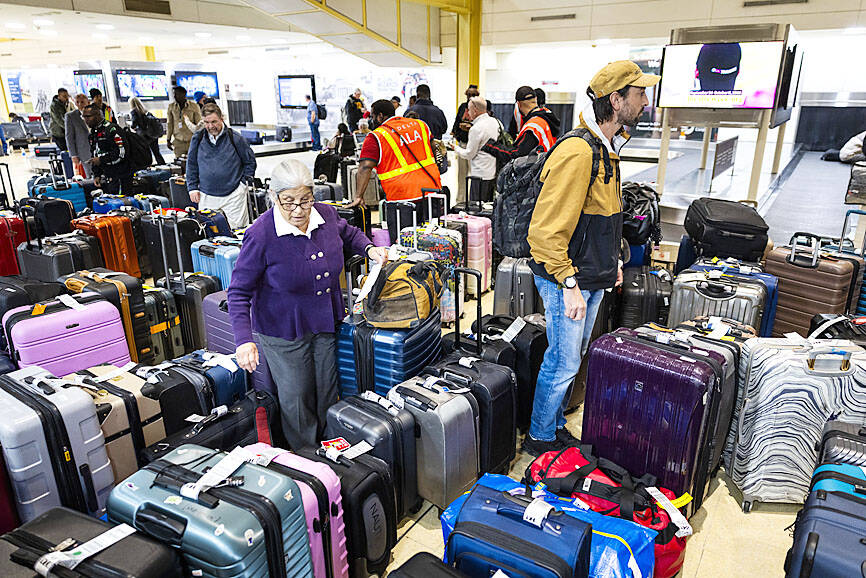
Airplane luggage from canceled flights pile up during a nationwide ground stop at Ronald Reagan Washington National Airport in Arlington, Virginia, on Friday.
Photo: EPA
The nationwide stop was the first since January 2023, when another key Federal Aviation Administration (FAA) computer system that sends notices to pilots malfunctioned, and the second since the Sept. 11, 2001, attacks.
At airports across the US, passengers stared at screens showing delays or rushed to find buses or trains to their destinations.
Sports teams scheduled to play this weekend adjusted game start times, searched for hotel rooms, rescheduled flights and chartered buses.
US Secretary of Transportation Sean Duffy encouraged NCAA football teams to reach out to the FAA so the agency can prioritize flights for Saturday games.
More than 2,500 flights were canceled in the US and hundreds more were delayed, FlightAware said.
At London’s Heathrow Airport, several flights to and from the US were listed as delayed or canceled.
“While US flights have resumed, there may be some follow-on disruption as airlines work to rebook affected passengers and get all services back to normal,” British Civil Aviation Authority consumer director Tim Johnson said.
US Secretary of Homeland Security Markwayne Mullin said no one was in any danger as more than 3,000 flights landed safely.
Duffy blamed the US Congress for failing to approve more funding for new technology, while downplaying the fact that trying to implement new fixes overtaxed the system. He suggested more disruptions might occur.
“We didn’t think we would have this kind of outage. We did,” he said. “We were able to review what went wrong, and then reboot the system and go. But, you will have more of these.”
The malfunction was not linked to the FAA’s new artificial intelligence-powered system, which the agency is rolling out to help predict problems in the sky, Duffy said.
“This is all the old legacy equipment. All of the new equipment that’s been deployed did not go down,” Duffy said.
The FAA has already replaced thousands of old copper wires with fiber optic lines and upgraded hundreds of radio systems as part of the overhaul that began last year, after the US Congress approved US$12.5 billion of funding.
Duffy and the White House are pushing for US$30 billion more to complete the work.
KioskNews shows a cleaned-up reading view extracted from the publisher’s page — the original always lives on their site, not ours.