EU rolls out red carpet to Canada to become its first 'associate member'
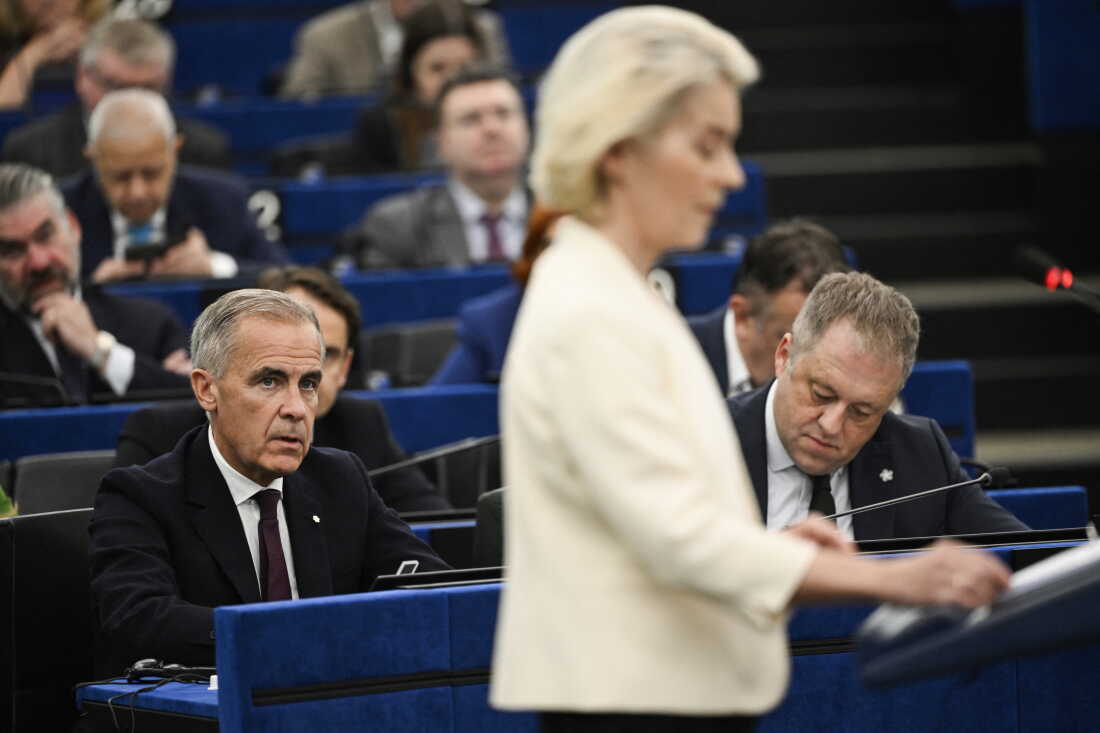
Canadian Prime Minister Mark Carney listens to European Commission President Ursula von der Leyen during her annual State of the Union address at the European Parliament in Strasbourg, France, on Sept. 16, 2026. Von der Leyen proposed opening the door for Canada to become the EU's first "associate member." Jean-Christophe-Verhaegen/AFP hide caption
toggle caption
Jean-Christophe-Verhaegen/AFP
BRUSSELS — The European Union is proposing a new kind of relationship with Canada, one that could make it the EU's first-ever "associate member" — a model that does not currently exist.
European Commission President Ursula von der Leyen made the proposal Wednesday during her annual State of the Union address, with Canadian Prime Minister Mark Carney sitting in the European Parliament as her special guest.
"Dear Mark," von der Leyen said, "Europe and Canada believe in democracy, that power does not belong to the strongest, richest and loudest, but to all of us."
And adding the key phrase to her prepared remarks, seen by NPR, which did not include it, von der Leyen went on: "I would like to work with you on opening the door for Canada to being the first associate member of the European Union."
The announcement drew a standing ovation from lawmakers and dignitaries in the chamber, as von der Leyen and Carney exchanged kisses on the cheeks.
The moment comes as the EU and Canada look to strengthen their partnership amid increasingly difficult relations with Washington under President Trump.
Von der Leyen stressed that the proposed relationship was not "against anyone." But the very fact she felt she had to emphasize that made the context even more obvious.
For many Europeans, Carney has become a prominent voice for closer cooperation among U.S. partners he calls "middle powers", speaking more forcefully than they themselves dare. At the World Economic Forum in January, Carney warned that "recently, great powers have begun using economic integration as weapons, tariffs as leverage, financial infrastructure as coercion, supply chains as vulnerabilities to be exploited."
"He said it out loud," said Rem Korteweg of the Dutch Clingendael Institute, who says Carney's message has resonated across Europe even as Canada itself has come under intense pressure from the Trump administration.
"All of a sudden Mark Carney is bombarded as almost this honorary hero of what Europeans are actually saying to themselves behind closed doors," Korteweg explained. "Across Europe there is this realization, well, perhaps we need to keep Canada closer to us."
But von der Leyen's proposal also raises a fundamental question: What exactly would associate membership mean?
"This is where things become tricky," Korteweg said.
Carney has made clear that Canada does not want to fully integrate with the EU's single market. Canada and the EU already have a free-trade agreement, although Carney is expected to press the 10 EU countries that have not yet ratified it.
The two sides have also been expanding cooperation in security and defense. They signed an agreement deepening security cooperation in 2025, and Canada this year became the only non-European country allowed to participate in the EU's 150-billion-euro fund for joint defense purchases.
So what would a new political status add?
For Jason Wiseman, a Canadian working in the European Parliament, the proposal reflects the opportunity created by the worsening relationship with Washington."The main thing is that we have momentum now," Wiseman said. He sees opportunities for Canada and Europe to build more resilient supply chains and cooperate in strategically important industries.
"Across all of the main sectors that matter the most to the EU and Canada right now, to have the kind of resilient supply chains that would include third-country like-minded partners like Canada," Wiseman says. "Things like critical raw materials. We've got a wealth of small-medium enterprises making mission-critical software…emerging disruptive technologies, especially drones."
The proposal, however, was not preceded by a detailed public negotiation, raising questions inside the EU about how the announcement came about.
Wiseman says he hasn't met anyone in the European Parliament who's against the associate membership idea. But there are reports that some EU governments were furious they were not consulted before von der Leyen's offer, suggesting there may be more resistance in EU capitals whose unanimous support will be needed to create any new partnership.
The proposal is also prompting political questions in Canada, particularly over what an associate membership would actually mean and what closer ties with the EU could require from Canada.
Aaron Gasch Burnett, an analyst with the Center for Strategic Statecraft in Canada, says both Carney's political supporters and opponents have seized on it.
"There's a lot of excitement about what associate membership means when it does not in fact exist … among people who would support closer ties to the EU," Burnett says. "This is also becoming a partisan issue in Canada, with the opposition now saying, well, please explain what powers you're willing to give up to Brussels and what you would get in return."
On Thursday, Mark Carney will get a chance to do that, when it is his turn to address the European Parliament and explain where he thinks this political romance is headed.
KioskNews shows a cleaned-up reading view extracted from the publisher’s page — the original always lives on their site, not ours.