Australians will no longer be hit with card surcharges from 1 October. What will the ban mean for you?

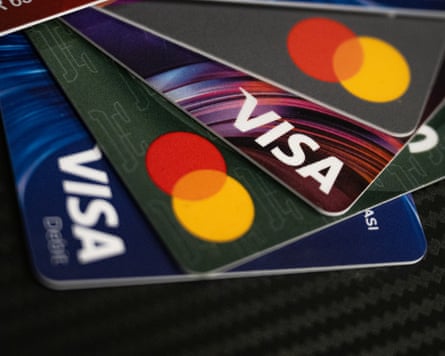
Debit and credit card surcharges will be eliminated from 1 October, as part of Reserve Bank reforms that will do away with extra checkout fees on Visa, Mastercard, and Eftpos payments.
The RBA estimates the changes will save consumers about $1.6bn a year in surcharges, but the big banks and credit companies are likely to recoup the costs of processing transactions in other ways, including through fewer perks for cardholders.
How will this affect my credit card?
Major card providers have already started making changes to their reward schemes, including capping the amount of points customers can earn on their purchases, and scrapping travel insurance and other travel perks.
Some banks have also lifted interest rates on unpaid credit, raised annual fees and scrapped fee waivers – which means customers will have to pay to use the card even if they hit what was once the minimum required spend to avoid a fee.
And with a fortnight left before the surcharge ban, more changes are expected.
Sally Tindall, the data insights director at financial comparison site Canstar, which has been compiling a list of the changes, says every card will be different.
“It’s really important to get across exactly what it means for your credit card,” she says.
“Customers getting a letter or an email from their card provider – it’s really important not to just file it away or delete it knowing that it might be bad news: it’s one that you need to open up and read through”.
Why are banks and credit card companies doing this?
Labor had promised to eradicate surcharges on debit card payments as one of its cost-of-living measures. The RBA went a step further: after an 18-month review of Australia’s payment system, it announced a ban on surcharges for both debit and credit cards payments.

The RBA flagged the changes in March, with the governor, Michele Bullock, saying it had become more difficult for people to avoid surcharges and the system was no longer fit for purpose.
About 16% of Australian businesses surcharge, according to the RBA. When you make a payment in one of these stores or restaurants, you pay an extra fee when you tap your card which the merchant uses to cover the cost of processing the payment.
There are several components involved, including interchange fees – which the merchant’s bank pays to the customer’s card issuer to cover the cost of processing the payment. This payment goes through an intermediary – known as an “acquirer” – which includes payment processing companies such as Square.
Both the merchant’s bank and the customer’s card issuer pay “scheme” fees to the operator of the overall payment network being used – such as Visa, Mastercard or Eftpos. Scheme fees are also ultimately passed on to consumers, the RBA says.
The RBA has effectively banned these costs from being passed on directly with the end of surcharging. In order to to soften the effect on small businesses of having to absorb the costs on their own, the RBA will further limit interchange fees.
This means the maximum a card issuer can charge a small businesses for each payment drops from 0.80% to 0.30% of the transaction, or from 80 cents to 30 cents on a $100 purchase.
Tindall says the change will “have a significant impact on how much the banks earn in these interchange fees”.
“And banks not willing to really cop that loss on the chin have now come through and changed up the credit card fees [and rewards],” she says.
However, Tindall says plenty of card issuers are using the RBA reforms as an opportunity to “completely reset their credit card offering”.
It’s a good opportunity for consumers to stop and do a thorough assessment of their credit card, and to shop around for a better deal if needed, she says.
When the RBA reviewed the surcharge scheme, some banks suggested they would have to hike credit card fees and interest rates while slashing rewards and points.
In its review, the central bank found this would be an intended consequence of the reforms, as debit card surcharges were already subsidising the rewards accruing to credit cardholders.
“I would use an analogy of a cake,” says Prof Angel Zhong, a finance expert from RMIT University.
“In the past there was a large slice of surcharges and another slice from credit card annual fees which support rewards programs. Then you have another slice which is the interchange fees. If you’re cutting surcharges, the other slices need to become larger.”
What does it mean for retailers? Will I need to pay more at the checkout?
The RBA estimates the new limits on interchange fees will save businesses an estimated $910m a year. In addition to this, Eftpos, Mastercard, Visa and large acquirers will have to publish the fees they charge in a bid to provide greater transparency to businesses that previously had to navigate an opaque system.
But payment schemes will still cost money to operate and businesses will still have to pay providers. So, while consumers will pay only the price on the menu or the shelf, these prices may be higher. The RBA estimated that, without access to surcharges, shelf or menu prices would likely have to increase, with prices likely to lift by a one-off 0.1%.
The RBA noted that the cost of card payments was “substantial” for small businesses, which pay much higher fees per transaction than large businesses.
Business groups have expressed concern that the burden on small businesses will be too great and they will be forced to lift prices. For example, Matthew Addison, the chair of the small business peak body Cosboa, previously welcomed the reduction of interchange fees but said the costs involved in card transactions would still need to be “absorbed” into base prices.
However, the RBA said its feedback from Australians was that they would prefer to know the final price, even if it was higher, instead of being caught with a hidden fee.
How can I get the best value?
Broadly speaking, annual fees are going up and rewards are going down, says Brandon Loo, the editor in chief of consumer website Point Hacks.
“If you were in a position to apply for a credit card now, there are still some very high sign-up bonuses in the market,” Loo says.
“After 1 October, we do expect that some of these bonuses will come down and from there you will have to do an overall assessment to see if the card is still worth it for you.”
However, as Loo points out, banks and credit card companies must perform an “interesting balancing act”: they’ll want to claw back interchange fees without losing new customers.
Loo believes banks will want to compete for credit card customers again – through rewards schemes and lower fees – once they better understand how the RBA changes will affect them.
For example, if the RBA reforms mean more people pay with credit or debit cards, the banks may not actually lose as much money as they thought.
Additionally, Loo says there are other ways to access rewards schemes; people who are keen to accrue frequent flyer points, for example, can consider shopping with an airline’s “on-ground” partners, or health insurance policies that come with points.
Is it still worth 'churning' credit cards?
Loo says “it’s going to be harder” to churn cards – the practice of signing up and then cancelling credit cards to earn sign-up bonuses – if banks reduce these perks.
However, he says banks were already increasing the cooling-off periods between cancelling one card and being eligible to register for another.
It used to be 12 months for most banks and now some have increased the wait-time to up to 24 months, Loo says.
“Churning is probably not the way to go. Maybe if you swap your cards around every year or two, but on its own it’s not the best strategy.”
KioskNews shows a cleaned-up reading view extracted from the publisher’s page — the original always lives on their site, not ours.