US airbase Kadena gets F-15EX fighters but no upper hand against China, analysts say
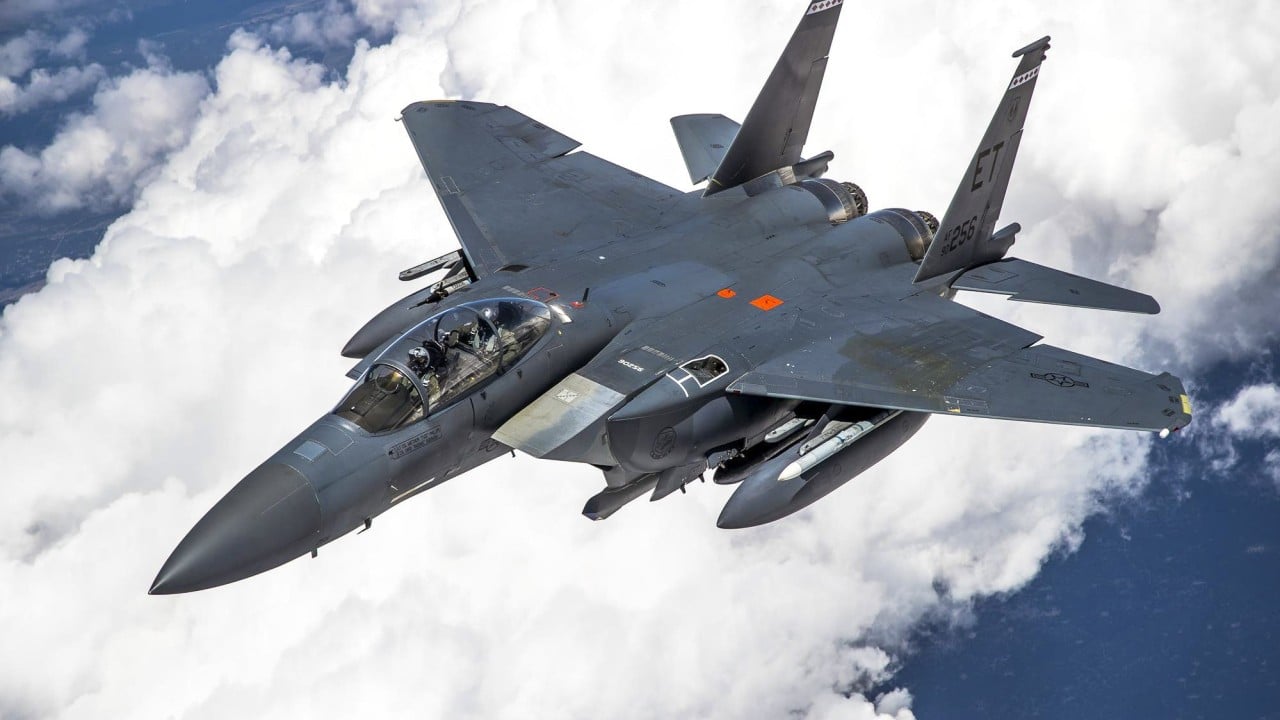
The first two American F-15EX Eagle II fighter jets arrived at Kadena in Okinawa, Japan on Sunday marking an upgrade for the ageing US fleet, but analysts say a shift in the regional air power balance is unlikely given China’s growing capabilities.
Kadena is the first airbase to receive the F-15EX outside the United States, according to a US Air Force statement on Saturday. The new aircraft will be operated by the 44th and 67th Fighter Squadrons under the 18th Wing.
They are the first of 36 F-15EX fighter jets planned for the Kadena base. America’s most strategically important military installation in the western Pacific, Kadena is located about 600km (370 miles) northeast of Taiwan.
The new fighter jets are equipped with a modern active electronically scanned array radar, upgraded electronic warfare systems and digital flight controls. Compared with the ageing F-15C/D fighters being used at Kadena, the F-15EX offers improved sensors, greater weapons capacity and more advanced avionics.
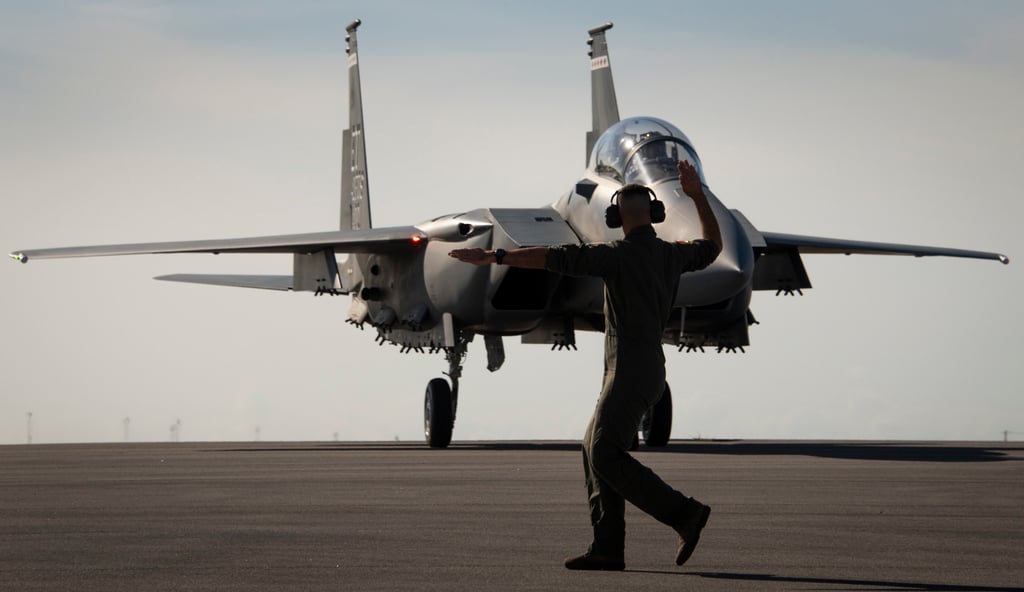
In the statement, Brigadier General John Gallemore, commander of the 18th Wing, said the arrival of the new fighters “marks a significant milestone for American air power in the Pacific”.
“These aircraft strengthen our ability to deter aggression, respond to emerging threats and defend Japan alongside our allies and partners,” Gallemore said.
“Their permanent presence at Kadena reinforces our commitment to the US-Japan alliance and ensures we continue to bring advanced combat capabilities to one of the most strategically important regions in the world.”
Kadena serves as a major hub for fighter operations, aerial refuelling, airborne surveillance and regional force projection. Its proximity to Taiwan and the East China Sea gives American forces a forward position along the first island chain in any potential conflict with the People’s Liberation Army.
The first island chain stretches from Okinawa to Taiwan and down to the Philippines and is part of a US strategy to contain the PLA in the Pacific.
Until last year, Kadena’s main fighter fleet consisted of 48 F-15C/Ds, which had been in service for more than four decades since 1979. The US Air Force said in 2024 that it would replace the F-15C/Ds with 36 more advanced F-15EX fighters, completing the withdrawal of the older aircraft in January 2025.
During the transition period, fourth- and fifth-generation fighters, such as F-22s, were deployed to Kadena on rotation.
Chinese analysts said the upgrade did not give the US the upper hand in regional air power.
They pointed to the PLA’s 4.5-generation multirole fighter the J-16, which is often compared with the F-15EX as both are twin-engine, two-seat heavyweight fighters. The J-16 has been dubbed the “bomb truck” for its heavy payload capacity.
SCMP Plus is a new premium news platform that gives you an
all-inclusive edge to stay ahead on China news.
To access our exclusive content you’ll need to subscribe.
Already a subscriber?
LOG IN
The F-15EX has a weapons payload capacity of 13.4 tonnes, while the J-16 has a capacity of 12 tonnes, and both have active electronically scanned array radar.
“Even though the F-15EX has a bigger payload, you can’t carry that much payload during combat as it will affect its range, mobility and supersonic flight,” according to Chinese military expert Fu Qianshao.
Fu said while the overall performance of the two aircraft was similar, he believed the J-16 had an advantage in manoeuvrability.
In addition, he said that while operating in the East China Sea – even if paired with fifth-generation US fighter the F-22 – the F-15EX would not have an advantage against the Chinese combination of the J-16 and J-20.
Senior US military officials including Admiral Samuel Paparo, commander of the US Indo-Pacific Command, have publicly acknowledged that it would be extremely difficult to achieve air superiority against the PLA in a conflict around Taiwan.
Paparo was asked at a congressional hearing in April last year if China was now capable of denying the US air superiority in the first island chain. “Yeah, I give them high marks in their ability to do that,” he said.
Hong Kong-based military expert Song Zhongping noted that the F-15EX had some stealth ability. But he said that compared to the capabilities of the PLA, the US “doesn’t have an advantage”.
“Whether it’s the F-15EX, F-22 or F-35, they do not have the upper hand on China’s doorstep because China has far more military capabilities,” he said. “And it’s not just an air force to air force, navy to navy comparison.”
China and the US have had several air encounters over the East China Sea.
In 2022, then-Pacific Air Forces commander General Kenneth Wilsbach revealed that American F-35s had flown relatively close to Chinese J-20s over the East China Sea. He said US pilots were impressed by the Chinese aircraft’s command-and-control support. He did not disclose the date, distance or outcome of the encounter but said it was not an engagement.
The following year, state broadcaster CCTV reported that the J-20 had played a leading role in intercepting planes over the East China Sea and Taiwan Strait, which an expert said could involve US stealth fighters.
In 2024, CCTV also reported that a Chinese J-16 fighter had locked onto two unidentified foreign aircraft that experts suggested could be US F-22s and escorted them away from China’s air defence identification zone.
KioskNews shows a cleaned-up reading view extracted from the publisher’s page — the original always lives on their site, not ours.