‘Pull the plug’: protesters resort to direct action against AI firms

In a bar below Waterloo Bridge, a cell of a fast-growing anti-AI protest movement met last week to plot their latest move: disrupting a tech industry dinner being addressed by a senior executive from the chip maker Nvidia.
Emma, a 28-year-old bartender, had never before taken direct action and was the most nervous of the four plotters from Pull The Plug, one of a growing number of AI-focused campaign groups around the world.
Around the table were a former climate protester and a campaigner versed in the anti-nuclear movement. Emma signed up after a summer of feeling rising alarm at the catastrophic risks of AI, first when a swarm of OpenAI agents escaped their training “sandbox”, cheated, deceived and conspired to hack into the Hugging Face website and then as Jacob Coxon, an Anthropic researcher, quit with an apocalyptic warning that superintelligent AI “could kill us all by the end of the decade”.
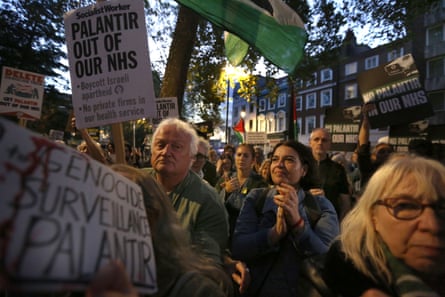
As darkness fell they crossed the Thames to the Claremont hotel where Emma filmed while two others unfurled a banner in a function room, shouting “Pull the plug on Nvidia” and “Pull the plug on Palantir”. Hundreds of protesters also staged a rally in front of Palantir’s London HQ last Thursday.
“We did not consent to the kind of build-out that you are planning here,” the activists yelled as they were wrestled out of the door. They edited a video clip – “activist disrupts elite AI network dinner – Nvidia edition” – and uploaded it to Instagram. It was a small gesture, but they had made their stand.
“I want to show other people that they don’t have to feel powerless among all of these articles coming out [about AI doom],” said Emma. “It’s easy to fall into a spiral that it’s too late. This shows people they can address the tech executives, disrupt their meetings, make them feel uncomfortable and get some answers.”
Pull The Plug was launched in January and has about 300 members – mostly aged from 20 to 40. It is backed by an anonymous funder who works in the AI industry, organisers said. Several campaigns resisting AI acceleration are funded by tech insiders.
Pull The Plug advocates direct action – a tactic other AI campaigns have rejected. Last month, one of its members climbed on to a chair in a packed AI conference in London addressed by speakers from OpenAI and Amazon and delivered an impassioned speech.
“Best case scenario: the men handling this technology are completely incompetent,” the female activist said in an outburst that garnered 153,000 Instagram likes and was picked up by the Washington Post. “Worst case scenario: we are all being led into a disaster.”
Other AI protest movements are gaining momentum after a torrent of news about AI dangers. Anthropic told investors this week that advanced AI could pose “existential risks to humanity”. Pause AI, a confederation of campaign groups in 17 countries, saw a fourfold jump in sign-ups when worrying news about rogue AI agents was breaking in August and last month.
“We have had a lot of volunteers who have suddenly decided to dedicate way more of their time to the cause,” said Maxime Fournes, a Cambridge-educated mathematician and deep learning engineer who is chief executive of PauseAI Global. Volunteer sign-ups doubled to about 100 a week after the Hugging Face incident and soared to 681 in the week of Coxon’s “kill us all” warning, when PauseAI organised protests in Paris, London and Berlin.
Donald Trump may be one of the movement’s most important recruiting sergeants. He announced last week that he wanted AI companies to “self-police” despite widespread demands, including from the companies, for federal and international rules to limit AI-enabled cyber-attacks and bioweapons.
The surge in worrying news has given campaigners like Fournes hope that “we could actually survive this situation”. He added: “Suddenly we have a large fraction of the world population that is waking up.”
Joseph Miller, an AI safety researcher who has suspended his doctoral studies at Oxford University to run Pause AI’s UK branch, noticed the shift while campaigning outside Brixton tube station in London. He said: “It was the easiest flyering we’ve ever done, because people would just come and talk to me … one every few minutes.”
People he spoke to were worried about cognitive decline in schools and AI resulting in sloppy work in the office. “I heard ‘killing everyone’ more from young people,” Miller added.
Pausing or halting AI is a cause that cuts across political and generational boundaries, according to campaigners. University students sign up because they fear AI will wreck career paths, while older conservationists rally against datacentre construction.
after newsletter promotion
In Scotland, where at least 21 datacentres are planned, Action to Protect Rural Scotland, a 100-year old charity better known for campaigning for green belt land, said its supporter list had swollen from 400 to 4,000.
“I’ve never seen grassroots energy like this,” said Kat Jones, the charity’s director. She affectionately calls it “a campaign of nerds” with supporters probing the workings of AI datacentre cooling systems and the power grid and lodging freedom of information requests.
AI’s need for vast physical infrastructure has provided a “very physical, concrete object of protest”, said Fournes, and, in some cases, a target for direct action. In the last year, far-left or anarchist groups protesting over the climate crisis and AI have claimed responsibility for criminal attacks on infrastructure in France and Germany.
In August, Wynd Kaufmyn, became the first anti-AI protester believed to have been jailed for taking direct action – in her case blocking the entrance to OpenAI’s HQ in San Francisco. In April, another protester hurled a petrol bomb at the house of the company’s chief executive, Sam Altman. The same month, an attacker fired gunshots into the home of an Indianapolis politician in protest at datacentre plans.
Mauro Lubrano, assistant professor of terrorism and political violence at the University of Leiden, said that if rising demands for accountability, transparency, and democracy in AI governance were not met, more people could get drawn to violence.
“It’s quite likely that we will see anti-AI violence becoming more prominent as a driver to political violence,” he said, citing last month’s vandalism of a Canadian AI institute, Mila, and a nearby software company in Montreal. Windows were smashed and graffiti scrawled reading “burn the data centers”.
Some Pull The Plug activists have diverted their energy from Just Stop Oil and Extinction Rebellion. One member of Emma’s cell glued herself to roads to protest against the climate crisis – tactics that have alienated the public.
Such direct action is “extremely counterproductive”, said Fournes who predicted it would trigger “an immune response” from wider society and would provide “a golden opportunity for the AI labs … to say, they are criminals and it is easier to turn the broader public against the movement against the development of AI”.
KioskNews shows a cleaned-up reading view extracted from the publisher’s page — the original always lives on their site, not ours.