India’s August exports up 26% amid lower US tariff, rupee fall
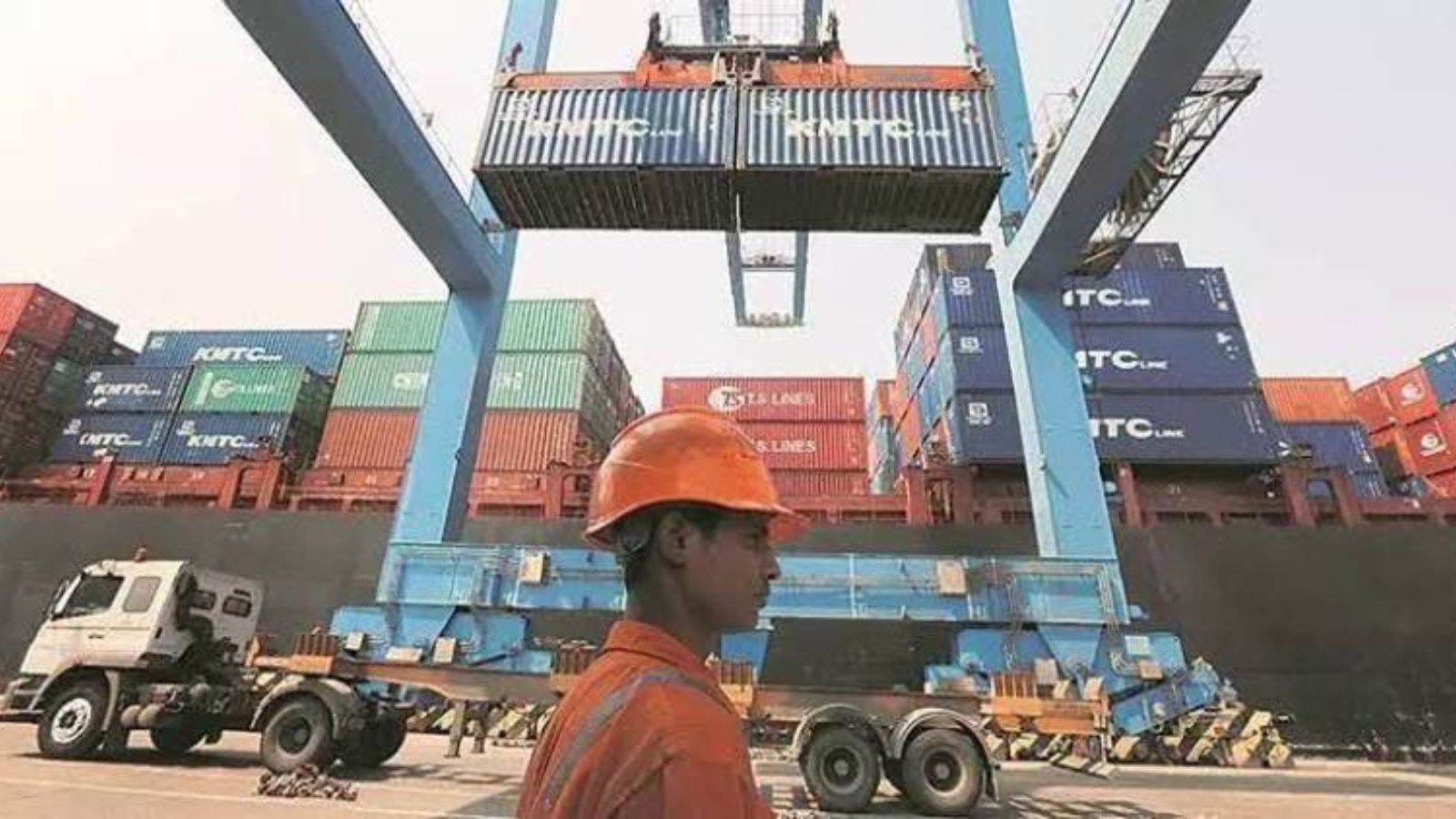
Compared to August last year, India’s exports are only facing 10% tariffs. (File Photo)
India’s goods exports in August jumped 26%, driven by a sharp jump in shipments to the US which rose by over 20% amid lower tariffs on Indian goods compared to last year, when heightened tensions with Washington led to 50% tariffs by August 27, 2025, according to data released Tuesday by the Ministry of Commerce.
In August, exports to the US jumped over 21% to $8.3 billion compared to $6.8 billion. This was the sharpest export jump to Washington this calendar year.
Depreciation in the domestic currency by over 10% also helped India’s goods exports jump 26% to $43.81 billion in August this year compared to $34.74 billion during August 2025. Lower gold imports also helped goods imports last month grow at a slower pace of 14.05% to $70.67 billion compared to $61.96 billion in August 2025.
This is the first time during the ongoing financial year that gold imports declined sharply to $2.30 billion in August this year compared to $5.44 billion in August last year.
“Goods import growth is lower than export growth. This has helped the goods trade deficit decline from $26.86 billion in August this year compared to $27.20 billion in August 2025,” Commerce Secretary Rajesh Agarwal told the press.
The sharp jump in exports this August comes on a lower base, as US tariffs last year had begun impacting India. The first set of 25% reciprocal tariffs came into effect on August 7, 2025. And by August 27, additional tariffs of another 25% over Russian oil imports also came into effect, raising the overall tariffs to 50%.
Compared to August last year, India’s exports are only facing 10% tariffs.
Story continues below this ad
Meanwhile, economists said that the sharp rupee depreciation is also helping exports, but the benefits may be more visible in high-margin products.
An HSBC report last month said that high-tech exports (around half of core exports) show relatively higher uplift after rupee depreciation. “Within this bucket, machinery, electronics, and transport show the most positive response over the two- to three-quarter horizon,” the report said.
This is followed by low-tech exports, which respond modestly to the depreciating currency. Marine goods and food products show the most positive response in this category, and then have mid-tech exports (about one-third of the core exports), which show negligible response, and the results hold across categories like textiles, footwear, plastics, and stones, the report said.
During the April to June quarter, high-end products such as engineering goods, electronics and pharmaceuticals grew 18.1%, 22.6% and 6.8%, respectively, and several labour-intensive sectors registered a sharp decline.
Story continues below this ad
Textile exports slipped 12.4%, while leather products declined 4.7%. Exports of low-margin products such as fruits and vegetables, ceramics and glassware, and jute products fell 10.3%, 25%, and 13.4%, respectively. Tea exports were under particular pressure, falling 17.5%. Of the 31 export sectors, 11 posted a year-on-year decline in April-June.
S C Ralhan, president of the Federation of Indian Export Organisations (FIEO), said the 26.12 per cent growth in merchandise exports in August is encouraging and reflects the resilience, competitiveness and adaptability of Indian exporters.
He said that encouraging export growth across markets such as China, Singapore, Germany, South Africa, Malaysia, Tanzania, Hong Kong, Australia, Spain and Sri Lanka points towards greater diversification of India’s export basket.
“Automobile exports also recorded a strong 22.2% year-on-year increase, led by two- and three-wheelers, while gems and jewellery exports remained positive, rising 3.14% to $2.30 billion. The continued expansion of electronics and engineering exports, along with the resilience of chemicals, pharmaceuticals and other manufacturing-intensive sectors, indicates a strengthening of India’s diversified export basket,” he said.
Story continues below this ad
On the import side, petroleum and energy products, electronic goods and other industrial inputs continued to account for significant import demand, reflecting domestic production and consumption requirements, while gold imports declined sharply to around $ 2.3 billion, helping moderate the merchandise trade deficit, Ralhan said.

Ravi Dutta Mishra is a Principal Correspondent with The Indian Express, specializing in economic policy and financial regulations. With over five years of experience in business journalism, he provides critical coverage of the frameworks that govern India's commercial landscape. Expertise & Focus Areas: Mishra’s reporting concentrates on the intersection of government policy and market operations. His core beats include: Trade & Commerce: Analysis of India's import-export trends, trade agreements, and commercial policies. Banking & Finance: Covering regulatory changes and policy decisions affecting the banking sector. Professional Experience: Prior to joining The Indian Express, Mishra built a robust portfolio working with some of India's leading financial news organizations. His background includes tenures at: Mint CNBC-TV18 This diverse experience across both print and broadcast media has equipped him with a holistic understanding of financial storytelling and news cycles. Find all stories by Ravi Dutta Mishra here ... Read More
KioskNews shows a cleaned-up reading view extracted from the publisher’s page — the original always lives on their site, not ours.