A car that is pet-friendly, an extension of its owner: Vehicle design ideas for 2036
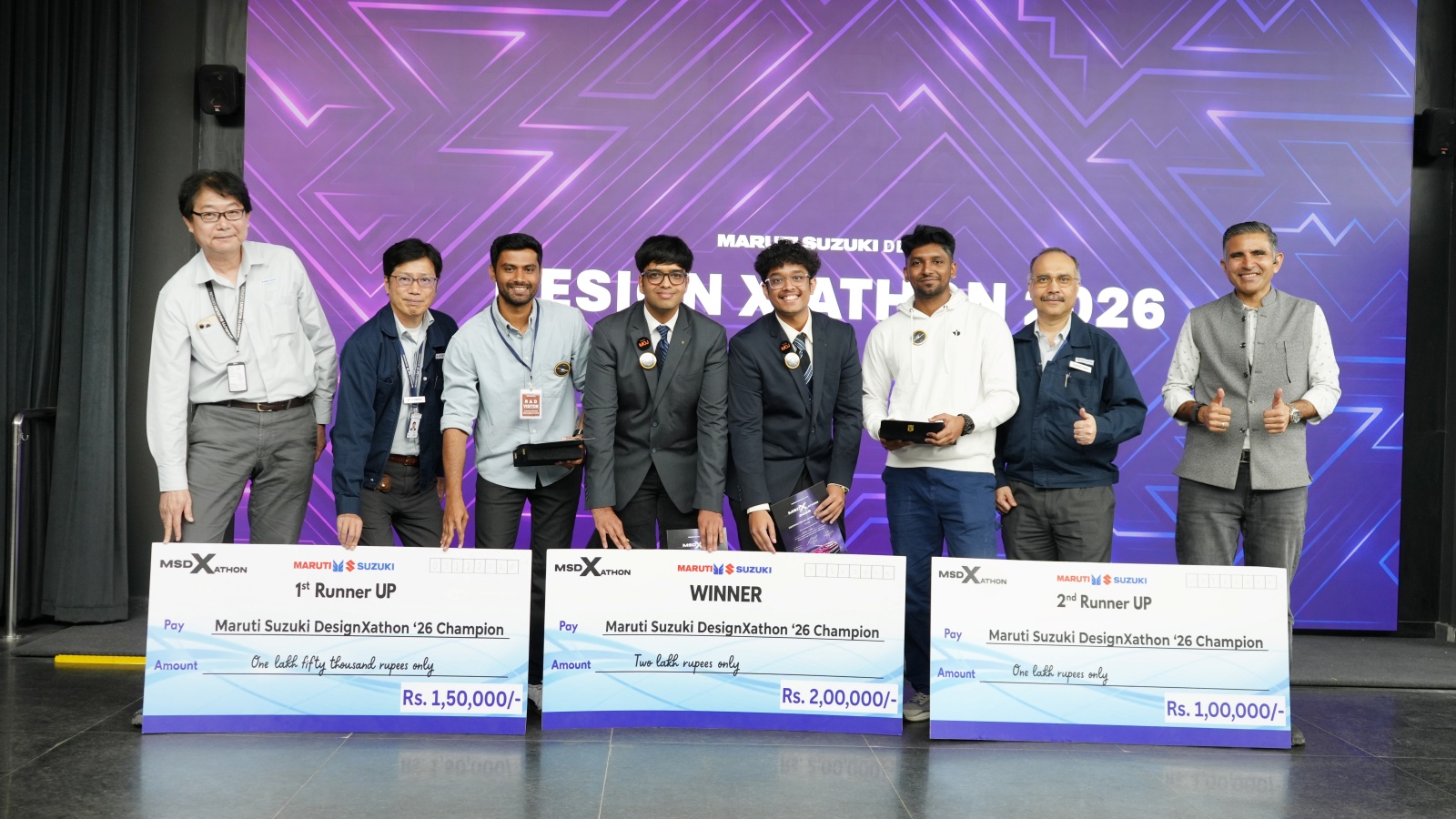
What kind of car would a child who reaches the legal driving age of 18 in 2036 like to ride? Two students at Gandhinagar’s National Institute of Design (NID) thought these young automobile users of the future might like a car that is “an avatar of its owner”, or one that is “pet-friendly”.
These students may or may not be right – who knows what the world of cars might look like 10 years later? But for now, their prototypes have won awards at DesignXathon 2026, the second edition of Maruti Suzuki India Ltd’s flagship automotive design competition.
Jayendra Singh Tomar and Rahul S Nair, both 27-year-old automobile design students at NID, Gandhinagar, were awarded the first and second runner-up positions respectively from among 450 students of 70 design schools in India and abroad who participated in the challenge.
The competition brief from India’s largest automaker: “Envision an iconic vehicle GenZ and Gen Alpha would aspire to own in 2036”.
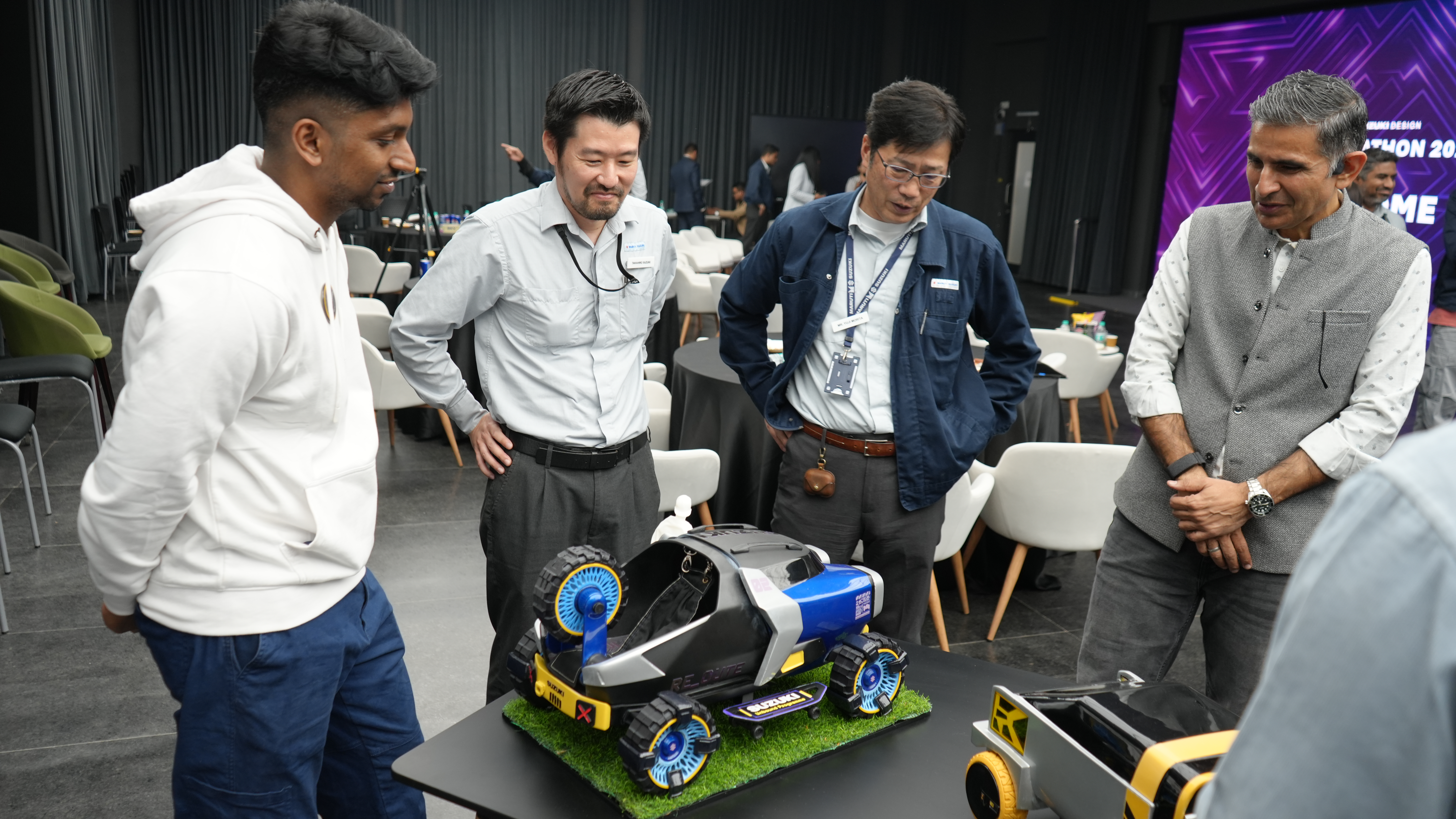 Members of the jury view prototypes of the cars built by the teams in the competition. Rahul S Nair is on the left. (Photo: Maruti Suzuki)
GenZ is the demographic cohort following the Millennials and preceding Gen Alpha. They are generally defined as people who were born between 1997 and 2012, which would make them 14-29 years old now. Gen Alpha are the first entirely 21st-century generation, with birth years 2010 to 2024, who would be between 2 and 16 years old in 2026.
Team IED Torino (Istituto Europeo di Design in Turin, Italy) was declared the winner of DesignXathon, Maruti Suzuki said in a press release. The winning team comprised Aviral Gour and Shivansh Upadhyay.
The top three teams were awarded cash prizes and 6-month internships at Maruti Suzuki’s India Design Studio, the release said.
The boy who doodled cars
Story continues below this ad
“My core concept was ‘mobility as an extension of lifestyle’, where the car can be your persona, your avatar,” Rahul S Nair told The Indian Express on Thursday (November 12).
As a five-year-old, the boy from Pathanamthitta in Kerala liked to doodle bikes in his school notebook. “One day, I drew a car, a bike and an aeroplane on a page in pink sketchpen and threw it away. When I returned from school, there was my father standing by his bike, with my mother and grandmother beside him, waiting for me,” Nair said.
“He gave me a hundred rupees and the crumpled piece of paper that had my sketches on it. It was a moment of emotional connect with me. He appreciated and realised that this is what I loved,” Nair said.
He went on to join Mantra Academy, an automobile design school in Bengaluru founded by Narayan Subramaniam, the CEO of motorcycle maker Ultraviolette, and later enrolled in NID, Gandhinagar, to work with Prof Namit Sharma, head of the Transportation and Automobile Design department.
A car for your dog and you
Story continues below this ad
In Jayendra Singh Tomar’s understanding, the design of the future car needed to be compatible with what could be the shape and size of the typical family in 2036.
“Our family structures are evolving – from joint family to nuclear family, and in future it might just be the case that a pet and a human make a family. This was my premise,” he told The Indian Express.
“Nowadays there is the trend of remote work, and of people living alone for longer periods. I see ‘pet humanisation’, which basically means people treat their pets as their kids. They take them along for trips – and this lit a spark,” Tomar said.
He built what he calls a “micro-adventure vehicle” that is meant for a human and a pet to travel together. “Its front portion can have a balcony from where the pet can see the view. They can put their heads out. Behind, it can have a pet carrier which is modular and can slide out. So if you are trekking, you can keep the dog in the pet carrier and take it along. If there are other dogs (or other animals) around, the pet stays safe inside,” Tomar said.
Story continues below this ad
Tomar who is the first runner-up in DesignXathon, worked in a design studio before he joined NID in 2024. He is now in his final semester at the institute, and Prof Sharma and other faculty are his mentors.
A car that is an ‘extension of you’
Nair calls his project “Rerouting life”. His design premise was: “What a vehicle can do apart from transporting you from point A to point B”.
The model he built has an extra wheel at the back that can be deployed at a time of emergencies – such as when the car is stuck in mud. The other new feature is the headlights, which function as “human eyes” using Vision-Language-Action (VLA) technology, Nair said.
“I have mounted the spare wheel in a way that it can be deployed when the car is stuck in mud. There is a motor on the mount which can make it act as a supporting wheel,” he said.
Story continues below this ad
The headlights, he said, have a “pixellated display that represents eyeballs”, and “if you are happy, the car shows you are happy, like robots”.
“I want to make the vehicle more lively,” Nair said. “In future, young people would probably be tired of swiping right and left – so they might set out to make new connections on the go. Imagine two cars coming across each other and sending a request and travelling together using VLA technology, which enables vehicle interaction,” Nair said.
10-14-year-olds of today want the “digital and physical experience” in their cars, and the machine that Nair has imagined changes the concept of a car “from just a machine to a companion that can be relied on to become an extension of yourself”.
‘Young minds, unconventional thinking’
The Maruti Suzuki statement quoted Hisashi Takeuchi, Managing Director & CEO, Maruti Suzuki India Ltd as saying: “Customer aspirations, lifestyles and automotive technology are evolving. I believe young minds, with their fresh perspectives and unconventional thinking, will play an important role in shaping the future of mobility.”
Story continues below this ad
Takeuchi said that India, the world’s third-largest passenger vehicle market, has “immense young talent and creative potential to shape the future of mobility”. Maruti Suzuki, he said, was “committed to connecting this talent with the industry”, and DesignXathon aims “to foster open innovation and collaboration, nurture emerging designers, and lay the foundation for a strong design ecosystem in India”.
After several rounds of evaluation and mentorship by Maruti Suzuki’s Design Studio team, the top ten teams presented their concepts through prototypes that were 1/8th the size of the actual vehicles at the Grand Finale held at the company’s India Design Studio in Gurugram.
This was the company’s second DesignXathon, aimed at “nurturing an industry-academia collaboration” and offering a “real-world scenario” to students, the statement said.
KioskNews shows a cleaned-up reading view extracted from the publisher’s page — the original always lives on their site, not ours.