Jesse Kline: Don’t panic — we’re talking about deeper ties with Paris, not Moscow
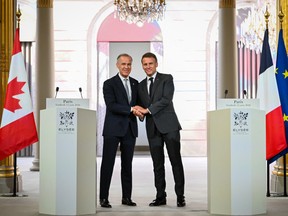
Judging by the reaction within some conservative circles to news that Prime Minister Mark Carney has spent months laying the groundwork for deeper integration with the European Union, one would think he was trying to revive the old Warsaw Pact and cozy up to the despot in Moscow, rather than improve relations with our liberal-democratic allies.
Sign In or Create an Account
While skepticism of the EU’s crushing bureaucracy and lax immigration policies, as well as Carney’s ability to follow through on his ambitions, is certainly warranted, this has the potential to be a huge benefit to Canada.
Regardless of whether you think Carney could have done more to secure a deal with the United States, the fact remains that Canada is now locked into a trade war. U.S. President Donald Trump has shown himself to be an unpredictable and unreliable negotiating partner, violating the agreement he signed during his first term and upending nearly four decades of free trade.

Columnist Jesse Kline keeps you up to date with what’s happening in Israel and the effects of antisemitism on life here in Canada. Friday mornings.
By signing up you consent to receive the above newsletter from Postmedia Network Inc.
A welcome email is on its way. If you don't see it, please check your junk folder.
The next issue of Channel Israel will soon be in your inbox.
We encountered an issue signing you up. Please try again
We should all hope that this is merely a temporary blip in our bilateral relationship. But in the meantime, the correct strategy is to diversify our trading relationship with the rest of the world, so Canadians have access to a wider array of goods and services, and our businesses have the ability to export to other jurisdictions.
At the moment, around two-thirds of our exports head south, a level of concentration that has always posed a risk. Courting the Europeans does not prevent us from rekindling our relationship with the Americans, as international trade and co-operation are not zero-sum games. But it could open a world of possibilities for Canadian governments, businesses, consumers and students, while providing the impetus this country needs to build much-needed infrastructure.
The devil, of course, will be in the details. The EU is a notoriously bureaucratic institution that imposes a high regulatory burden. But the Canadian government is also famous for its bureaucratic inefficiency and overabundance of regulations and red tape. The idea that we’re some sort of bastion of free markets attempting to hold the line against hordes of European socialists is simply unfounded.
Optimally, Canada will be able to strike a deal that won’t require the wholesale adoption of EU regulations, but there should be no doubt that harmonizing some of our existing rules would be a net benefit to everyone involved.
There’s no reason, for example, for Canadians to think that our nutrition-labelling requirements for a box of cereal are so superior that we could not possibly adopt a different standard. If a requirement is good enough for 450-million Europeans from industrialized countries who speak a variety of languages, it should be acceptable to Canadians.
One of Canada’s biggest challenges is that we can’t even get our own provinces to agree on a uniform set of standards, but a process of regulatory harmonization with Europe could provide the impetus we need to finally move the needle. This would serve to facilitate freer trade both within Canada and across the Atlantic.
That increased trade is one of the greatest potential benefits Canada could realize by forging a “unique alliance” with the EU. The combined GDP of Europe’s single market is 18-trillion euros (C$29 trillion), making it the world’s second-largest economy. It’s smaller than the U.S., but no one should expect that we could divert all, or even most, of our exports to Europe.
What we can do is make it easier for companies operating in the EU to sell their wares in Canada, thus putting downward pressure on the cost of living, while increasing Canadian access to European markets, thus offsetting some of the losses from U.S. tariffs.
According to the Wall Street Journal, which broke this story on Saturday, Carney is hoping to build pipelines that would allow Canadian energy to be sent across the Atlantic, effectively creating the “business case” for liquefied natural gas exports that his predecessor, Justin Trudeau, claimed didn’t exist.
The Journal also reported that the prime minister hopes to use icebreakers to clear paths through the Northwest Passage to facilitate the export of Canadian fertilizer and critical minerals. Coupled with a push to increase defence co-operation with our European allies, we could significantly increase our ability to assert sovereignty in the North and work to deter the shared threat posed by an increasingly militaristic Russia.
There are also significant opportunities for Canadian governments and businesses to tap into the sovereign cloud and artificial-intelligence infrastructure being developed in Europe, allowing us to bypass American surveillance and take advantage of Europe’s more stringent privacy laws, while potentially saving taxpayers millions by following the European lead of adopting open-source software in government.
Of course, aligning with the EU comes with its own sovereignty implications. Icelanders recently rejected a bid to seek full membership in the bloc for that very reason, with opponents warning about a loss of control over the country’s fisheries and future trade deals. But Icelanders already enjoy access to Europe’s single market and the Schengen free-travel zone, which is the sort of hybrid relationship Canada seems interested in pursuing.
The trick for Canada will be to try to reap the benefits of the EU without the downsides: to reduce trade barriers without being beholden to Brussels; to make it easier to live, work and study abroad, without importing large numbers of unskilled immigrants who don’t always share our values.
But these things should be possible. And if we do decide to cede some of our sovereignty, at least we will have the ability to debate it beforehand and go into it with clear eyes. This contrasts sharply with recent negotiations with the Trump administration, which has attempted to force Ottawa to change its laws on tariffs, taxes and cultural regulations.
Forging deeper ties with the Europeans is by no means a substitute for trading with the Americans. But nor should we pretend as though Europe is some sort of socialist hellhole akin to North Korea. We’re talking about advanced western countries that share our liberal values and have similar labour and environmental laws. If we’re going to cozy up to anyone, it should be the Europeans.
National Post
jkline@postmedia.com
Twitter.com/accessd
Join the Conversation
This website uses cookies to personalize your content (including ads), and allows us to analyze our traffic. Read more about cookies here. By continuing to use our site, you agree to our Terms of Use and Privacy Policy.
KioskNews shows a cleaned-up reading view extracted from the publisher’s page — the original always lives on their site, not ours.