Chinese vessels block PH operation vs. foreign dynamite fishers near Pag-asa Island
Make this your preferred source to get more updates from this publisher on Google.
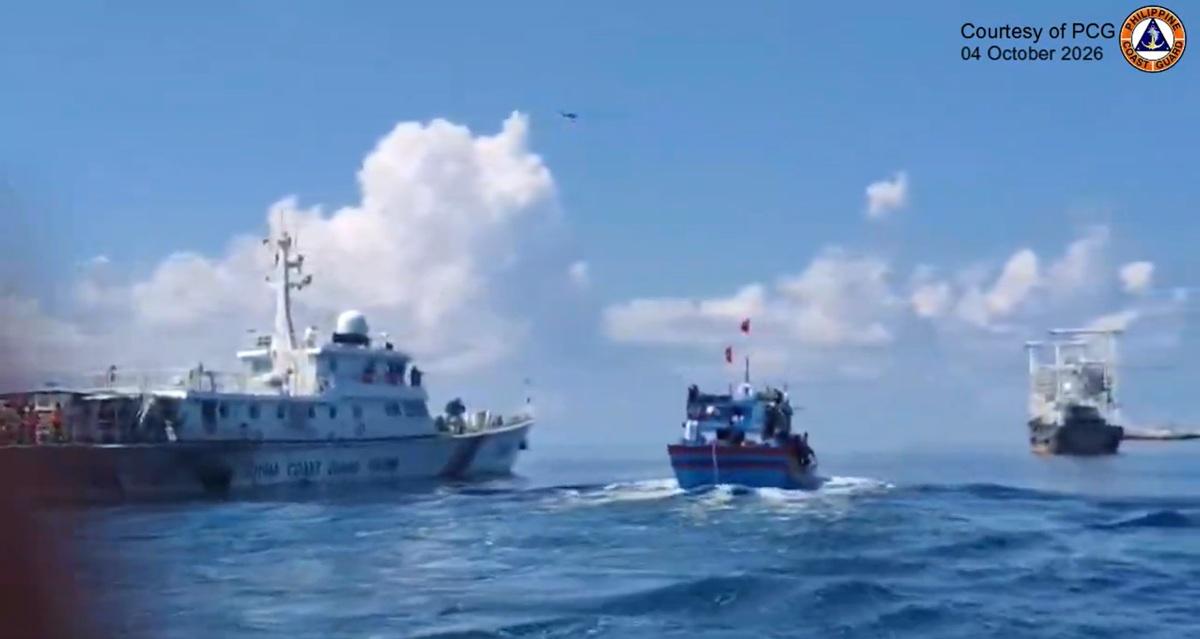
The Philippine Coast Guard said on Sunday Chinese vessels obstructed a law enforcement operation against a foreign fishing vessel suspected of dynamite fishing near Pag-asa Island in the West Philippine Sea.
It described the presence of a Chinese navy helicopter as an "unnecessary act of intimidation." It was the latest in a series of recent maritime confrontations between Manila and Beijing.
The operation involved personnel from the PCG, the Philippine Navy and the Philippine National Police Maritime Group responding to a report of suspected blast fishing near Sandy Cays 2 and 3, about three nautical miles west of Pag-asa.
The PCG said two China Coast Guard vessels sounded their horns, radio-challenged the Philippine team and later shadowed and blocked its boats. A People's Liberation Army Navy helicopter also circled above the Philippine personnel four times.
The Philippine team ordered the foreign fishing vessel to stop and radioed it several times, but the vessel ignored the orders and sailed southwest toward Subi Reef (Zamora Reef), one of seven artificial islands China has built in the Spratlys to support its sovereignty claims.
Philippine authorities ended the pursuit for safety reasons and returned to Pag-asa.
PCG, PN, PNP-MG TEAM RESPONDS TO DESTRUCTIVE FISHING NEAR PAG-ASA ISLAND; CHINA COAST GUARD OBSTRUCTS LAWFUL OPERATION On 04 October 2026, an inter-agency maritime law enforcement team from the Philippine Coast Guard (PCG), the Philippine Navy, including Marines, and the PNP Maritime Group responded to a report of suspected dynamite fishing near Sandy Cays 2 and 3, about three (3) nautical miles west of Pag-asa Island, within the territorial sea of the Philippines. The operation was led by the Coast Guard District Kalayaan Island Group (CGD KIG) under Commodore Gesulgon, under the guidance of PCG Commandant Admiral Ronnie Gil Gavan to carry out whole-of-government maritime law enforcement together with the other uniformed services on Pag-asa Island. Establishing CGD KIG has raised the PCG's presence in the Kalayaan Island Group to a new level. It allows faster response and better sustainment of operations, working closely with the Municipality of Kalayaan and other government agencies. At around 0720H, personnel of the Joint Task Unit Pag-asa saw a foreign fishing vessel apparently doing blast fishing in the area. CGD KIG quickly formed an inter-agency team. The team deployed PCG High-Speed Response Boat HSRB-019, a Philippine Navy RHIB and rubber boat, and a PNP Maritime Group RHIB. The team left the sheltered port of Pag-asa at 0950H. Within minutes, China Coast Guard vessels 5102 and 21581 moved toward its path. They sounded their horns and radio-challenged the Philippine team inside Philippine territorial waters. At around 1000H, the team reached the fishing vessel about 500 meters east-southeast of Sandy Cay 2. The small boats that were reportedly doing the blasting had already returned to the mother boat. The team ordered the vessel to stop and radioed it several times. The vessel ignored these orders and sailed southwest toward Zamora (Subi) Reef. While the team followed the vessel, CCG 21581 shadowed and blocked the Philippine boats. At one point it came within about ten (10) yards of HSRB-019. At 1013H, a People's Liberation Army Navy helicopter (tail number 09) circled over the team four times. At 1023H, about 1.2 nautical miles east-southeast of Sandy Cay 5, the team stopped following the vessel for safety reasons. All personnel returned safely to Pag-asa at 1048H. Dynamite fishing destroys coral reefs and the fish stocks that Filipino fishermen in the Kalayaan Island Group depend on. It is prohibited under the Philippine Fisheries Code. The PCG stresses that this was a routine law enforcement operation against an illegal and destructive practice. It was not directed at any country. The incident will be documented and referred through the Department of Foreign Affairs for appropriate action through existing channels. The China Coast Guard has no law enforcement authority in the territorial sea of Pag-asa Island. By obstructing Philippine authorities, the CCG did not protect the marine environment. It made it easier for a suspected violator to escape. The deployment of a PLA Navy helicopter over a civilian law enforcement operation in Philippine territorial waters is an unnecessary act of intimidation. Any claim that the CCG "handled" the situation or "expelled" Philippine vessels is false. The PCG, together with the Philippine Navy and the PNP Maritime Group, will continue to enforce Philippine laws and protect the marine resources around Pag-asa Island and the Kalayaan Island Group. This mission is in accordance with the guidance of President Ferdinand R. Marcos Jr., who has called for firm national resolve in defending what is ours and for responsible stewardship of the country's marine resources.
— Jay Tarriela (@jaytaryela) October 4, 2026
The PCG said the China Coast Guard had "no law enforcement authority" in the territorial sea of Pag-asa and said its actions "made it easier for a suspected violator to escape." It also rejected any Chinese claim that its vessels had been expelled from the area.
At just 37 hectares (0.14 square miles), the coral-fringed Pag-asa is the largest and most prized of the nine Philippines-held features in the Spratly archipelago, located 450 km (280 miles) from the mainland.
Separately, the military said a Chinese J-16 fighter jet repeatedly approached and maneuvered close to a Philippine patrol aircraft over the disputed Scarborough Shoal on Saturday, creating an aviation safety risk.
The Armed Forces of the Philippines said the incident was part of a "recurring pattern of unsafe and coercive behavior" against Philippine vessels and aircraft conducting lawful operations.
The Chinese Embassy in Manila did not immediately respond to a request for comment on the weekend incidents. — Reuters
KioskNews shows a cleaned-up reading view extracted from the publisher’s page — the original always lives on their site, not ours.