Soldier indicted for disobeying orders about sleeping
By Hsu Kuo-chen and Fion Khan / Staff reporter, with staff writer


The Taichung District Prosecutors’ Office has indicted a soldier on a charge of disobeying orders after he allegedly refused to go to sleep or get out of bed, seeking a heavy sentence.
The soldier, surnamed Lee (李), assigned to the 302nd Infantry Brigade at the Chenggong Ling (成功嶺) training depot in Taichung, was suspended on July 4, prosecutors said.
Lee allegedly struggled to adapt to military life and repeatedly disobeyed orders from his superiors, investigators found.
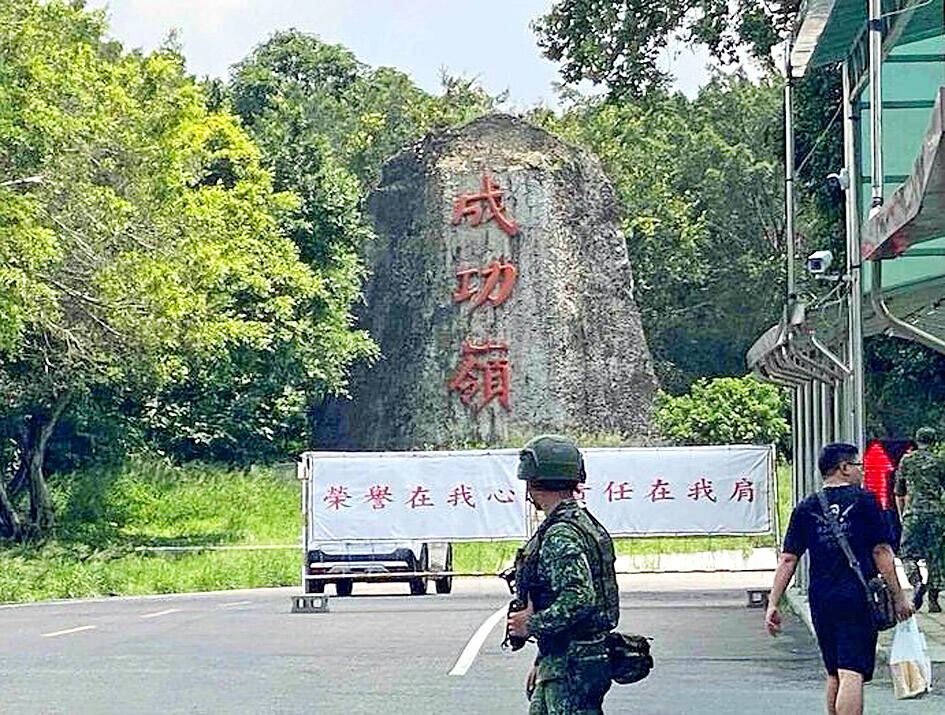
The Chenggong Ling military training depot in Taichung is pictured in an undated photograph.
Photo:Taipei Times
At about 10pm on May 3, he allegedly refused to go to bed at lights-out after being told to do so by his company commander, surnamed Lin (林), and was eventually carried bodily to the dormitory by other soldiers.
The following morning, he ignored orders issued by Lin to get up, sleeping in until 9:30am, the indictment said.
Lee allegedly disobeyed orders issued by his commander within the scope of his authority and related to military duties on two consecutive occasions within a short period, prosecutors said.
The alleged conduct went beyond his daily routine, involving military discipline and the chain of command, they said.
Lee had admitted the offenses, prosecutors said, adding that testimony from Lin and other officers supported the allegations and there was sufficient evidence to prosecute.
Lee was charged under the Criminal Code of the Armed Forces (陸海空軍刑法) with disobeying orders issued within the scope of authority regarding military affairs.
The case, referred for investigation by the Taichung military police of the Military Police Command, had a serious impact on unit discipline and the authority of the commanding officer, prosecutors said, requesting the court impose a heavy sentence.
When asked for comment, lawyer Lee Hsueh-yung (李學鏞) said on Saturday that soldiers are obliged to obey lawful, clear orders issued by superiors within their authority and concerning military matters.
Under Article 47-1 of the Criminal Code of the Armed Forces, anyone who disobeys an order issued by higher authorities or within the commander’s powers faces a sentence of up to five years in prison, he said.
The punishment for disobeying orders is not limited to disciplinary action, such as demerits or confinement to base, but can lead to criminal prosecution, he said.
Not every instance of disobeying orders constitutes the crime of disobedience, he said.
Orders involving ordinary day-to-day matters would not necessarily fall within the scope of criminal law, he said.
The key issues are whether the order was issued with the superior’s authority, whether its content was clear and whether it concerned military matters, he said.
The issue in this case is whether the orders to “return to the dormitory and go to bed” and to “get up” constituted orders related to military duties, unit routines and military management, he said.
Based on the indictment, the soldier did refused to obey more than once, and he continued to disregard the company commander’s orders despite being repeatedly instructed to comply, he said.
Both incidents involved disobedience of orders issued by a superior within the scope of the officer’s authority and related to military matters, he said.
The court would consider factors including the frequency of violations, degree of defiance, impact on discipline, and the defendant’s attitude after the offenses, he said.
Last year, a soldier was sentenced to three months in prison, commutable to a fine of NT$90,000, for allegedly twice ignoring a sergeant major’s orders to put away his mobile phone during an inspection at Penghu Defense Command. The court ruled that while it was not a direct combat order, it concerned military affairs, leaving the soldier with no right to refuse to comply.
KioskNews shows a cleaned-up reading view extracted from the publisher’s page — the original always lives on their site, not ours.