‘They were keeping it for a rainy day’: Ukraine’s Kerch bridge attack is proof Kyiv still has cards to play
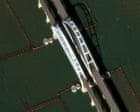
Ukraine’s attack on the Kerch road bridge overnight is the culmination of weeks, and perhaps months, of military operations plus years of industrial development, during which Kyiv has developed its own cruise missiles and long range drones.
The demolition is not quite total, because the rail bridge is still standing, one line in operation – but the attack is an obvious embarrassment to Russia two days before Vladimir Putin is due to meet Donald Trump and Xi Jinping in Shenzhen.
The collapse of a span of the roadway and the loss of its supporting arch above appears to be a level of damage that “cannot be repaired any time soon,” says Ben Hodges, a former commanding general of the US army in Europe.
The 19km (12 mile), $3.6bn (£2.7bn) road bridge connecting Russia to the east of Crimea was completed in 2018, a project closely associated with Putin and his efforts to secure the 2014 annexation of Crimea by opening up a supply route to the peninsula.
The Russian leader was filmed driving an orange truck into Crimea, greeted by cheering workers once the construction was complete. “Putin initiated this project himself,” the Kremlin spokesperson, Dmitry Peskov, said at the time.
That was four years before Putin’s full scale invasion of Ukraine, which has, if anything, made Russia’s position in Crimea more precarious, though the change in the balance of power is a while coming.
Russia was able to bomb anywhere in Ukraine in 2022, while Kyiv was denied long range western missiles, particularly those powerful enough to strike such a politically sensitive and strategic target.
Instead, Ukraine tried to blow the bridge up with a truck bomb in 2022 and a sea drone attack a year later. Neither did much long term damage. It was only as Ukraine’s own long range drones and cruise missiles came to fruition near the beginning of 2026 that a knockout strike became possible.
Volodymyr Zelenskyy said on Tuesday that the culminating attacks on the bridge, the end of two days of strikes, involved Ukrainian made Neptune and Flamingo FP-5 cruise missiles, Palianytsia rocket drones plus Ruta cruise missiles from the Dutch manufacturer Destinus, the only foreign arms company confirmed as involved.
It was, the Ukrainian president said, the “seventh stage” in an operation “carried out over several weeks”. Radars, jamming equipment and air defence systems were progressively neutralised, opening up corridors of attack.
Meanwhile, Russia had already started what is becoming a battle of the bridges. Moscow attacked Kyiv’s busy Northern and Southern bridges in early October, part of its scaled up campaign against the capital and the country’s other large cities.
Russia is struggling to make progress on the frontline, and a record 50,000 troops were killed or seriously wounded in October, according to the Nato secretary general, Mark Rutte. Its efforts are focused on knocking out Ukraine’s electricity, heating and water supplies, though attacking bridges show its target list is expanding in grim desperation.
Yet the Kremlin has chosen this expansion at a time when Ukraine can strike back. The pro-war Russian military blogger Military Informant notes that Ukraine has a “parity in firepower”, having downed the Kerch road bridge in two days of air raids. “It cannot be ruled out that the railway section will be destroyed next,” the blogger adds.
If anything, further attacks on the bridge are almost certain both to prevent its repair and to make resupplying Crimea more difficult. Cutting the bridge entirely, rail and road, would leave Moscow with only the R-280 land highway from Rostov to Crimea, already the subject of months of Ukrainian drone attacks.
Hodges has long argued that Crimea could be a defining theatre of the war, because “of what Crimea represents to Putin”. Ukraine should try to make “Russian occupation untenable” by destroying the bridge and asserting fire control over the R-280, he adds.
A supply squeeze, however, is a slow process, though its political benefits may be felt more quickly. Bringing down the road bridge “further kills the narrative that Russian victory is inevitable or that Crimea is theirs”, Hodges says, although Trump may not bring up the episode in his meeting with Putin and Xi on Thursday.
The danger is that both sides, in their desperation to end a deadlocked war, will escalate further. However, cut out of the talks in Shenzen, Zelenskyy had little choice but to remind Trump as well as Putin that Ukraine still has cards to play.
Emily Ferris, a Russia expert with the Rusi thinktank, says that Ukraine’s military-industrial complex was ready for some months, meaning the timing of the attack on the Kerch bridge can be interpreted only as political.
“They were keeping it for a rainy day, and that day has come,” she said.
KioskNews shows a cleaned-up reading view extracted from the publisher’s page — the original always lives on their site, not ours.