Europe’s cost-of-living protests hold a mirror to Asean — Phar Kim Beng
OCTOBER 20 — Europe is living through a period of mounting social anxiety. Recent protests in France, Portugal and Italy have centred on housing, wages, living costs and strained public services. They were not coordinated and should not be read as a single movement, nor should peaceful mobilisation be confused with the violence of smaller groups.
Yet together they raise a question that reaches beyond Europe: what happens when an economy looks sound on paper while its citizens feel increasingly insecure? Asean has a direct stake in Europe’s stability. Asean–EU trade in goods reached €274.9 billion in 2025. But the deeper lesson concerns the relationship between economic performance and political consent. Governments cannot take public confidence for granted when improvements in national indicators fail to translate into greater security at home.
In France, anger over public services has broadened into a wider challenge over living standards. School protests over teacher shortages and deteriorating conditions spread into nationwide demonstrations over inequality, public spending and rising costs. The political difficulty is straightforward: governments measure fiscal prudence through budgets and borrowing, while families judge it partly by whether a classroom has a teacher.
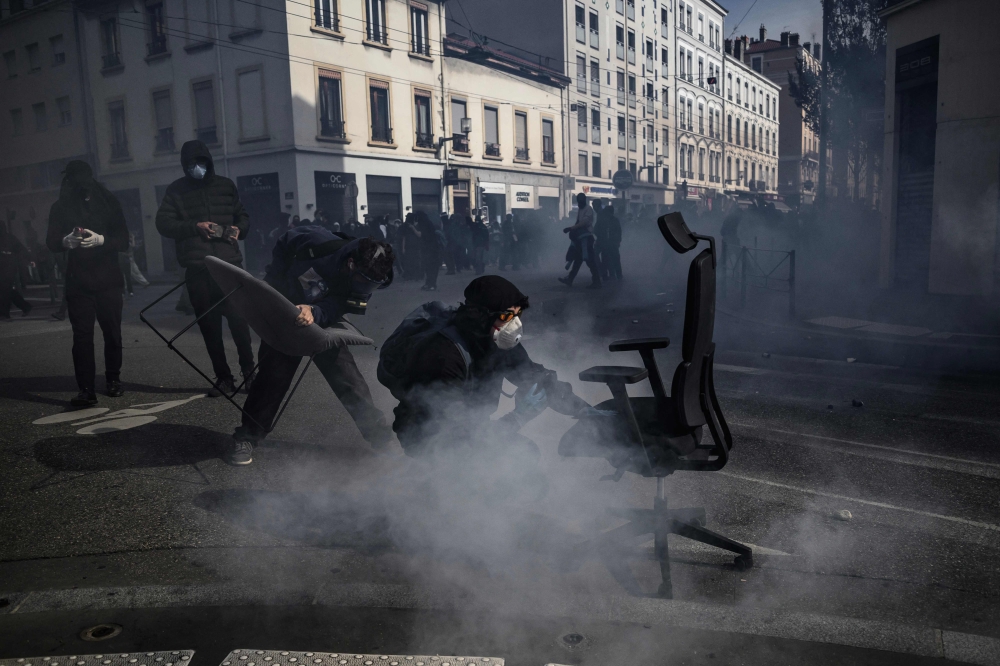
Demonstrators stand amid tear gas with fired by riot police during a high-school students protest as part of a nationwide protest movement over learning conditions in Lyon on October 13, 2026. — AFP pic
This does not mean fiscal constraints can be ignored. It means that decisions about spending are also decisions about the services through which citizens experience the state. A government may improve its fiscal position while weakening public confidence if the adjustment leaves essential services visibly worse.
In Portugal, housing affordability exposes a similar gap between national economic performance and household security. Tens of thousands marched through Lisbon on October 17 against rising living costs and unaffordable housing, while protesters also established tent encampments to demand action. House prices have more than doubled since 2017, and rents on new leases have nearly doubled.
Portugal’s attraction to tourists, investors and mobile professionals has not necessarily made its cities more livable for existing residents. When housing supply fails to meet local needs and property prices outpace domestic wages, international success can deepen insecurity rather than relieve it. A city can become more attractive to the world while becoming less accessible to its own people.
In Milan, a march against war and rising living costs began peacefully before groups broke away, clashed with police and looted shops around Piazza del Duomo. Such violence should be condemned without being allowed to erase the grievances of peaceful demonstrators. Nor should the prosperity of a major financial and commercial centre be mistaken for security shared by all its residents.
External shocks are intensifying these domestic pressures. The conflict involving the United States, Israel and Iran has disrupted energy supplies and shipping through the Strait of Hormuz. The European Union imports about 80 per cent of the gas it needs, leaving households and industry exposed to international supply disruptions and price increases. Insecurity along the Red Sea route adds risks to shipping between Asia and Europe.
These shocks did not create Europe’s housing shortages or public-service grievances. They aggravate existing strains. Higher energy and transport costs reach citizens through electricity bills, petrol prices and supermarket purchases, while governments face renewed demands for assistance. Households already struggling to cover essentials have little room to absorb another increase.
Asean is exposed to the same external pressures. The region is a net oil importer, and its petroleum-security framework recognize the importance of reliable and diversified supplies. Energy and freight disruptions can raise production costs for South-east Asian firms even as pressure on European households threatens demand for their exports.
Europe’s domestic difficulties could also complicate its external economic agenda. Governments facing demands to protect jobs and purchasing power may find some trade compromises harder to defend. But this is not an inevitable retreat: both Europe and Asean retain strong incentives to diversify markets and deepen economic ties. The practical task is to sustain cooperation while preparing for a less predictable trading environment.
The more uncomfortable lesson, however, lies within Asean itself. Europe’s predicament should not invite triumphalism. Housing affordability, insecure employment and uneven access to public services are not exclusively European concerns.
Malaysia’s housing debate illustrates the point. Local incomes and housing prices do not always align, and national averages can obscure substantial differences between places and households. A buoyant property market is not, by itself, evidence that ordinary families can afford a suitable home. Local household incomes should guide public-housing prices, while new homes should connect residents to jobs and public transport. A lower purchase price offers little relief if the savings are swallowed by commuting costs.
Household security also depends on the region’s ability to withstand external disruptions. Asean renewed its petroleum-security agreement in 2025, and member states have recently advanced cooperation on the Asean Power Grid. Putting these commitments into practice requires clearer emergency supply-sharing arrangements, coordinated stockpile planning and investment in cross-border electricity connections.
Regional cooperation must be matched by support for households when prices spike. Governments should prepare targeted transfers and protect affordable transport and basic services before a crisis forces them into improvised relief.
Europe’s governments must maintain order while protecting the right to peaceful protest. Their harder task is restoring confidence that economic adjustment will not repeatedly fall on those least able to bear it.
Malaysia and Asean should read these protests as a warning, not a spectacle. Growth, investment and openness remain important, but their political durability depends on whether citizens can see a place for themselves in the prosperity they generate. Economic resilience requires more than sound national accounts. it requires households that can withstand disruption without losing confidence in their future.
* Phar Kim Beng, PhD, is Professor of Asean Studies at the International Islamic University of Malaysia and Director of the Institute of International and Asean Studies (IINTAS), while Dr Vic Li is a Lecturer in East Asian Studies at the University of Sheffield, United Kingdom.
** This is the personal opinion of the writer or publication and does not necessarily represent the views of Malay Mail.
KioskNews shows a cleaned-up reading view extracted from the publisher’s page — the original always lives on their site, not ours.