Negotiating Portraits as Sites For Identity and Selfhood in Luchong’s Portraiture
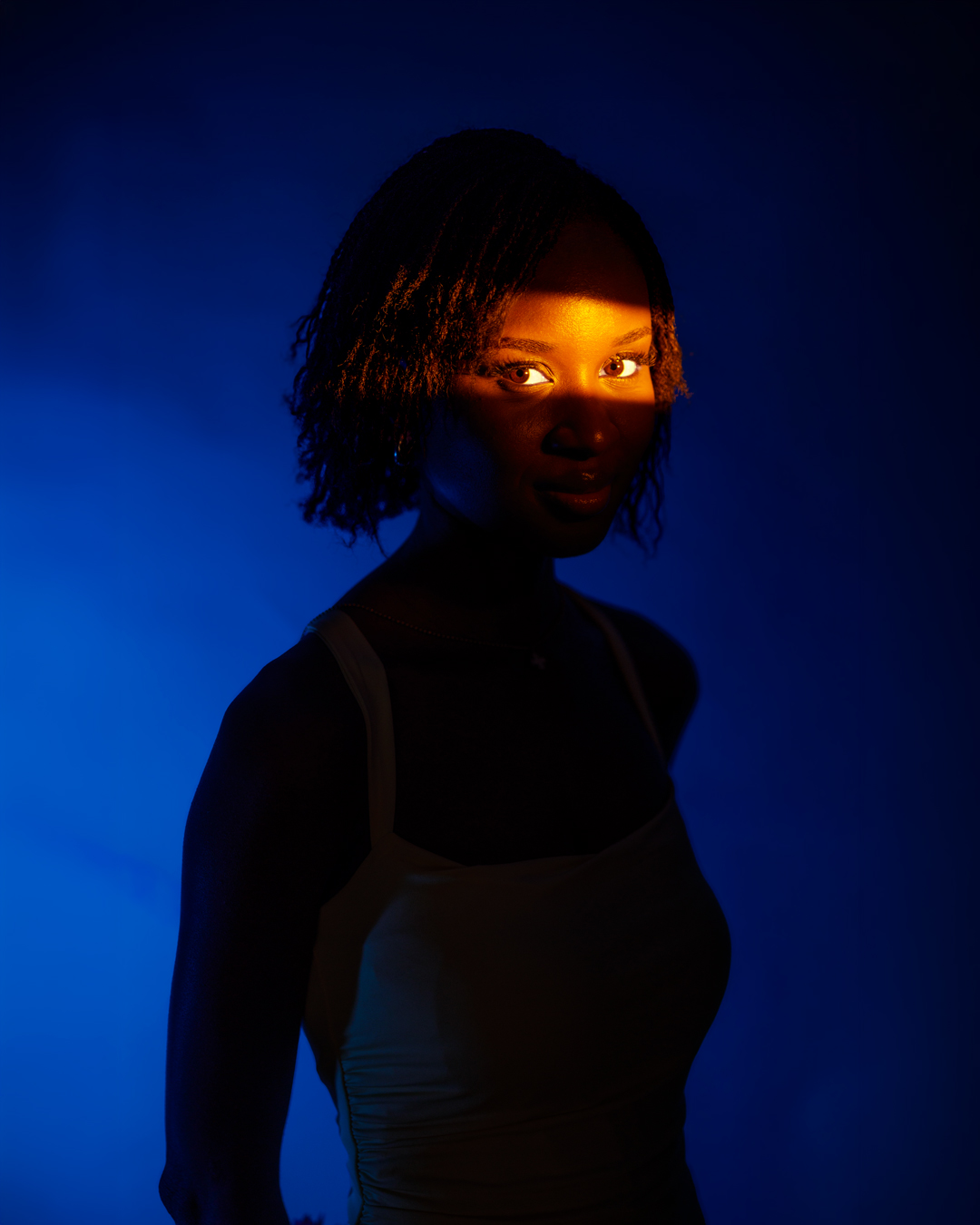
Gladys John, aka Luchong
Nigerian-born, Los Angeles-based artist Njideka Akunyili Crosby describes portrait photographs as an opportunity for the sitter to “curate and show the world who they were (or desired to be).” Her observation points to the agency of the person being depicted. The sitter is not simply being looked at; they also decide, or are allowed to decide, how they will appear.
Rendering this multiplicity on canvas is a deliberate, delicate skill that Gladys John, a multidisciplinary artist working under the name Luchong, has developed with remarkable precision. Through colour, line, texture and pattern, she explores the complexities and dualities of the self. Her paintings operate like nested poems: inside the colour is a face, inside the face is an eye, and inside the eye is an interior world of emotion and experience. Their pleasure lies partly in this invitation to look beyond what is immediately apparent. Her portraits become sites where identity is presented, interpreted and reshaped through the act of looking.
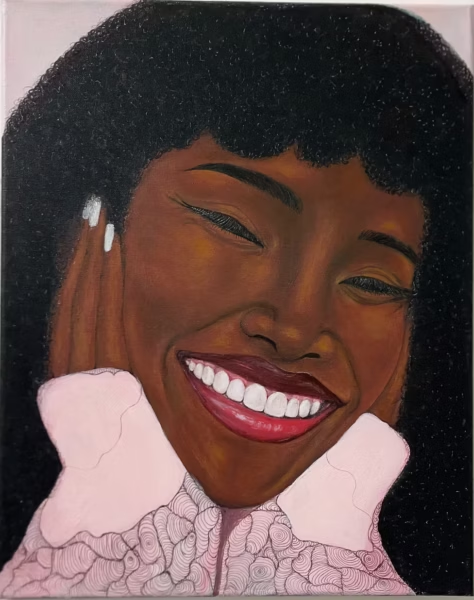
Does My Smile Make You Uncomfortable? by Luchong
In Does My Smile Make You Uncomfortable? (2026), the smile gets you first. Then, if you stay, other details interrupt it. The hair and eyebrows are textured, recognisably Black and African, while the patterned garment is marked by lines that resemble cracks. You begin to wonder what you are witnessing. Is it Black girl joy, a victory laugh or laughter covering trauma? The painting refuses to settle the question. Your interpretation completes it. Though you are looking at a face, nothing about it can be taken at face value.
The same tension appears in Keep Me Safe (2026). Two women occupy the frame, one behind the other. They appear close and relaxed; they could be sisters or friends. At first, their bodies convey warmth. Then you notice their eyes and the mood shifts. Their gazes are direct but guarded, as if they are trying to decipher something beyond the visible frame. Luchong’s portraits make room for the contradiction that a face can hold tenderness and suspicion, intimacy and distance, safety and fear at once.
Luchong is equally attentive to what surrounds the body. In Repair, blue is not simply applied to the canvas; it becomes cloth, rendered through ruffles, folds and texture. Her attention to clothing, hair, jewellery and other adornments gives these materials a life of their own. The body is never isolated from the world that shapes it. Through acrylic on canvas, Luchong demonstrates a remarkable command of skin tone and colour, while her attention to the body’s surface repeatedly leads us towards what lies beneath it.
Her paintings strike an intriguing balance between realism and surrealism. The figures are recognisable and materially present, while the emotional worlds around them are almost fluid. Realism grounds them in bodies, clothing, culture and community; surrealism opens these forms onto inner lives that cannot be fully explained by appearance.
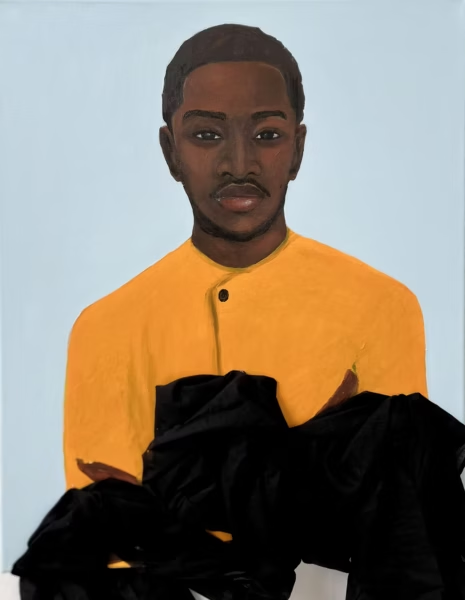
Na Man Yo Be No Mean Say E No Pain You by Luchong
In Na Man Yo Be No Mean Say E No Pain You, she paints a masculine figure whose expression complicates the familiar performance of masculinity. The figure is allowed to appear as someone who can feel, hurt and remain unresolved. Vulnerability finds a place within masculinity without stripping the body of its strength.
Then there is A Book on Manipulation, in which five figures pose for what initially appears to be a family portrait. The image is beautiful at first glance, and that cultural beauty almost distracts you. You want to know their tribe, the story that brought them together and what connects them. Then you look at their faces, and the group begins to come apart. They are not feeling the same thing. Each face carries its own tension, suggesting a story that cannot be contained by the arrangement of the bodies. Each figure has a lore.
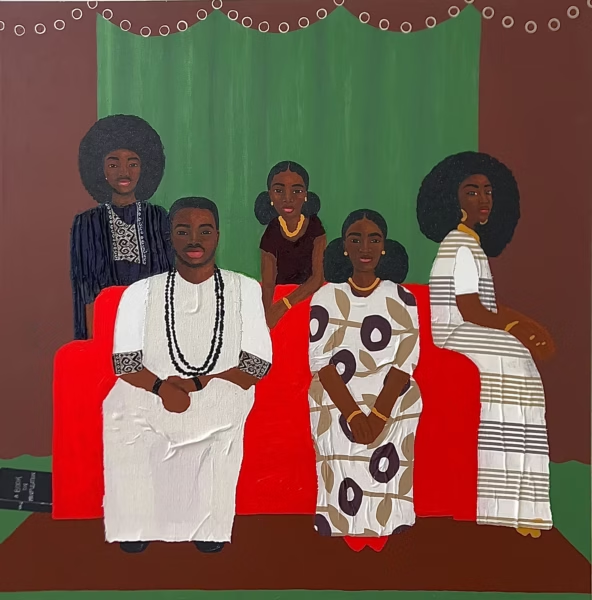
A Book on Manipulation by Luchong
This attention to the figure places Luchong’s work in conversation with other Nigerian artists who have made Black bodies, particularly Black women, central to their practices. Like Renike Olusanya, she works with vivid colour and expression, paying close attention to hair, clothing, bodies and self-presentation. There are also points of contact with Chigozie Obi, whose work draws from women’s everyday experiences, Igbo culture and the preservation of ordinary, intimate moments. What connects these practices is sustained care for the figure and the world around it; a commitment to representing Black women with complexity, tenderness and agency.
Luchong is fundamentally a storyteller because the figures she paints possess lives that begin before the painting and will continue after the viewer leaves. It is therefore fitting that her work has moved naturally into conversation with poetry.
Her duo exhibition Before I Learned to Hide, presented with poet Faith Moyosore Agboola at St Margaret’s Gallery in Norwich, brought a seamless juxtaposition of visual art and poetry. Leonardo da Vinci famously described painting as “poetry which is seen and not heard” and poetry as “a painting which is heard but not seen,” but I think Luchong’s work complicates this distinction. Her paintings ask to be seen, and they also invite us to imagine what cannot be seen or heard. You can almost hear the jewellery clanging, imagine fabric ruffling against the body or sense the quiet between two figures. Her paintings possess a kind of visual onomatopoeia; they make the unseen audible in the imagination.
This attention to interior life extends to her self-portraits. In her solo show Woman Like Me, aspects of the self return through the images. The woman in Luchong’s paintings is not simply a subject being observed; she is also someone constructing an image of herself. The self-portrait becomes another negotiation between seeing and being seen.
At the risk of sounding precious, Luchong’s mastery of expression recalls the mythology surrounding the Mona Lisa: the idea that her eyes follow you around the room and that her expression changes depending on where you stand. Luchong’s paintings do not change as you move around them. You do. The longer you witness the painting, the more unstable your first interpretation becomes. Her figures allow themselves to be seen without surrendering themselves completely to the viewer.
Luchong’s most significant achievement may be that, in a world increasingly shaped by speed, scrolling and shortened attention spans, she has laboured her time to create art that will always hold your gaze.
All rights to artworks, culled from the website, belong to Luchong.
KioskNews shows a cleaned-up reading view extracted from the publisher’s page — the original always lives on their site, not ours.