5 Classic Books That Are a Masterclass in Prose


Linda Chavers is a writer, cultural critic, and longtime consumer of stories in just about every form they come in. Her essays have appeared in The Boston Globe Magazine, The LA Times, The Independent, Elle, and
(the now sadly defunct) Gawker Media.
Linda can turn almost anything—from a novel to a reality TV reunion—into an argument. That's because she's opinionated about anything she gets to stay in pajamas for. It's also because she holds a Ph.D. in African and African American Studies from Harvard University, where she specialized in modern literature. She has taught at Harvard University and Temple University.
Her tastes are wide-ranging. She loves literary fiction, popular culture, reality television, and Law and Order marathons.
When she's not writing, or avoiding writing by thinking very seriously about writing, Linda is usually reading a novel or trying to remember which show she watched on which streaming app she's still subscribed to.
Sign in to your Collider account
There are books with good stories, and then there are books where the sentences themselves make you stop. Maybe you reread a paragraph because you missed something the first time; maybe you reread it because you didn't. Either way, great prose makes the language feel inseparable from the story being told.
These five classics all do that differently. Toni Morrison turns memory into flesh, Ralph Ellison gives us a voice constantly negotiating how it is seen, Charlotte Brontë turns interior life into high drama, Truman Capote makes nonfiction move like a novel, and Gabriel García Márquez writes the impossible as though it were simply another Tuesday. If you want to understand what prose can actually do, start here.
'Beloved' (1987)

Toni Morrison tells us almost everything about Beloved in eight words: "124 was spiteful. Full of a baby's venom." There is a haunted house, an angry dead child, and not a single attempt to ease us into either one; she gives a physical location emotions before we even know who lives there. Morrison writes about slavery the same way — not as something that began and ended but as a living, ongoing remembrance. Sethe's past at Sweet Home keeps breaking into her new life in Ohio through memories, bodies, ghosts, and eventually Beloved herself. The story arrives in pieces, sometimes before we understand what we are being told, because Sethe doesn't experience her own history in a clean chronological order either. By the time we understand why 124 is spiteful, the novel has already made the past feel very much alive.
Morrison's prose is so extraordinary because it is almost always beautiful and brutal all at once. Her sentences move through memory sideways, again and again, incompletely, and usually without warning; one word will open a door Sethe has spent years trying to keep closed, and Morrison often trusts us to follow without stopping to explain the way. Even "rememory," Morrison's word for a memory that seems to exist outside the person remembering it, turns trauma into something almost physical that another person could stumble into. She moves from lyrical description to horrific violence without changing registers, leaving the reader without any comfort of pretending those things belong to separate worlds. Beloved does not only tell us that slavery survives in the people who lived through it; Morrison builds that survival into the way the sentences themselves behave.
'Invisible Man' (1952)

This book gets you from the first sentence, because Ralph Ellison's unnamed narrator introduces himself by insisting on the impossible: "I am invisible, understand, simply because people refuse to see me." He is funny, angry, astutely observant, painfully self-conscious, and politically useful to almost everyone he meets, whether he is being humiliated at the Battle Royal, working at Liberty Paints, or speaking for the Brotherhood. The more he tries to become the version of himself each room rewards, the less anyone seems interested in the actual person standing there. Even the metaphor of invisibility keeps changing as he understands more about who is looking at him and why.
What makes Invisible Man such a masterclass in voice is how intimately the narrator engages with us while still figuring himself out. Even that little "understand" in the famous line matters: this is no passive stance he's taking. He's immediately and directly grabbing you by the collar and insisting that we participate in recognizing it. He sounds like he is telling you a secret, arguing with you, performing for you, and sometimes laughing at the person he used to be, and in the same stretch of prose. Ellison moves from satire to rage to surrealism to political argument without losing that intensely close first-person voice, while language itself becomes part of the trap because speeches make the narrator visible to a crowd and simultaneously turn him into whatever symbol that crowd needs. By the end, invisibility has almost nothing to do with literally being unseen; it's what happens when everyone looks directly at you and only sees themselves.
'Jane Eyre' (1847)

I think Jane Eyre was my first "oh wow!" read as a kid, and what I remember most is not Rochester, Thornfield, or even the woman in the attic. I remember Jane. Charlotte Brontë gives a poor, plain, orphaned girl the kind of interior authority nineteenth-century literature was not exactly handing out freely, and Jane uses every bit of it. When Rochester tries to contain her, she answers, "I am no bird; and no net ensnares me; I am a free human being with an independent will." The sentence itself refuses containment: one declaration pushes into its next iteration until Jane has talked herself all the way from metaphor to a plain statement of freedom.
That's why Brontë's prose feels so immediate nearly two centuries later. Jane turns a conversation into an existential crisis because the real drama is whether she will betray herself to get something she desperately wants, and Brontë lets us consider every bit of the argument. Jane also talks directly to the reader, collapsing the distance between the girl experiencing the story and the woman who survived long enough to tell it, giving the novel an intimacy that feels startlingly modern. Even when the novel gets wildly Gothic, the prose keeps returning us to one stubborn consciousness asking what she owes herself. Love is important, but so is dignity, and Jane does not simply want Rochester; she wants him without having to disappear inside him.
Collider Exclusive · The Sorting Hat Awaits Which Hogwarts House Are You? Gryffindor · Slytherin · Hufflepuff · Ravenclaw
Four houses. One destiny. The Sorting Hat has considered thousands of students — now it's your turn. Answer honestly and discover where you truly belong at Hogwarts School of Witchcraft and Wizardry.
🦁Gryffindor
🐍Slytherin
🦡Hufflepuff
🦅Ravenclaw
01
What quality do you value most in yourself? Answer as honestly as you can — the Hat always knows.
02
A friend is being treated unfairly. What do you do? How you protect others says everything about who you are.
03
What does success look like to you? What you're working toward defines who you're becoming.
04
What is your greatest fear? Fear is the most honest thing about a person.
05
The rules say no. Your gut says go. What do you do? Every institution has rules. What you do with them is a choice.
06
What kind of friend are you? Who you are to the people you love is who you really are.
07
You look into the Mirror of Erised. What do you see? The mirror shows the deepest desire of your heart.
08
The Sorting Hat pauses. It whispers: "You could do well in any house. But what matters most to you — truly?" This is your tiebreaker. The Hat always listens.
The Sorting Hat Speaks Your House Has Been Chosen
After careful deliberation, the Sorting Hat has made its decision. This is the house your values, your instincts, and your particular way of being in the world were made for.
🦁 Gryffindor
You have nerve. Not the reckless kind, but the deep, quiet courage that shows up even when you're terrified — especially then.
- Gryffindors don't act because they're fearless — they act because they understand that some things are worth being afraid for.
- You stand up for people when it would be easier to look away.
- You charge toward what's right even when the odds are terrible.
- Harry, Hermione, Ron — the heroes of Hogwarts's greatest chapter — all called the tower with the scarlet and gold home. And now, so do you.
🐍 Slytherin
You are driven, sharp, and utterly clear-eyed about what you want and how to get there.
- Slytherin has long been misunderstood — painted as the house of villains when it is, at its best, the house of those who refuse to accept limits placed on them by others.
- You are resourceful, strategic, and you play the long game.
- You know your worth. You protect your own fiercely.
- The dungeon common room with its view of the Black Lake is yours — and the ambitions that will take you further than anyone expects are yours too.
🦡 Hufflepuff
You are the kind of person that makes the world genuinely better just by being in it.
- Hufflepuff is not the "safe" house or the "leftover" house — it is the house of those with the greatest heart and the most unwavering integrity.
- You show up. You work hard. You don't need glory or recognition — you do what's right because it's right.
- Your loyalty never wavers, even when tested.
- Nymphadora Tonks, Cedric Diggory, Newt Scamander — some of the wizarding world's finest. And now you join them.
🦅 Ravenclaw
Your mind is your greatest gift, and you've always known it.
- Ravenclaws are the thinkers, the questioners, the ones who find a puzzle irresistible and a good book better company than most people.
- Ravenclaw is not merely about intelligence — it's about the love of learning, the pursuit of truth, and the rare courage to admit you don't know something yet.
- You see the world with unusual clarity and depth.
- Luna Lovegood, Filius Flitwick, Rowena Ravenclaw herself — all extraordinary, all original. And so are you.
'In Cold Blood' (1966)

If you listen to any of the hundreds (thousands, even?) true-crime podcasts out there, this is the book to be thankful for. Truman Capote does not begin In Cold Blood with blood, but with geography: "The village of Holcomb stands on the high wheat plains of western Kansas, a lonesome area that other Kansans call 'out there.'" "Lonesome" and "out there" do a lot right away before anything has happened, making Holcomb feel isolated enough for pending danger while still sounding like an ordinary place people know and name casually (it's giving Dateline's Keith Morrison welcoming us to a lovely town with secrets to hide). Before the Clutter family is murdered, Capote makes us see the place where they live, see how isolated it feels, and how ordinary everything can still look when terrible things happen within it. There is no mystery about who committed the crime because we spend much of the book following Perry Smith and Dick Hickock; instead, Capote builds real suspense by letting us know in detail where everybody is headed while the people inside the story keep moving toward it.
Capote intentionally described the book as a "nonfiction novel," and that contradiction matters. He uses scene, pacing, shifting perspectives, dialogue, landscape, and tiny domestic details with the confidence of a novelist, except these people were real and four of them were murdered. A perfectly ordinary detail turns ominous when we know something the person inside the scene does not, and that dramatic irony does an enormous amount of work: the calmness of the prose makes the violence worse. Capote does not need to tell us that something is sinister because we bring that knowledge into every description ourselves, which is exactly why a quiet Kansas landscape can feel threatening before a crime has even occurred on the page. There are legitimate questions about where he blurred fact and reconstruction, but In Cold Blood permanently changed what narrative nonfiction could sound like, and true crime has been borrowing from it ever since.
'One Hundred Years of Solitude' (1967)

Gabriel García Márquez can make you accept almost anything. A plague of insomnia spreads through a town, ghosts stop by, a woman ascends into heaven while folding laundry, and nobody seems especially interested in stopping the story to explain any of it. Early in One Hundred Years of Solitude he writes, "The world was so recent that many things lacked names, and in order to indicate them it was necessary to point." I just love the ridiculous confidence of "the world was so recent": Márquez compresses mythology, history, and childhood into five simple words and just keeps it moving as if he's explained something perfectly reasonable. That sentence alone tells you the rules of Macondo: this is a place where reality itself still feels unfinished, and Márquez describes the impossible with the same level of alarm he might use to tell us who made tonight's dinner.
Which is how magical realism works. Márquez gives war, sex, death, politics, ghosts, miracles, household chores, and entire generations of family lore the same narrative confidence, so the extraordinary and the mundane are rarely opposites. His sentences stretch across years and never lose their rhythm, piling event upon event until time feels less like something folding back over itself. The Buendías repeat names, desires, mistakes, obsessions, and histories so often that keeping track feels like madness. And then you realize repetition isn't a bug in the novel, it is the central feature. By the end, even the prose is trapped in the same cycle as the family, and the way the story is told has become impossible to separate from what the story means.
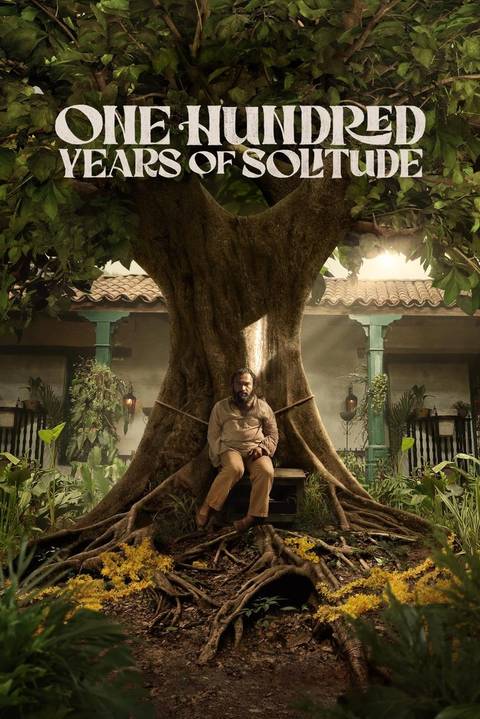
One Hundred Years of Solitude
10 10
- Release Date
- 2024 - 2026-00-00
- Network
- Netflix
- Directors
- Laura Mora, Alex Garcia Lopez, Carlos Moreno
- Writers
- Jose Rivera
-

Gino Montesinos
Melchiades the Alchemist
-
Claudio Cataño
Colonel Aureliano Buendía
One Hundred Years of Solitude (2024): Based on Gabriel García Márquez's acclaimed novel, the series chronicles the multi-generational story of the Buendía family in the fictional town of Macondo. As magical realism intertwines with historical events, the family's triumphs and tragedies reflect broader themes of love, power, and destiny.
KioskNews shows a cleaned-up reading view extracted from the publisher’s page — the original always lives on their site, not ours.