Adventures in Streaming: What to watch if you’re in your hostage era
Historically, the ‘70s was the era of the hostage, including the kidnapping of Patty Hearst (1974), the attempted bank robbery in Stockholm that supposedly birthed the concept of Stockholm Syndrome (1973) and the Iran hostage crisis (1979-81).
Sign In or Create an Account
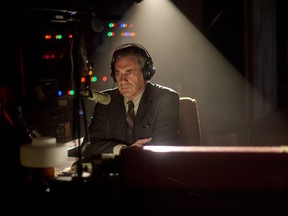
One is reminded of this when watching the new MGM+ series American Hostage (streaming on Crave), a retelling of an actual hostage-taking in Indianapolis in which an apparent madman kidnapped the scion of a local mortgage brokerage and demanded the local radio station broadcast an interview between himself and a revered local radio journalist.
The same incident was recounted in the Gus Van Sant film Dead Man’s Wire (also streaming on Crave). But the eight-part miniseries, created for television by Shawn Ryan and Eileen Myers, allows a more in-depth look at the impact of the 63-hour emergency — not just focusing on kidnapper Tony Kiritsis (Giovanni Ribisi) and his victim Dick Hall (Kristoffer Polaha) but on their families, attendant cops and lawyers, and radio host Fred Heckman (Jon Hamm).
As voluble as he is volatile, Kiritsis is on a mission of vengeance, having gone into hock to the Meridian Mortgage Company only to decide the company has conned him. He enlists Heckman, who does indeed investigate Meridian’s sketchy practises but also Kiritsis’s own troubled past. Still, Heckman’s role takes him into progressively tricky territory, where he becomes part of the story instead of merely covering it.
With episodes directed by either Adam Arkin or Nina Lopez-Corrado (The Last of Us), the show allows a sense of absurdity: Two lives are on the line, and the radio station manager (Joe Cobden) is frantic about the fines levied by the FCC every time Kiritsis utters an expletive on the air.
It gets a little tricky straddling comedy, drama and absurdity over eight episodes. Fortunately, the dramatic stuff ultimately holds it together.

If the ‘70s was a banner year for hostage crises, it was also a great decade for hostage movies, including Steven Spielberg’s second feature, The Sugarland Express (1975, available to rent on Prime.) But perhaps the best hostage movie of the decade was Sidney Lumet’s Dog Day Afternoon (1976, free on Hoopla).
Another movie inspired by a stranger-than-fiction true story, the film stars Al Pacino and John Cazale as novice bank robbers who hit a Brooklyn bank and botch things up, discovering the bank is surrounded by police mid-heist. Pacino’s Sonny takes charge, alternately threatening and calming the hostages.
Sonny’s motivations for scoring the money are revealed to be romantic: He wants to fund a sex change for his lover Leon (Chris Sarandon), a reveal that panics Cazale’s Sal, who feels compelled to tell the world he’s straight.
Lumet crafts the best possible answer to the question: What were the ‘70s really like?
Another New York-flavoured drama to answer to that question is The Taking of Pelham One Two Three (1974, on Tubi), director Joseph Sargent’s nail-biter about a seemingly insane scheme: Four armed men take over a New York City subway car and demand the city pay them a million dollars in cash or they will start killing one hostage per minute.
Walter Matthau is his magnificent hangdog self as Garber, the transit cop who negotiates with the leader Mr. Blue (Robert Shaw).
Three reasons to check it out: One: David Shire’s unique score, as dirty and propulsive as the train of the title. Two: One of cinema’s finest exemplars of New York City grunge. Three: Matthau and Jerry Stiller (as Garber’s partner Patrone) have screen chemistry to rival Tracy and Hepburn.
The movie was so good, it was remade twice. You should stick with the original.
randall.king.arts@gmail.com
Join the Conversation
This website uses cookies to personalize your content (including ads), and allows us to analyze our traffic. Read more about cookies here. By continuing to use our site, you agree to our Terms of Use and Privacy Policy.
KioskNews shows a cleaned-up reading view extracted from the publisher’s page — the original always lives on their site, not ours.