Almost half of Fayed abuse accusers are potential trafficking victims, MPs told

Almost half of the women who reported allegations of sexual abuse by Mohamed Al Fayed to the Metropolitan police are potential victims of human trafficking, MPs have been told.
In a briefing for the all-party parliamentary group (APPG) for the survivors of Fayed and Harrods in July, senior Met officers said a review earlier this year found 70 survivors’ accounts bore the hallmarks of trafficking.
Last month the Home Office confirmed that at least five survivors were victims of international and domestic trafficking.
The Met’s figures suggested the number of confirmed cases could climb much higher, said the Liberal Democrat MP Wendy Chamberlain, a co-chair of the APPG.
“I can’t believe that wouldn’t increase,” said Chamberlain, who also compared the scale of Fayed’s abuse to Jimmy Savile’s.
The Labour MP Dave Robertson, the APPG’s other co-chair, said: “The number of women who were trafficked by Mohammed Fayed and his trafficking ring is certainly much higher.”
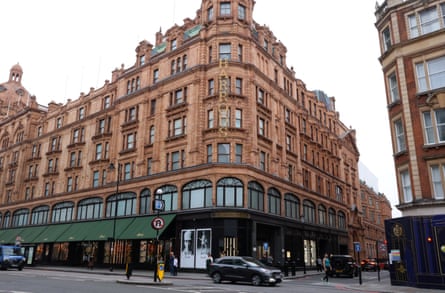
Some women were trafficked from Harrods to Fayed’s private offices and residence in Park Lane while others were taken out of the UK and abused overseas, senior police officers running the Met’s investigation, Operation Cornpoppy, told the APPG.
But several survivors told the Guardian that the Home Office had not recognised them as victims of trafficking because they now live abroad.
Amy, who lives in Italy, said she was trafficked from Harrods, where she initially worked on the shop floor, and her home to Fayed’s other properties. She said she was transferred to a PA role in his private residence and office at 60 Park Lane in London, where he allegedly sexually abused her, including groping her breasts and forced kissing.
She said Fayed also took her in his private car and helicopter to his estate in Oxted, Surrey, where she was sexually assaulted in a lagoon-style swimming pool located behind a concealed door.
“I would be removed from my home in Hammersmith and then be changed into clothes like Lacoste polo shirts and Bermuda shorts and boat shoes, which I absolutely hated,” said Amy. “That was robbing me of my actual identity. Whoever saw me leave my bedsit would say that’s not her. That’s a strong component of what trafficking is and was very calculating.”

In a letter sent in June to the then minister for safeguarding and violence against women and girls, Natalie Fleet, Amy raised concerns about the apparent exclusion of survivors living outside the UK from the Home Office assessment of potential trafficking victims, the National Referral Mechanism (NRM).
She received a response from the Home Office in August, which said there was not a requirement that a potential victim be resident in the UK before being referred to the NRM by the police, or another first responder organisation.
But last month Amy was informed by her contact officer at the Met that the Home Office had confirmed it would reject any referrals made for international residents.
KP Law (KPL), which represents Amy and 277 other alleged survivors of Fayed’s abuse, said nearly a quarter of those women now lived overseas.
Lucy Traynor, a senior associate at KPL, criticised the apparently inconsistent advice as to who was eligible to be recognised as a victim of trafficking.
The lawyer said: “We are still seeing individuals whose experiences meet the threshold for trafficking struggling to secure recognition through these systems which are designed to identify and protect victims. Amy’s case is a stark example. Despite the nature of what she experienced, she continues to face barriers to recognition outside the UK. That disconnect between what the Home Office has committed to and what survivors experience in practice is simply not acceptable.”
First responders including police forces and some charities can refer someone to the NRM if they suspect they are a victim of human trafficking.
The Home Office then makes an initial “reasonable grounds” decision if it believes a crime may have occurred before investigating further and making a final “conclusive grounds” decision. So far it has confirmed that five women allegedly abused by Fayed were trafficking victims.
Eleanor Lyons, the independent anti-slavery commissioner, said the Home Office’s statutory guidance explicitly stated that people needed to be in the UK to be referred to the NRM.
Lyons said this was because the process involved getting access to support including a safe house and counselling, which officials believed would be difficult to provide to people who do not live in the UK.
But she called on the Home Office to reconsider the requirement because many affected people she spoke to just wanted to be recognised as trafficking victims, adding that the situation was causing deep distress for alleged survivors of Fayed’s abuse.
“The government should be doing everything it can to make it easier to identify these women and recognise them as potential victims of modern slavery,” Lyons said. “They’re doing directly the opposite right now, which is causing further harm to the survivors.”
Survivors’ groups say more than 500 women have come forward about abuse that allegedly took place at Harrods, Park Lane, Fulham football club, the Ritz hotel in Paris, and other places owned by Fayed. The Met is investigating 165 victims who have contacted the force directly.
A Met police spokesperson said: “We were previously making referrals to the Home Office for victims living in the UK and abroad, but those relating to victims living abroad were being rejected. As a result, we have paused any further such referrals. Should the Home Office position change, we will restart those submissions. Our support to victims continues, regardless of where they live.”
A Home Office spokesperson paid tribute to “the incredible bravery” of survivors of Fayed’s alleged abuse. They added: “We are ensuring modern slavery survivors get the support they need to recover and move on with their lives.”
A Harrods spokesperson said it “supports all survivors in their pursuit of justice and continues to work closely with the Met police on its investigation”.
KioskNews shows a cleaned-up reading view extracted from the publisher’s page — the original always lives on their site, not ours.