Hanoi's parking shortage pushes cars onto sidewalks and streets
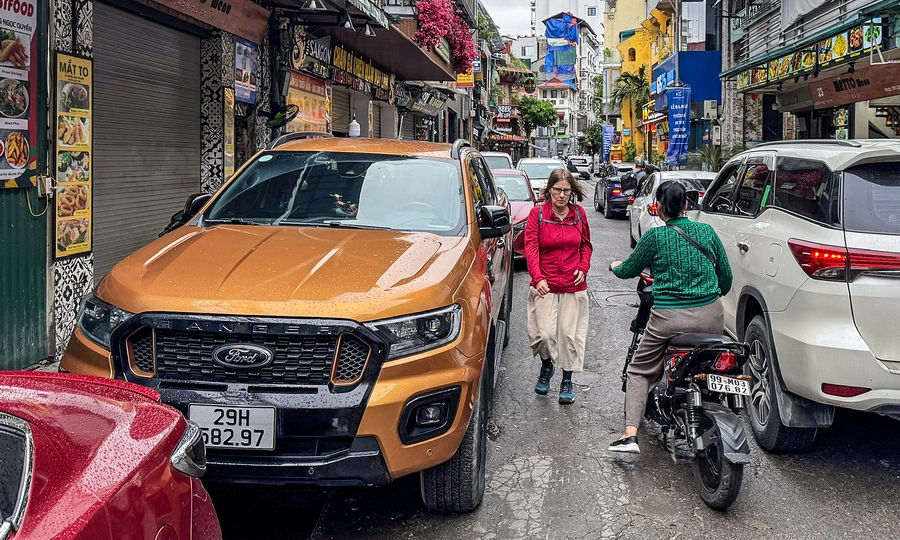
Hanoi's streets and sidewalks are increasingly crowded with parked cars, as only 72 of 1,690 planned public parking facilities have opened.

Vehicles line both sides of Luong Ngoc Quyen Street in Hanoi's central Hoan Kiem Ward, which is 324 m long and 6 m wide. The scene is frequent during morning rush hours, despite an active parking ban.
Under a plan approved by the Hanoi People's Committee in 2022, the city will develop 1,690 public parking facilities, including 97 underground facilities and 469 multi-story parking structures.
Progress has been limited. To date, only 72 facilities have become operational. An additional 61 are under construction, while the remaining 1,557 projects are still on paper.

Vehicles parked along Yen Ninh Street in central Ba Dinh Ward obstruct traffic flow, heightening the risk of congestion during peak hours.

Illegal parking is common on many streets and at different times of the day. At a parking lot on Hai Ba Trung Street in Cua Nam Ward, many cars are parked outside designated spaces marked by white paint.

Nearly 10 km away, an informal parking area has sprung up along Tuong Mai Street in Tuong Mai Ward since a new road was opened.
Many drivers use vacant plots of land along the road to park their vehicles.

Vehicles are frequently parked along Dai Tu Street in Dinh Cong Ward, despite parking prohibitions in the area.
Mai Hoa, a local shopkeeper, noted that following municipal sidewalk clearance operations, many cars have now moved onto the roadway, causing frequent congestion during morning and evening rush hours.

A section of the central median on Tran Khat Chan Street has been informally repurposed as a parking area.
Vehicles are routinely parked directly on the grass plots, encroaching upon spaces explicitly designated for urban greenery and landscaping.

On Tran Nguyen Han Street, many vehicles are parked in unauthorized areas despite the presence of signs and road markings.

The parking facility along Tran Quang Khai Street frequently operates at maximum capacity, underscoring the severe strain on Hanoi's existing parking infrastructure.
According to data from the municipal Department of Construction, the city's registered automobile fleet reached nearly 1.5 million vehicles by the end of 2025.
The total land area allocated for transport infrastructure and public parking accounts for less than 1% of the city's urban footprint, significantly short of the projected urban planning target, which mandates a 3% to 4% spatial dedication for such facilities.

The parking facility along Ngo Quyen Street frequently operates at maximum capacity.
In response to the city's acute shortage of available parking spaces, municipal authorities in Hanoi have implemented increased parking tariffs as an effort to gradually deter the reliance on private vehicles.
However, for such pricing policies to achieve their intended impact, they must be implemented in tandem with the development of centralized parking infrastructure and the establishment of transparent fee collection mechanisms.
Concurrent improvements to the overall quality of the public transit network are essential to provide residents with viable, alternative commuting options.

An unauthorized parking facility on Hong Quang Street in Dinh Cong Ward was recently ordered to suspend operations.
Local authorities posted a formal violation notice at the entrance, advising residents against utilizing the site.

In the same ward, a combined parking and commercial center project is slated to commence development.
According to the approved urban plan, the site spans over 8 hectares, including early 2 hectares dedicated to road infrastructure.

The Tran Nhat Duat parking facility, inaugurated on April 24, 2015, stands as one of the pioneering multi-story parking structures in Hanoi's Old Quarter.
The infrastructure encompasses over 400 sq.m and comprises seven distinct blocks. Each four-level block reaches 8.5 m and provides capacity for 91 automobiles.
Supported by an automated parking system, the facility processes each vehicle drop-off or retrieval in approximately two minutes.
The current parking tariff is set at VND50,000 (US$1.95) per 120-minute interval. This pricing model is regarded by patrons as equitable, particularly given the facility's location within a high-density, central commercial zone.

Many parking facilities across Hanoi have transitioned to electronic payment systems, a modernization effort implemented concurrently with a citywide increase in parking tariffs.
Under the revised fee schedule, hourly parking charges for passenger vehicles with up to nine seats and light trucks weighing under two metric tons have risen from VND30,000 to VND50,000.
This premium rate applies to 12 streets within the city's central urban core: Nguyen Xi, Dinh Le, Ly Thai To, Tran Hung Dao, Ly Thuong Kiet, Hai Ba Trung, Hang Duong, Hang Dao, Hang Ngang, Hang Giay, Phu Doan, and Quan Su.
For parking zones on other routes within the Ring Road 1 perimeter, inclusive of the ring road itself but excluding the aforementioned central urban core, hourly parking fees for passenger vehicles of up to nine seats have been adjusted from VND25,000 to VND45,000.
KioskNews shows a cleaned-up reading view extracted from the publisher’s page — the original always lives on their site, not ours.