Military quadbot exhibited at tech forum in Taipei
By Chen Yu-fu and William Hetherington / Staff reporter, with staff writer


A military-use quadruped robot dog was presented at the Taiwan-Japan Future Technology Forum in Taipei yesterday, by the event’s organizer, the Indo-Pacific Strategy Thinktank.
The robot is built on the Vision 60 platform developed by US-based Ghost Robotics, which has been adopted by the US Marine Corps, Army and Air Force. In addition to autonomous reconnaissance and surveillance, the robot can be armed and engage targets, and has been used in Japanese Self-Defense Forces military exercises.
The Vision 60 has an IP67 protection rating, allowing it to withstand immersion in one meter of water for 30 minutes. It operates at temperatures from minus-40°C to 55°C.
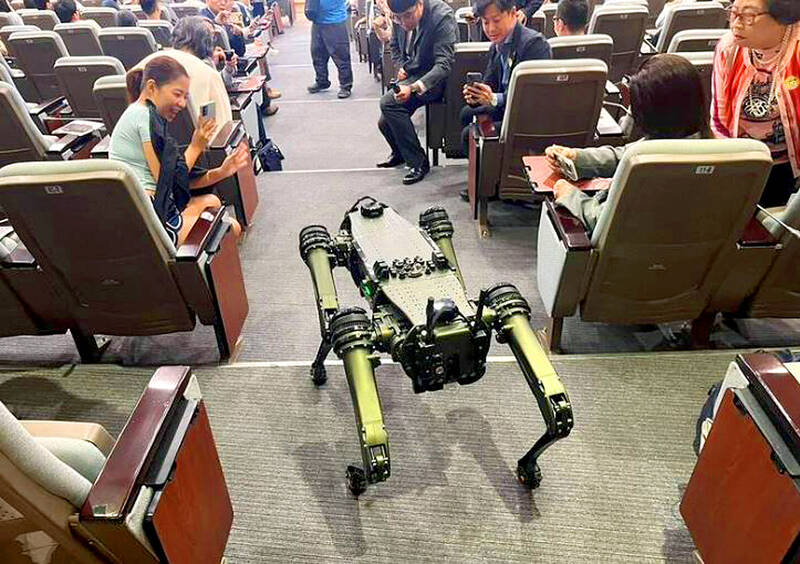
People take pictures of a Ghost Robotics Vision 60 robot dog that was introduced at the Taiwan-Japan Future Technology Forum in Taipei yesterday.
Photo: Chen Yu-fu, Taipei Times
Powered by an Nvidia Jetson system, the robot can carry a 10kg payload and operate for more than three hours per charge, compared with about 90 minutes for similar products. Its modular design allows a malfunctioning leg to be replaced quickly.
Wu Jung-tsan (吳榮燦), deputy general manager of Tansimo Robotic Manufacturing, said mission-specific equipment allows the platform to perform tasks ranging from inspections and search and rescue to security and detection.
The robot can be equipped with light detection and ranging (LiDAR) technology for autonomous navigation and obstacle avoidance across complex terrain, including indoor and underground environments without GPS signals. With a wireless charging station, it can return to recharge independently, supporting extended monitoring missions while reducing maintenance needs.
A six-degree-of-freedom (6DoF) robotic arm can open doors and handle objects, including ammunition. With a gripping force of up to 11.3kg, it can move objects weighing up to 3.75kg, making it suitable for explosive ordnance disposal, disaster response and other hazardous tasks.
Imaging options include a low-light camera capable of operating at 0.0001 lux and a pan-tilt-zoom camera with 33x optical zoom, 360° horizontal rotation and infrared night vision at distances of up to 50m. A security payload combines target detection and tracking with low-light and thermal imaging, while AI-powered image recognition can support personnel management at industrial facilities.
Wu said the Vision 60 took part in a Japanese military exercise in the first quarter of this year, demonstrating that quadruped robots have moved beyond the laboratory into practical use.
Deploying unmanned systems for some high-risk tasks can improve operational efficiency and reduce risks to personnel, he said.
KioskNews shows a cleaned-up reading view extracted from the publisher’s page — the original always lives on their site, not ours.