Helping, not snitching: How primary school pupils in Sengkang are learning to stand up for others
SINGAPORE – Yianne Chen, 10, used to look the other way when pupils were being treated unfairly or excluded from activities.
Now, the Primary 4 pupil at Palm View Primary School knows how to step in and help.
“Last time, I didn’t know what to do. But now, I will get the facts, understand what is happening and seek help,” said Yianne, who is also a class monitor and school prefect.
Her new-found confidence to speak up for others – like a classmate who was left out of games during a physical education lesson – is the result of a programme introduced by her school’s vice-principal, Jeremy Ang, to teach pupils how to safely look out for others.

Chen Yianne (left), 10 engaging members of the public at the Kids On Patrol – Upstanders in Action exhibition on Nov 14.
ST PHOTO: NG SOR LUAN
Launched in March in partnership with the Sengkang Neighbourhood Police Centre (NPC), the programme builds on one of the recommendations from the Education Ministry’s (MOE) bullying review – to teach children how to respond and seek help when they are bullied or hurt by others.
Called GUARD, Ang said it goes beyond teaching pupils to protect themselves by helping them recognise when others may be at risk and giving them practical skills to take action against bullying and hurtful behaviours, such as name-calling, exclusion and fighting.
The name GUARD outlines five steps: Get the facts, understand the situation, act safely, reach out to help victims and engage trusted adults, and do your part as an upstander.
The programme has since been piloted at five other primary schools in Sengkang – Anchor Green, North Vista, Sengkang, Rivervale and Springdale.
Many children have a natural sense of fairness and want to help others, said Ang. But they may not know how to act, especially when faced with peer pressure, uncertainty or potentially intimidating situations.
For instance, Ang said a student may recognise that a classmate is being bullied but hesitate to speak up for fear of becoming the next target.
Likewise, a child who spots a safety concern in the community may want to help, but may lack the confidence or judgment to decide what to do.
Though loosely modelled on the Singapore Police Force’s Citizens on Patrol scheme, Ang said the intent is not for pupils to patrol streets or police their peers.
“We are encouraging students to be responsible ‘eyes and ears on the ground’, remaining alert to safety concerns wherever they may be,” he said.
Pupils are also taught to avoid getting into physical fights or confronting aggressors.
“We do not want them to be put in danger or have incidents where they are filmed, with videos uploaded onto social media,” said Ang.
Instead, they learn practical skills such as staying calm, gathering key details and knowing what to say when calling 995 or alerting a trusted adult.
Developed by a team of Palm View Primary teachers, the lessons use role-playing and hands-on activities. The skills are taught at all levels during assemblies and some form teacher periods.
Police officers from the Sengkang NPC also engage pupils during assemblies and conduct after-school sessions for student leaders, including prefects and leaders of co-curricular activities. Using common youth crime scenarios involving bullying, vandalism, shop theft and scams, officers teach pupils how to recognise potential trouble and respond safely, both in and outside school.
The commanding officer of Sengkang NPC, Superintendent Rane Chua, said interacting with police officers helps pupils see them as approachable figures they can turn to for help.
The lessons also serve as a deterrent for misdeeds, he said.
Said Chua: “Through education, children learn that harmful behaviours have consequences, that their choices can affect others, and that witnesses can seek help safely.”
Speaking up is not snitching
For Primary 5 vice-head prefect Alfric Tee, 11, the lessons have changed how he views reporting wrongdoing.
“Most people think an upstander is a snitch, but they actually help to make the community and school a safer place,” he said. An upstander is a person who speaks up or intervenes when he sees hurtful or harmful behaviour, as opposed to a passive bystander.
He also learnt that helping others does not always mean stepping in directly.
Rather than rushing to break up fights between schoolmates and risking injury, Alfric now knows to assess the situation, keep a safe distance and seek help.
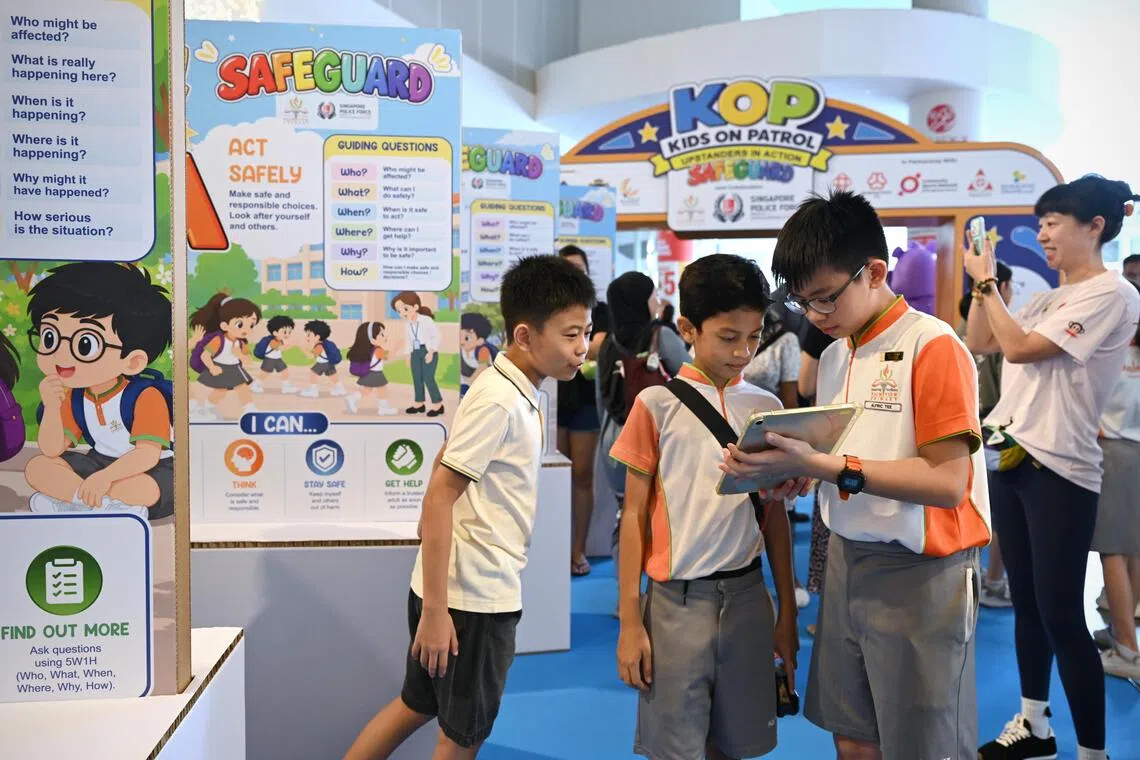
Alfric Tee (right), 11 engaging other pupils at the Kids On Patrol – Upstanders in Action exhibition on Nov 14.
ST PHOTO: NG SOR LUAN
At Anchor Green Primary School, GUARD was introduced to student leaders, including prefects, peer support leaders and sports leaders.
Au Yard Wah, the school’s vice-principal, said the programme complements the school’s efforts in fostering peer support and encouraging students to make kind, safe and responsible choices.
Standing up for others is not inherently difficult for children, she said. But they need to be taught how to do it safely while growing in confidence and developing good judgment.
“These are skills and dispositions that need to be explicitly taught, practised and reinforced as children grow.”
Au said the school intends to extend the lessons to all pupils in 2027.
KioskNews shows a cleaned-up reading view extracted from the publisher’s page — the original always lives on their site, not ours.