Am I Caribbean, or am I a tourist? How art helped me find the answer
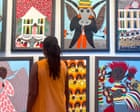
When I tell people I’m travelling to the Bahamas to report on Fuze Caribbean art fair, no one believes I’m really going for work. There are smirks and jokes about it being a tough life, about drinking from coconuts on the beach. The tourist gaze pervades global perceptions of the Caribbean. This week, I speak to the region’s artists about how they use images to speak back.
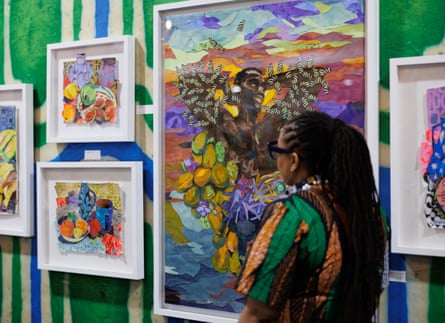
I have Antiguan and Jamaican heritage, so I’m familiar with the fantasies the Caribbean sparks, which Antiguan-American writer Jamaica Kincaid described as so beautiful that its fluffy white clouds, blue spectral waters and “bottomless” black nights seemed “unreal”. Images have done much to flatten the Caribbean in the global imagination – so why shouldn’t Caribbean people use images to speak back?
“Artists from The Bahamas and the wider Caribbean are in constant dialogue with the expectations of outsiders looking at our destinations as spaces of relaxation and service,” says leading Bahamian artist and curator John Cox, who I meet on a gallery tour of the nation’s capital, Nassau. “Those expectations often fetishise exotic notions of paradise, drawing on Hollywood images of an appealing landscape inhabited by people whose lives and cultures are presumed to be less sophisticated.”
What does it mean to ‘paint Black’?
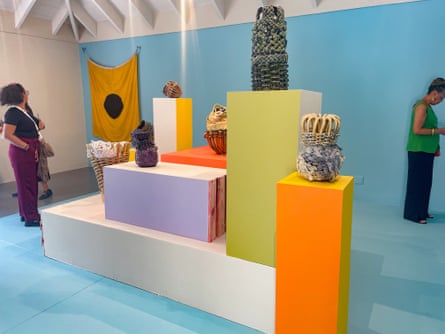
Through this process, culture becomes flattened, and local people participate to make a living. Take the capital’s famous straw market, one of the nation’s most popular tourist attractions, where vendors sell bags and other items made from woven silver top and palmetto palms. The market helped local women earn money in the early days of tourism; now many of its goods are imported from China, and you can buy a bag with Minnie Mouse’s face braided onto it. Artist Anina Major, who recently exhibited at TERN gallery in Nassau, has made ceramic sculptures from hand-weaved clay to resemble the baskets. But in her work, they are crumpled and sinking into themselves – a deflated replica of Bahamian identity, performed entirely for the tourist gaze. I encounter this cynicism and resentment towards tourists among many of the Bahamians I meet.
Other artists decentre the tourist, going deeper into cultural traditions, such as Caribbean connection with the sea, the flora and the land. Virtually everywhere you look at the fair, there are fluorescent colours: pinks, yellows and aquas. Antonius Roberts, another of the Bahamas’ foremost and prolific artists, suggests that this palette may be the reason that when he first went to study in the US, he was told to stop “painting Black”. “It was seen as too bright, the paint coming right out of the tube,” he tells me. “I was like: ‘You haven’t been to the Caribbean have you? You haven’t seen our beautiful beaches, right? You haven’t seen our bright tropical sunlight?’”
The 68-year-old now also works with wood, stone, goat skins and other natural and recycled materials, drawing on traditional craft knowledge. Roberts’ works are often towering and awe-inspiring – reflecting the spirit of Caribbean dignity and integrity that he emphasises as we speak. “People want to come here, buy a nice little painting, take it back and say ‘oh I bought this in the Bahamas!’” he says. The cruise industry, which he describes as the “new colonial power” in the region, is complicit in these dynamics, by curating what their customers see – no political art, no climate breakdown.
Am I a tourist?
After the abolition of transatlantic enslavement, perceptions of danger, poverty and uncleanliness plagued the Bahamas, much like other Caribbean countries, well into the 20th century. Economies reliant on exports such as sugar gave way to tourism. Postcards and photography intentionally depicted the Caribbean as a holiday destination, ramping up in the middle of the century. This transformed global – and importantly, American – impressions of the region. The Bahamas was a testing ground for this tourist economy, with external perceptions now deeply shaped by the idea that it is a tropical playground for Americans. Flights from the south of Florida can be as short as 30 minutes, Roberts tells me: “If the Americans sneeze, we get a cold.”
The art fair is hosted at a luxury resort. I feel alienated from the American tourists here on bachelor parties who fill the resort’s casinos, in which it is illegal for Bahamians to play. In a throwaway comment during the gallery tour, I remark that I’m “not like them” – and a Black British curator, who regularly visits her sister in the Bahamas, responds quickly: “You are”.
Kincaid wrote that a tourist is an ugly thing, and as I’m reminded of this, I wonder whether I am looking at the Bahamas from the inside or the outside; whether the love I have suddenly acquired for the fuchsias, turquoises and yellows of the art and the landscape is an act of reclamation or exoticisation; whether going to a half-hour workshop where I poured acrylic paint over a conch shell tokenised Caribbean artists’ tradition of using the land and nature for creativity. I then mentally flog myself for these diasporan thoughts, which feel clichéd. But locals I speak to express a strikingly similar anxiety – that those who go away to study in the US, for example, are told they are not truly Bahamian when they return.
When I’m engaging with the art, I find that there’s a bit more breathing room, and space for complexity. Art doesn’t demand a definitive answer, and doesn’t fix itself or the viewer in place. I wonder if it is uniquely placed to channel the spirit of Caribbeanness, which is so shaped by migration, flux, and expression as collective resistance.
after newsletter promotion
A new generation speaks to the world
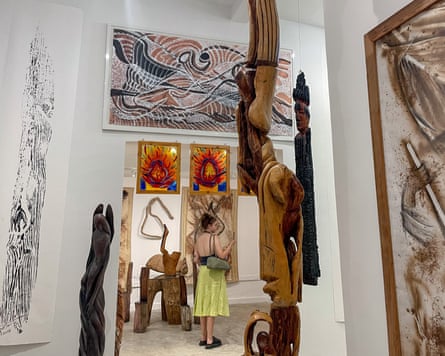
Art can encompass many themes and conflicts at once. Cox is excited about a new crop of Bahamian artists including Cydne Coleby, April Bey and Tavares Strachan. All of them play with composite materials, themes, or images from the past and the future. He says: “[They] retain the beauty and raw, seductive quality of this landscape while bringing forward the complexity of lives filled with diversity, humour, irony and connections to Europe, Africa and the wider West Indies.”
Both Roberts and Cox have become highly respected artists but they have also spent decades incubating others. Roberts helped establish the National Gallery of the Bahamas, and founded several art competitions and galleries, while Cox directed Fuze and has held multiple senior curatorial roles. The fair is significant because it brings together artists from across the Caribbean, even though the Bahamas is often seen as a high-income outlier in the region, which is able to generate more resources and opportunities for its artists.
Cox says: “The Caribbean has been formed through connections with continents across the world. Yet the intelligence, relevance and contribution of the region to global developments are too often underestimated. We encounter that in contemporary art and across the wider cultural sphere.”
“I believe that we have some of the most creative people on earth,” Roberts says. “What is happening in London has a lot to do with Caribbean energy, what is happening in the United States has a lot to do with Caribbean energy. In the art world, in the political world and whatever else, Caribbean people somehow always magically insert themselves into something larger than themselves,” Roberts says.
But they also come back. “My mother told me that my navel string was buried under a silk cotton tree,” he says. She’d hoped that he would stay rooted in his country, and return to help build the nation following independence. Through art, that is what he did – alongside other Caribbean artists who have made space to look inwards, to look at themselves. I look at the art, then I look at myself too. I wonder what I can’t see.
To receive the complete version of The Long Wave in your inbox every Wednesday, please subscribe here.
Tap in
What do you think the role of art is in exploring our cultural identities as Black people? Share your thoughts by replying to this, or emailing us at thelongwave@theguardian.com and we may include your response in a future issue.
KioskNews shows a cleaned-up reading view extracted from the publisher’s page — the original always lives on their site, not ours.