Why Russia’s Potemkin election actually matters
Putin’s stage-managed vote might lack democratic meaning, but it gives the Kremlin a fresh mandate to demand greater sacrifice at home while pressing its war against Ukraine and Europe
By Marc Champion / Bloomberg Opinion


In what must be the world’s least surprising election result, parties loyal to Russian President Vladimir Putin have made a clean sweep in elections to Russia’s parliament, the State Duma. There is little purpose to parsing who won what share of the vote; the point is that opponents of Putin and his war were either jailed, dead, in exile or banned from running. As a democratic exercise, this signified nothing — but it was an important moment nonetheless.
Putin’s approach to this conflict has changed. Where he once felt he had time to wait until Ukraine and its backers faltered, he now wants the war over quickly and on his terms. So what mattered to the career KGB agent and his like-minded officials this weekend was not that the election would let Russians pass judgement his plans, but rather that it should help ensure public acquiescence to the demands for greater sacrifice he will soon make.
For one thing, the vote and its result will allow Putin to push harder on the claim that neither Ukrainian President Volodymyr Zelenskiy nor his government are legitimate, and that they are therefore inadequate negotiating partners. After all, unlike Russia, they have refused to hold wartime elections. Never mind that Russia is not being invaded, meaning that what is possible for Moscow is not necessarily viable for Kyiv.
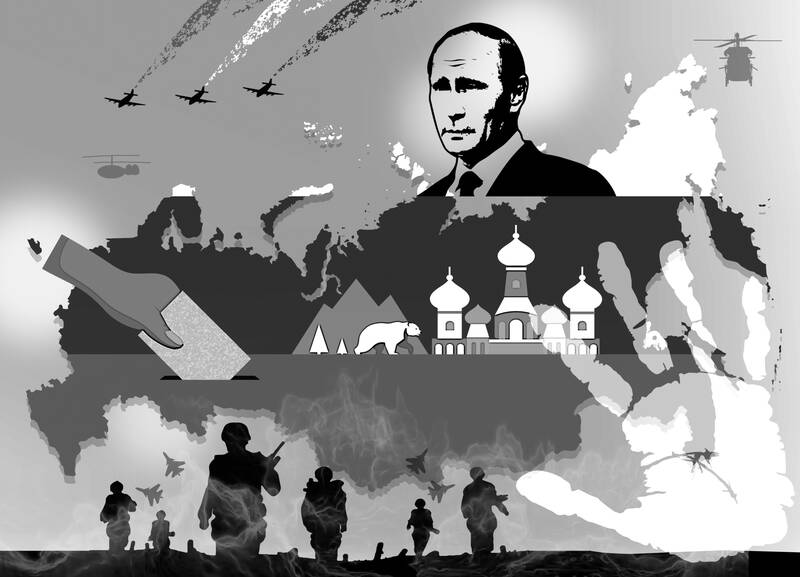
Illustration: Louise Ting
But more critical: Despite Putin’s denials, Russians have been speculating that a further troop mobilization is coming. This could be formally announced or take place under the radar, but in either case the Kremlin needs to raise hundreds of thousands more troops to replace those who are wounded or dying — and high salaries are no longer drawing enough recruits. That is easier to do when the government can make the argument, supported by a fresh (if fake) electoral mandate, that the public supports the war.
Indeed, in an address last week, Putin made it clear that this was what the elections were about.
“Your choice and determination will show once again that millions of people are backing our fighters and that we stand together,” he told his fellow Russians. “Nobody can divide or intimidate us, undermine our statehood, our public and political system.”
By the same token, if continuing the war brings hardships in the form of higher taxes, cuts to social spending or regular Ukrainian drone attacks on Russian energy output and cities, this too is easier — even for an autocrat such as Putin — if he can portray the war as a nationally endorsed endeavor. That approval has often been real, but many Russians want the conflict to end.
Perhaps most important, though, is to lock down the home front before escalating not just in Ukraine, but also in Europe. That is where Putin appears to be shifting emphasis now, as the inevitable winter slowdown follows a summer fighting season marked by Russian frustration. For if the strategy of Ukraine and its allies is to inflict enough pain for Putin to conclude that his war of choice is no longer worth the pursuit, the Kremlin’s is to persuade Europeans that they cannot afford to push him to that point.
French President Emmanuel Macron last week became the latest European leader to warn his people that Russia’s hybrid war against the West is expanding. Multiple intelligence agencies, meanwhile, have recently warned that Putin may test NATO sooner rather than later. Russia’s escalating air war is driving up the cost of Ukraine’s defense, the vast majority of which now falls to Europe. The shortfall on the tens of billions already allocated this year, according to Kyiv, is a further US$27 billion.
So, with far-right, pro-Russian parties making inroads ahead of a slew of (real) elections in Europe next year, Putin has every reason to feel confident that Ukraine and its Western backers will reach their pain threshold before he does. Russia’s leaders have not even tried to conceal their glee at German Chancellor Friedrich Merz’s drubbing in a string of recent regional elections in Germany.
University of Chicagopolitical science professor John Mearsheimer, perhaps the purest US exponent of the so-called realist school of foreign policy, is one of very few Western academics still welcomed to Moscow. His recent YouTube interview with the Norwegian academic, Putin apologist and alt-right fan Glenn Diesen makes it clear why it rolls out the red carpet for the US professor — and why Russians are so certain of winning.
Much of Mearsheimer’s analysis is right on the money. He notes that whatever troubles the Russian economy is having, they are nascent compared with the potential catastrophe unfolding in Ukraine. Likewise, he says Putin’s escalation since June is already having an impact and (as I’ve written before) has a worryingly high chance of success this winter. This is largely due to the mismatch between expanding Russian missile production and Ukraine’s fast-shrinking air defenses.
He accurately describes Russia’s goal as to seize all territory that it considers historically Russian — including Odesa, the Black Sea coast and Kharkiv to the north — ensuring that a landlocked, rump Ukraine is so destroyed as to be dysfunctional.
Where he, Diesen and many others are deluded is in their embrace of the Kremlin’s portrayal of the war as an act of self-defense against Europe, which in this telling has sought for decades to use Ukraine as a “battering ram” to destroy Russia.
This is the story Putin tells to Russians and his sympathizers in the West, from academics such as Mearsheimer and Diesen, to populist political parties including Germany’s AfD and Marine Le Pen’s National Rally in France. Promoting it matters deeply, because if Russia is simply defending itself, there is little for Europe to fear in a Ukrainian defeat. If, by contrast, Putin has led a revisionist power to war, then Europe has a great deal to fear.
Having put that argument to bed at home, Putin can now move on to persuading voters in the West. There elections do have the power to throw leaders out — and with that to divide Europe, destroy Ukraine and win the war for Russia.
Marc Champion is a Bloomberg Opinion columnist covering Europe, Russia and the Middle East. He was previously Istanbul bureau chief for the Wall Street Journal. This column reflects the personal views of the author and does not necessarily reflect the opinion of the editorial board or Bloomberg LP and its owners.
KioskNews shows a cleaned-up reading view extracted from the publisher’s page — the original always lives on their site, not ours.