A call a day keeps the phone company away
By Liu Hsiao-hsin and Fion Khan / Staff reporter, with staff writer


An 88-year-old bakery owner in Changhua has found an unusual way to preserve a piece of Taiwan’s telecommunications history: by making a daily phone call from the public payphone outside his shop to his own home phone.
Li Tien-an (李添安), owner of the Hsing An Chen Bakery (興安珍餅行), now only sells mooncakes for 15 days each year during the Mid-Autumn Festival season due to his age, but he still carries coins to use the payphone outside his store every day to ensure it remains in use so that it would not be removed.
Li said he opened the bakery in 1962 and moved to a location on Minsheng Road in 1967. The next year, he applied to have a public payphone installed outside the store.
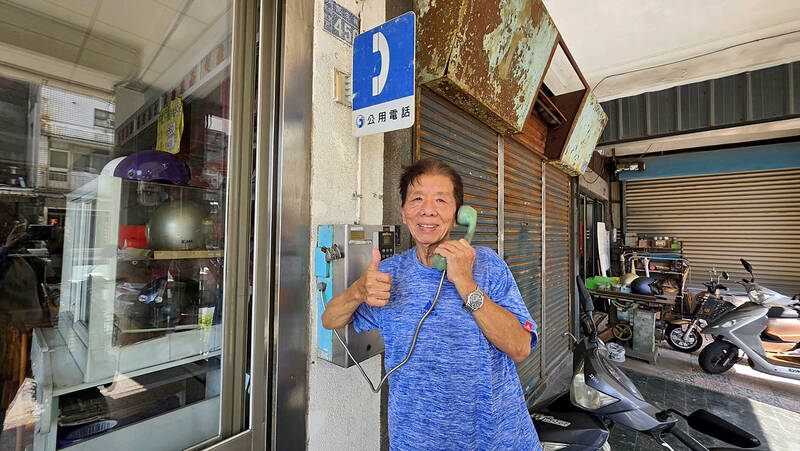
Baker Li Tien-an poses with a public payphone outside his shop in Changhua City on Sept. 27.
Photo: Liu Hsiao-hsin, Taipei Times
Before the construction of the nearby Minsheng underpass, the shop stood just one railway crossing away from the Changhua Railway Roundhouse, and the area was busy with foot traffic, making the payphone highly popular, he said.
At the time, mobile phones did not exist and payphones were heavily used, he added.
In the early days, the Directorate-General of Telecommunications, the predecessor of Chunghwa Telecom, paid commissions to businesses that hosted public payphones, he said.
He recalled receiving NT$300 a month, which provided a useful supplement to his income.
The payphone remained busy during the pager era, when people receiving messages while outdoors would search for a public phone to return calls, he said, adding that people frequently came to his bakery to exchange money for coins.
However, after mobile phones became widespread, payphones use fell off sharply, he said.
“In the past, people sometimes had to line up to use a payphone,” he said. “Nowadays, everyone has a mobile phone. A payphone’s main function is providing free access to emergency calls.”
After learning that payphones with insufficient usage could be removed, Li took steps to prevent it.
Every day, he inserts coins into the payphone and dials the family’s home telephone inside the store, hanging up as soon as he hears it ring.
“In the old days, having a payphone earned me money, but now I have to spend money to keep it from being removed,” he said.
The payphone has remained outside his store for 58 years and has been replaced with several different models across the decades, he said.
Li said he plans to continue making his daily calls to ensure the phone remains outside his shop.
KioskNews shows a cleaned-up reading view extracted from the publisher’s page — the original always lives on their site, not ours.