Specialised talent, stipend support, no resume pile: A smarter way for deep-tech start-ups to hire
Before home-grown medical technology firm Vivo Surgical brought robotics engineer Zhao Yuxuan on board in 2025, it spent about a year searching for a suitable candidate via online human resource portals. The firm develops medical devices for surgery, including an endoscopic robot for minimally invasive procedures in the gastrointestinal tract.
“Hiring talent in medtech is challenging, especially for specialised engineering roles and start-ups at a later stage of development, like us,” says Vivo Surgical founder and chief executive Kevin Koh. “Many candidates have strong academic backgrounds but only limited industry experience in areas like regulated product development, system integration and clinical workflows.”
An opportunity arose when Koh learnt about SGInnovate’s Helix Immersion Programme (HIP) via networking events. HIP’s main goal is to help deep-tech companies access and develop specialised talent. It does this by matching biotech and medtech businesses with people looking to grow their careers in these industries.
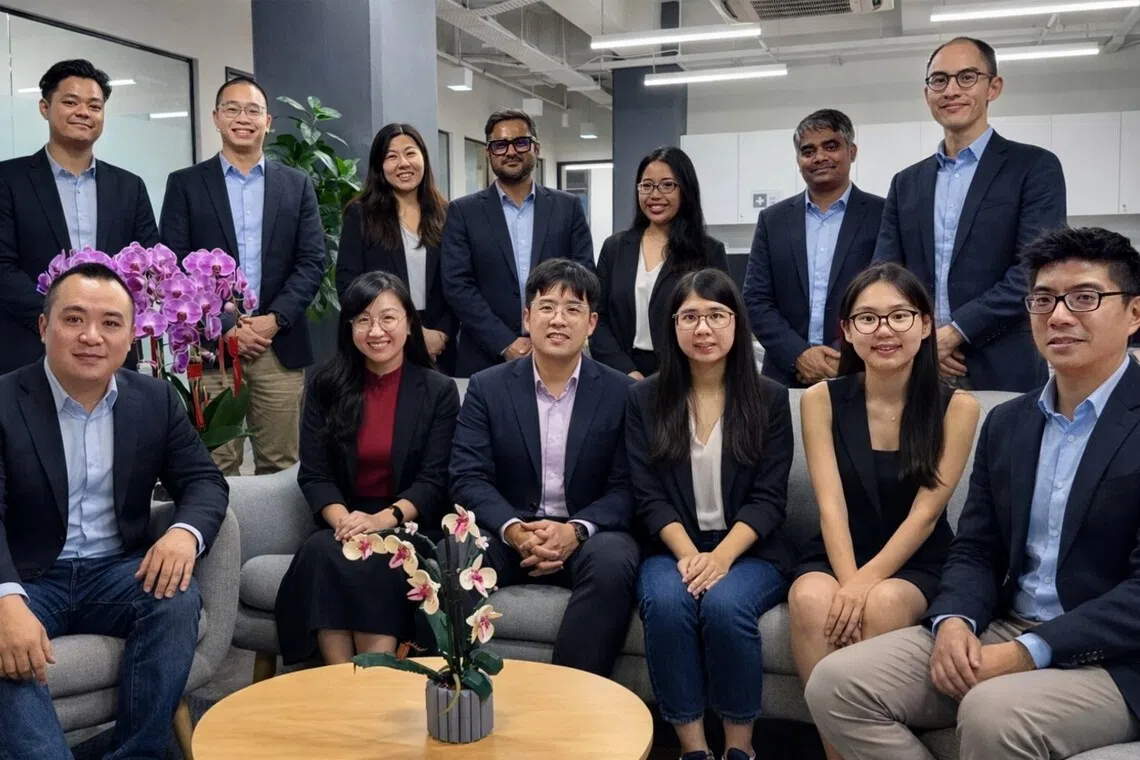
The Vivo Surgical team, with founder and chief executive Kevin Koh (front row, far left), have benefited from SGInnovate’s Helix Immersion Programme.
PHOTO: VIVO SURGICAL
The programme sources talent through universities and research institutions, as well as SGInnovate’s vast network on its centralised deep-tech ecosystem platform known as Deep Tech Central. Matched applicants, also called HIP fellows, join the companies for a year of full-time, on-the-job training, after which they could be offered permanent positions. Businesses that take on HIP fellows also get a monthly stipend to reduce hiring costs during the year-long fellowship (see box story).
To ensure strong matches, HIP works closely with the firms to understand their requirements, growth stage and operations. Suitable candidates are then shortlisted based on relevant skills, experience and transferable capabilities, as well as their readiness to work in start-ups or firms aiming to scale rapidly.
“This goes beyond resume-matching, because we also take into account potential employees’ motivation, adaptability and cultural fit to the company,” says Alicia Ng, SGInnovate’s deputy director, People, Working Professionals.
Zhao, for example, had recently graduated with a master of science in engineering, with a focus on medical robots, but she had also interned at a medical technology company for four months, giving her practical experience well suited to Vivo Surgical’s needs. “She had a strong robotics engineering background and structured technical approach,” Koh recalls.
During her HIP year with the firm, Zhao joined the engineering team in improving its endoscopic surgical robot’s performance and user-friendliness. Beyond her technical skills, Koh says she was also a good fit for the company culturally.
“She adapted quickly to the pace of a start-up environment, took ownership of her role early, and worked proactively across teams. Her technical contributions were strong, but what truly made her fellowship successful was her combination of soft and hard skills, which allowed her to integrate naturally with our company,” Koh explains.

Zhao Yuxuan has gone on to secure a full-time position at Vivo Surgical, following her completion of the Helix Immersion Programme.
PHOTO: SGINNOVATE
Says Zhao: “Vivo Surgical pushes me to grow every day – I’m constantly inspired by new challenges and motivated by a team that strives for excellence together.”
After Zhao completed her HIP fellowship in December last year, Vivo Surgical hired her full-time as a systems integration engineer.
Koh highlights: “This whole experience really showed us how HIP can help start-ups to bring on skilled personnel and develop talent.”
Exploring more support for businesses
While HIP initially focused on placing graduates with master’s degrees and PhDs into research-intensive roles, it is exploring opportunities to broaden its talent pool to meet the evolving needs of biomedical technology start-ups.
“Start-ups increasingly require talent for technical and operational functions such as quality assurance, regulatory affairs, manufacturing and product development. These roles may be suited to candidates with relevant bachelor’s degrees,” says Ng.
“At the same time, there is a growing pool of graduates in life sciences, biomedical sciences and engineering seeking structured pathways into industry. Exploring opportunities to include these degree holders could help HIP better address workforce needs while creating more pathways for scientific talent to contribute to the sector.”
Ng adds that, as the number of companies in Singapore’s biotech and medtech sectors grow over the next decade, hiring will become more difficult at all levels, especially for start-ups and smaller firms that have to compete with well-established, multinational corporations. This makes HIP’s support even more critical.
Says Koh: “I would definitely recommend HIP to other companies, because it provides access to motivated, technical talent within a structured framework that benefits both companies and individuals.”
He notes: “It worked for us and helped us to identify, develop and retain talent sustainably. In this way, beyond hiring, it is also helping to strengthen Singapore’s deep-tech talent pipeline in a practical and sustainable way.”
What companies can expect from the Helix Immersion Programme (HIP)
HIP reduces the mismatch between what biomedtech companies need and what academic training typically produces. In doing so, it helps start-ups build a sustainable pool of talent capable of contributing across scientific, operational and commercial functions, all critical to commercialising deep tech innovation. Companies that participate in HIP can expect:
Tailored role matching
SGInnovate works closely with the start-up to understand their hiring needs, growth stage and project requirements.Curated candidate shortlist
Gain access to candidates with relevant technical expertise and transferable skills who are ready to contribute in fast-moving start-ups and scaling firms.Hiring cost support
Receive co-funding for the HIP Fellow’s monthly stipend during the year-long fellowship.Structured programme support
Regular check-ins ensure fellows integrate smoothly, stay on track with project milestones and deliver meaningful outcomes.Hands-on facilitation when needed
SGInnovate helps align expectations, refine project scopes and resolve challenges quickly to keep collaborations productive.
KioskNews shows a cleaned-up reading view extracted from the publisher’s page — the original always lives on their site, not ours.