Justice Sichale: Kenyans, not just EACC and courts, must lead graft fight
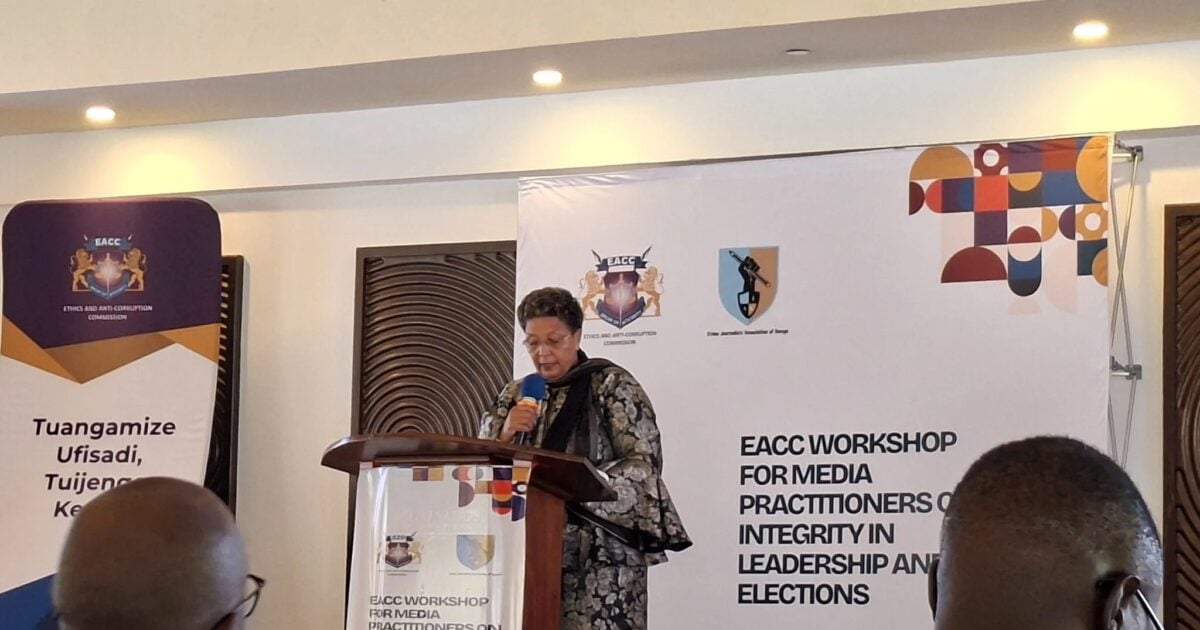
NAIROBI, Kenya, Nov 24 – Court of Appeal Judge Fatuma Sichale has warned that Kenya’s fight against corruption will remain unsuccessful unless citizens take personal responsibility for confronting graft, saying the burden cannot be left to investigative agencies and the Judiciary.
Sichale said institutional efforts by the Ethics and Anti-Corruption Commission (EACC), the courts and the media had helped advance accountability, but lasting change would depend on Kenyans rejecting corruption in their everyday dealings.
Speaking on Tuesday during the second day of an EACC workshop for media practitioners on integrity in leadership and elections in Mombasa, the judge said corruption had become deeply entrenched across public institutions and society, undermining efforts to build a culture of accountability.
Drawing from her experience as a former EACC commissioner and her involvement in the establishment of the country’s anti-graft institutions, Sichale said she had initially believed that the commission could lead the country towards defeating corruption.
However, she said her five-year experience at the commission left her with the realisation that no single institution could win the fight without broader public commitment.
“At the end of the five years, as I walked outside, as I left the Integrity Centre, I think I came to one conclusion: that the fight against corruption cannot be fought by one institution,” she said.
“The Anti-Corruption Commission will lead the fight against corruption, but it is upon all of us to fight corruption. Unless and until the Kenyan people are ready to fight corruption, you as an institution fighting corruption cannot succeed.”
Accountability
Sichale challenged Kenyans to examine their individual contribution to the fight against graft, regardless of their positions in society, arguing that personal accountability must begin within the spaces people occupy.
She invoked the late musician Michael Jackson’s message that change begins with the person in the mirror, saying the principle applied to the country’s struggle against corruption.
The judge also warned that dishonesty had spread beyond senior public officials, citing a case involving a magistrate who allegedly colluded with an applicant to fraudulently obtain letters of administration to access Sh15 million belonging to a person who was still alive.
She described how the scheme allegedly involved several actors, including a local chief, guarantors, officials responsible for civil registration and a doctor whose medical report was used to justify the applicant’s absence from court.
The case, she said, illustrated how corruption could thrive when different actors across institutions participated in or facilitated fraudulent transactions.
“We live in such a rotten society. It is the chief, it is the applicant, it is the guarantors, it is the registrar of births and deaths. It is the doctor. Who will save us?” she posed.
Sichale said the example demonstrated why the fight against corruption must go beyond targeting high-profile individuals to confronting dishonesty at every level of society.
On the role of the Judiciary, Sichale said courts had progressively given effect to Chapter Six of the Constitution on leadership and integrity, reinforcing the principle that public office is a public trust rather than a privilege.
She cited several landmark decisions that have shaped the interpretation of integrity requirements for individuals seeking or holding public office.
Among them was the Supreme Court’s decision in the impeachment case involving former Nairobi Governor Mike Sonko, which reaffirmed that constitutional provisions on leadership and integrity were not intended to be cosmetic.
The court emphasised that state officers exercise authority on behalf of the public and must demonstrate transparency, accountability and commitment to good governance.
Quoting the Supreme Court, Sichale said public authority carried the responsibility to serve citizens rather than the power to rule over them.
She also cited the case involving former Samburu Governor Moses Lenolkulal, in which the court upheld restrictions requiring him to obtain authorisation from the EACC before accessing county government offices while facing corruption charges.
The ruling, she explained, recognised the risk of interference with witnesses and public resources where an official facing corruption allegations continued exercising control over the institution under investigation.
Sichale said the decision reinforced the principle that constitutional provisions governing the removal of governors should not be used to undermine accountability during criminal proceedings.
She further highlighted the Court of Appeal’s decision in the case involving former Nairobi Governor Mike Sonko and the rulings on unexplained wealth, which affirmed the EACC’s authority to investigate assets disproportionate to a public officer’s known legitimate sources of income.
Citing the case involving former public official Jimmy Kiamba, she said courts had upheld the constitutionality of investigations into unexplained assets and the requirement for individuals to account for wealth once investigators establish that it is disproportionate to their known legitimate income.
She stressed that the constitutional right to privacy and protection of property did not provide blanket immunity for assets suspected to have been acquired unlawfully.
“The right protects the estate of the owner. It does not protect property acquired through embezzlement, money laundering or proceeds of crime,” she said, citing jurisprudence on unexplained wealth.
Media’s role in exposing graft
Sichale also challenged journalists to sustain investigative reporting, saying media investigations had historically provided leads that enabled anti-corruption agencies to pursue major financial scandals.
She recalled the investigations involving former Kenya Power chief executive Samuel Gichuru and former Energy Minister Chris Okemo, whose offshore wealth in Jersey came under scrutiny following revelations reported in the media.
She said reports arising from Gichuru’s divorce proceedings, which reportedly listed properties and assets, helped draw the attention of anti-corruption investigators to the matter.
The judge urged journalists to recognise their responsibility in exposing wrongdoing, noting that investigative reporting could strengthen institutional accountability by bringing potential cases to the attention of investigators.
She said the Judiciary, EACC and media each occupied an important position in the fight against corruption, but none could succeed without citizens also embracing integrity.
Sichale said Kenya’s ambition to attain the development standards of countries such as Singapore would remain difficult to achieve unless the country confronted the culture of corruption.
She said the challenge was not simply to strengthen laws and institutions but to ensure that integrity became a principle practised in both public and private life.
KioskNews shows a cleaned-up reading view extracted from the publisher’s page — the original always lives on their site, not ours.