Saptaparni’s heady whiff to Amaltas’s golden shower: How Delhi’s trees mark its seasons
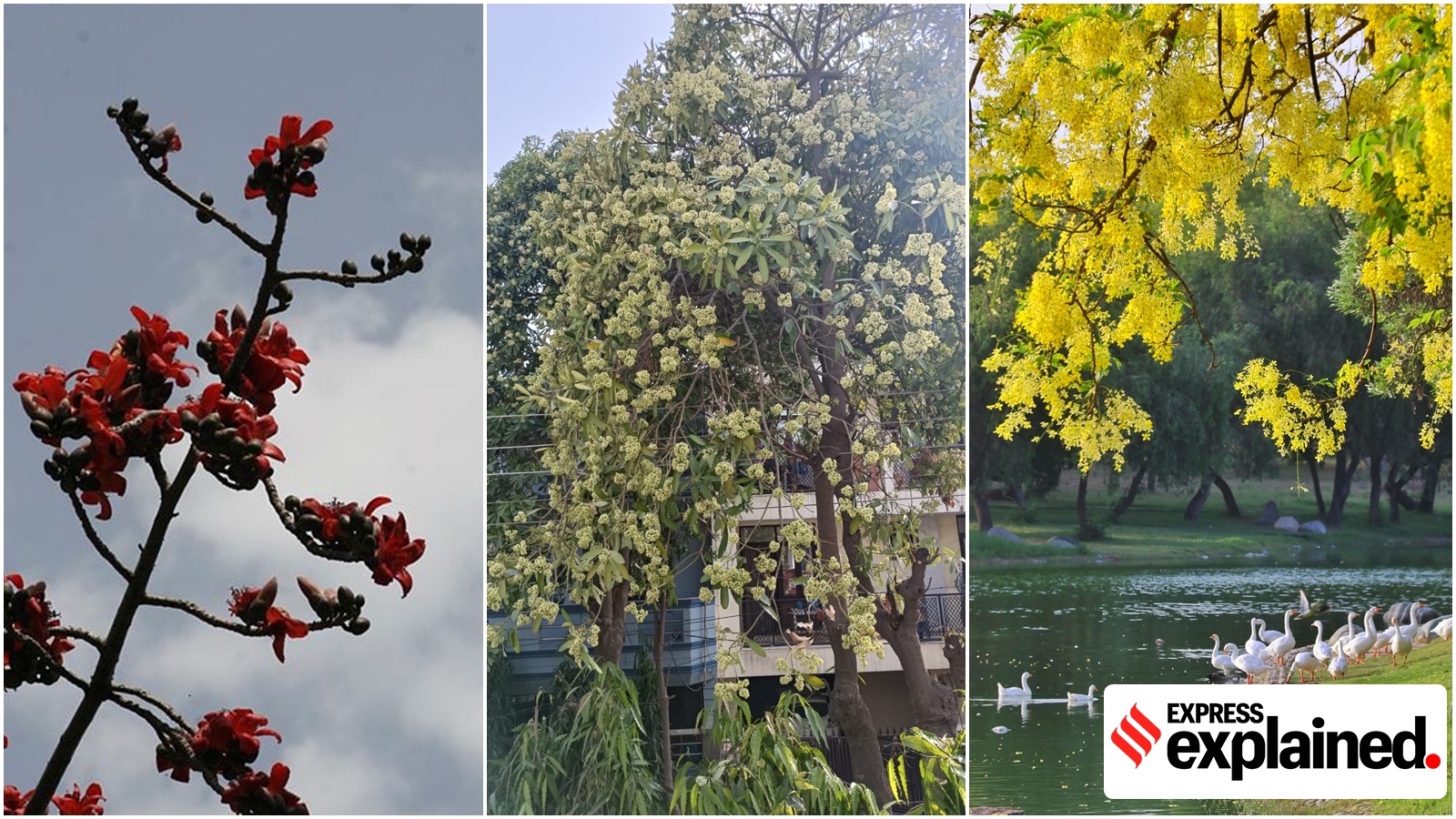
This is the time of the year when Delhi’s air has a sharp tang, a piercing heady scent that is seemingly everywhere in the evening. This is the fragrance of the Saptaparni tree, which blooms in October and announces the creeping winter to the city’s residents.
Delhi is, by nature, a monsoon forest. The rules of that forest explain why the city looks the way it does: trees here drop their leaves in response to dryness, not cold, and many flower in the dry season, usually with bare branches that make the blooms conspicuous.
The Capital has four distinct seasons and trees that are messengers of each, with foliage and flowers marking the passing of time.
Autumn: Saptaparni and Arjuna
Autumn in Delhi belongs to the Saptaparni. The exuberance of its fragrance is matched by the excess of its flowers, blooming in copious clusters across the length of the tree.
Saptaparni is something of an exception to the monsoon forest rule. While most native trees flower in the spring dry season, Saptaparni’s flowers appear in autumn and stay till December. Alstonia Scholaris gets the latter half of its name because its wood was once carved into slates for children. It is oft known as the Devil’s Tree as well, because in many parts of India, especially in Kerala, it is believed to be the abode of yakshis (female spirits) and evil spirits, a superstition linked to its intoxicating night-time fragrance and the toxic milky latex it exudes.
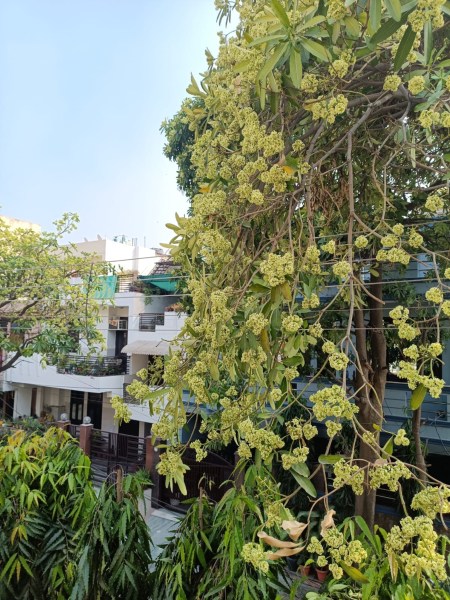 Alstonia Scholaris gets the latter half of its name because its wood was once carved into slates for children. (Express photo: Bhaskar Sarma)
Botanist S Natesh, author of Iconic Trees of India, explains the name of the tree, “Saptaparni is called so in Sanskrit because of the seven leaves at the end of the branches.” Sapta means seven, and parni means leaves. While being a pan-Indian native, Saptaparni is not indigenous to Delhi’s local ecology. It has become a familiar part of the city’s seasonal landscape since its introduction in the 1940s, when the Golf Links colony was being developed.
Besides it, the Arjuna tree flowers in the same weeks. Its blooms are light and fragrant, not showy, but its bark is among Ayurveda’s most important heart medicines.
Story continues below this ad
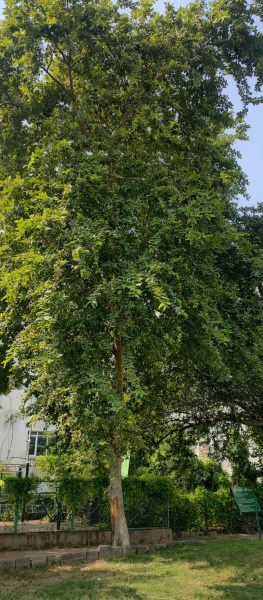 The tall Arjuna has quiet blooms and woody, star-shaped fruits. (Express photo: Yashee)
Semal’s spring
The lull of winter is followed by the blooms that declare spring. Among them are Semal, Mulberry and Chamrod, to name a few, but the rich red of the semal is impossible to miss.
“When it flowers, it lights up the whole Delhi landscape,” says S Natesh, about the Delhi-native semal’s red and orange flowers that are large enough to see from a distance, as they open on leafless branches. Semal is the prime example of the monsoon forest — because the tree has shed its leaves, there is nothing to hide the blooms from pollinators. “Parakeets, Hornbills, Yellow footed pigeon, squirrels, bulbuls and others throng to the tree during the entire flowering season that lasts for a month,” says Dwivedi.
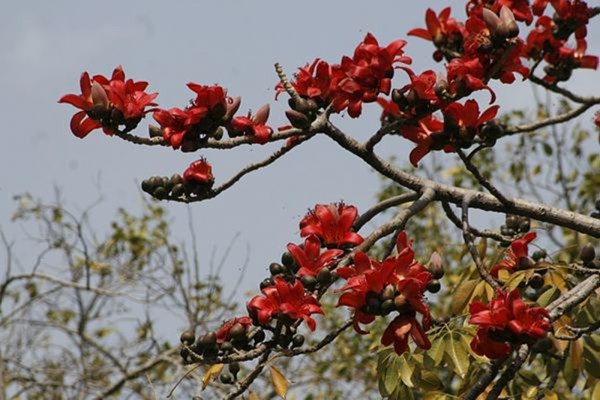 The Semal is impossible to miss in the spring. (Express photo: Partha Paul)
Semal is also known as shalmali. Its seed fibres — silk cotton — are collected to make various items like pillows. During Holika Dahan, the central core of the fire is made of this cotton. Semal’s unopened flower buds are also consumed by many a Delhiite as well as tribal areas of Assam, Manipur, and Meghalaya. These buds, called sembal dodde in local parlance, are a fleeting seasonal delicacy available only in the weeks before flowering (roughly January to March), foraged rather than bought.
Alongside Semal, the mulberry (commonly known as Shahtoot) is a Chinese native tree that arrived in India centuries ago, possibly via the Silk Route, though it has naturalised so much so it feels like a native. While mulberry is the host plant for silkworms, Delhi is not a sericulture belt, and hence, mulberry trees exist entirely as fruit trees here.
Story continues below this ad
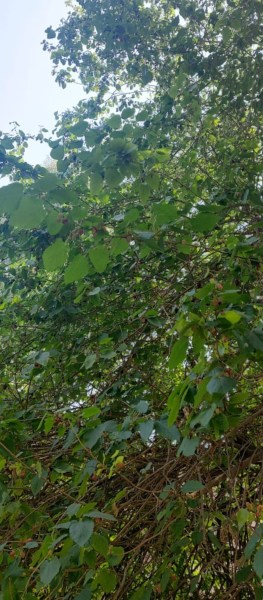 The pink fruits of mulberry ripen to a rich purple. (Express photo: Yashee)
Its flowers are inconspicuous — small, green catkins that appear in early spring — but the real event is the fruit, which is “much-awaited food for avifauna and animals after the cold winter,” says Dwivedi. By April and May, these berries ripen and are sold in markets like Karol Bagh and Old Delhi.
Just after Semal and Mulberry, Chamrod flowers in March to early April, signalling the shift from spring to summer, with its nose-pin sized white flowers and tiny clusters of berries hanging in bunches. “The berries are edible and a feast for birds and squirrels,” says Dwivedi. Chamrod does very well in dry conditions and needs very little care. Regions of Maharashtra worship the tree, though that is not the case in Delhi.
Then there is Pilkhan, which marks the short spring without a single flower. As ecologists note about Delhi’s monsoon forest, most trees start new leaves before the rains arrive, and these leaves go through a short phase of flushing pink or red before turning green. Pilkhan is the perfect example, as in early March, new leaves emerge coppery and purple, shifting to red and bronze before settling into green by mid-April.
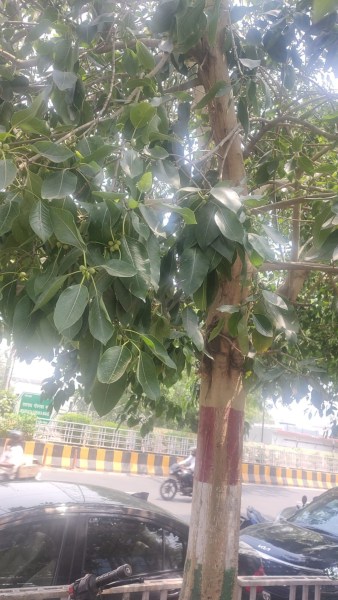 The Pilkhan’s flowers are hidden inside the fig. (Express photo: Yashee)
Padmavati Dwivedi, a biodiversity expert, notes that it “doesn’t have a single flower visible, but makes up with the ever-changing shades of leaves.”
Story continues below this ad
S. Natesh explains the trick inside its fruit: the flowers are hidden inside the fig, and a tiny wasp enters through a hole at the top to pollinate them. Each fig species has its own wasp. The figs themselves ripen in the monsoon, so while Pilkhan’s fruit belongs to the rains, its colour belongs to spring.
Golden summers
By late April, as the Delhi summer peaks and temperatures soar past 40°C, the city turns golden. The Amaltas (Cassia fistula), known as the Indian laburnum, is a native tree mentioned in the Ramayana and Mahabharata, and it thrives precisely in this harsh heat. It is deciduous, shedding its leaves in early April, so when the flowers bloom, they hang from bare branches in long, drooping clusters that S. Natesh describes as “chandelier-like inflorescences.”
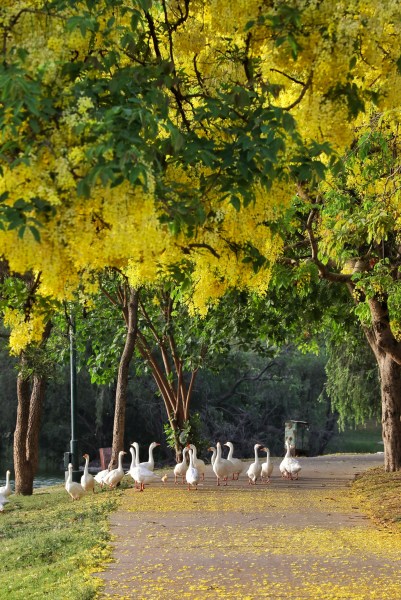 Amaltas trees in full bloom on a summer morning at Shanti Van in New Delhi. (Express photo: Abhinav Saha)
Flowering begins in late April, peaks in mid-to-late May, and continues into early June. Beyond its beauty, the tree is economically useful as well, its Sanskrit name Aragwadha translates to “disease destroyer,” its fruit pulp is used in Ayurveda as a laxative, and its long, woody pods — which do not split open — are dispersed in nature by jackals and civets on the Delhi Ridge. “Amrita Shergill Marg lined with these is a place to visit during its flowering season,” recommends Dwivedi.
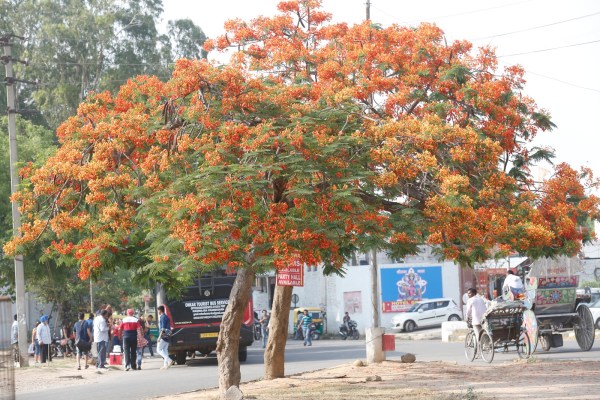 The red of the Gulmohar and the yellow of Amaltas complete Delhi’s summer symphony. (Express photo)
Rivalling the golden Amaltas in beauty are the Gulmohar’s red and orange blooms.
Rainy whites
Story continues below this ad
With the arrival of the rains, the Pilkhan’s green figs ripen, but the season’s true marker is Kaim (Mitragyna parvifolia). A member of the coffee family, Kaim flowers from July to September, small, creamy-white spherical heads that carry a delicate fragrance, thriving in the sandy beds and seasonal streams where softer species cannot survive.
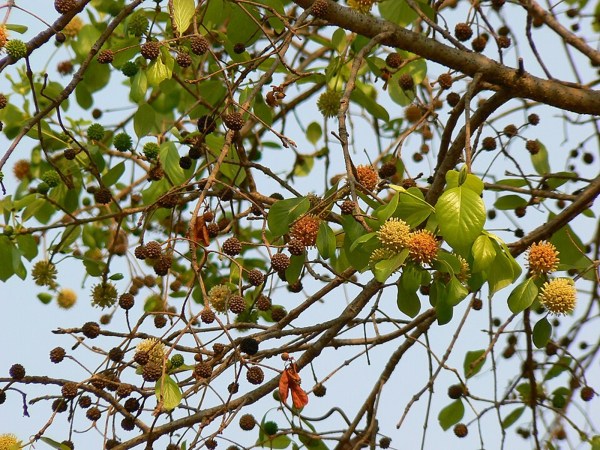 The Kaim’s flowers are spherical. (Photo: Wikimedia Commons)
Natesh points to the places you can find it in Delhi: near Nehru’s and Indira Gandhi’s samadhis, at Talkatora Garden and Lodhi Garden, near the Supreme Court, and scattered across the IIT campus.
Interestingly, while Lodhi Garden is also famous for its grove of Kadamb (Neolamarckia cadamba) blooming in August and September, botanists note a case of mistaken identity. The “true Kadamb” of Krishna’s Vrindavan is actually the Kaim. As Natesh explains, “Rasleela is supposed to have taken place under these Kaim trees.”
KioskNews shows a cleaned-up reading view extracted from the publisher’s page — the original always lives on their site, not ours.