'Need To Address This Injustice': Farooq Abdullah On J&K Reservation Hike
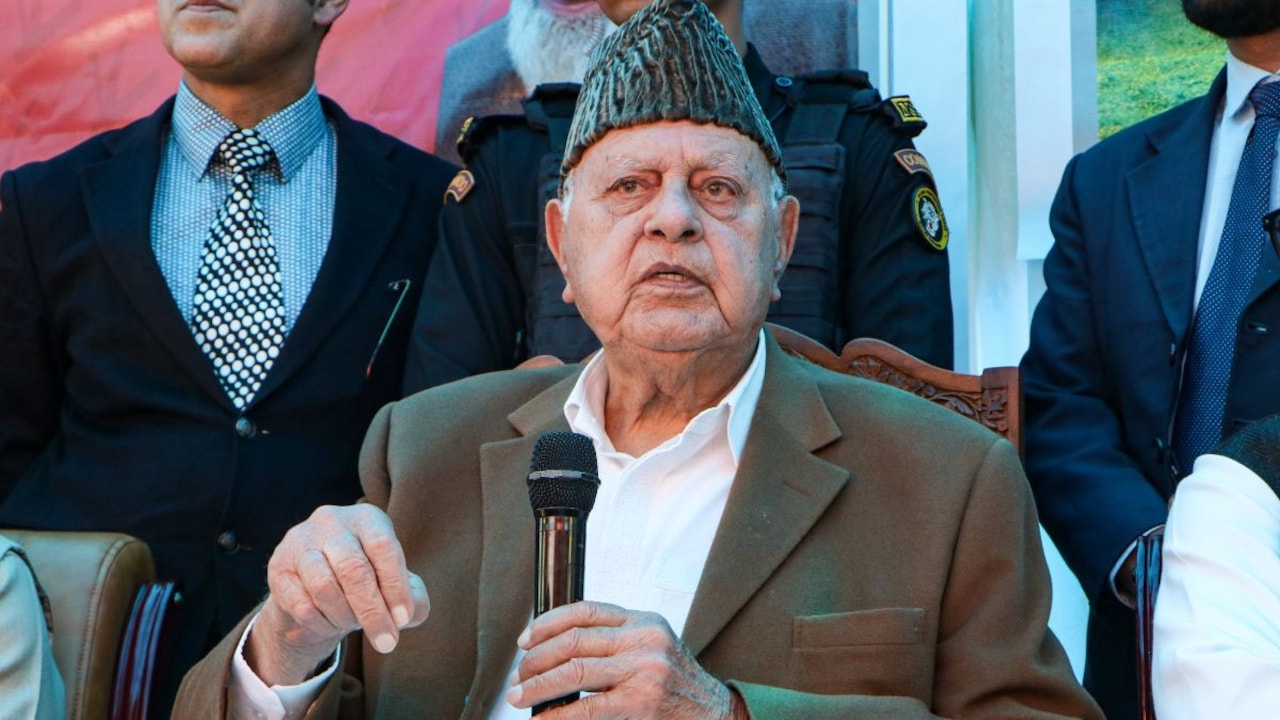
National Conference President Farooq Abdullah has said that the general category will be pushed to the same position as Schedule Casts were facing in 1947 if the reservation issue is not addressed.
Abdullah said that the open-merit students are increasingly complaining of being left out of jobs and professional courses. He said the increasing quotas are taking jobs at the cost of merit.
The remarks from Abdullah have come amid demands to rationalise the reservation limit in Jammu and Kashmir, as the general category is demanding its due as per the population ratio.
Jammu and Kashmir has a 70 per cent general category population but gets less than 40 per cent of jobs. Over 60 per cent goes to the reserved categories.
Abdullah termed the increased reservations as an injustice with respect to open merit and asked the government to address this injustice.
"We have to make an effort to address this injustice somehow. If we keep on increasing reservations, then the people (general category) who are outside the reservation system will be pushed to the same position as Scheduled Castes were in 1947,'' said Abdullah.
After Jammu and Kashmir was stripped of its statehood and special status under Article 370 in 2019, there have been major changes in rules, including reservations in jobs.
For example, in March 2024, the Centre granted Scheduled Tribe status to Pahari-speaking people and groups like Paddari, Koli and Gadda Brahmins in J&K. Before the abrogation, only the Gujjar and Bakerwal tribes were classified as Scheduled Tribes with 10 per cent reservation in jobs. After the inclusion of Paharis, the reservation quota for the ST category is now increased to 20 per cent.
Scheduled Castes, OBCs, EWS, Line of Control, and Resident Backwards Areas (RBC) are among other categories which take the reservation way above 60 per cent in a place which has 70 per cent general category population.
In December last year, Omar Abdullah's government approved a new reservation policy giving more representation to the General category. According to sources, 50 per cent of jobs will now remain available for Open Merit. But even after 10 months, the revised quota policy could not be implemented because it has not been cleared by the BJP-ruled Centre.
Abdullah said the general category boys and girls who secure more than 80 per cent marks do not get admission in professional colleges, while students from the reserved category with half the marks of general category students get admission.
"The problem is that the people who do not fall under any reservation category are now complaining. They say, 'Look at this boy or girl (from the reserved category) who is getting a medical seat, an engineering seat, or an agriculture seat with 45 per cent marks, while I am scoring 80 per cent and still cannot get admission anywhere','' said Abdullah.
Besides the larger reservation issue, two definitions of poverty in Jammu and Kashmir have also accentuated the row over job quotas. As 10 per cent of jobs are reserved for the Economically Weaker Sections (EWS) exclusively for General category applicants, a contested definition of EWS has become another flashpoint in the wider reservation debate.
The criteria employed by the government in issuing EWS certificates is seen in conflict with the government's own data on the poor and those living below the poverty line.
Political leaders allege regional bias in favour of Jammu, blaming the government for denying jobs to a large section of poor people in the Kashmir Valley.
Today, J&K Assembly Speaker Abdul Rahim Rather said that he has issued directions to the state government to examine the regional imbalance in EWS certificates.
"I have directed the government to examine the issue and see wherever there is scope for improvement to avoid injustice to any section of society,'' said Rather.
Based on the ration cards issued by the Department of Food Supplies and Consumer Affairs J&K, there are 37.71 lakh Priority Household (PHH)/Antyodaya Anna Yojana (AAY) ration cardholders in the Kashmir Valley and 29.81 lakh in Jammu.
Since the criteria for EWS conflict with the official data of the below-poverty-line (BPL) population, political leaders allege that the poor in the Valley are deliberately denied EWS certificates.
Sajad Lone, President of the Peoples Conference, presented a detailed note before the J&K assembly. According to Lone, against a BPL population of 55 per cent in Kashmir, only 8 per cent of people have been given an EWS certificate. The remaining 92 per cent of the EWS certificates have been issued in the Jammu region, which has a 45 per cent BPL population as per UT criteria. As per official data, over 26,000 EWS certificates have been issued in J&K over the last two years. Of these, 24,000 have been issued in Jammu and just 2,000 in the Kashmir Valley.
KioskNews shows a cleaned-up reading view extracted from the publisher’s page — the original always lives on their site, not ours.