Non-verbal, non-mobile S’pore girl joins global hackathon where experts try to solve medical mysteries
SINGAPORE – When Sarah Swee was born after 38 weeks’ gestation, she made a high-pitched, wheezing sound caused by disrupted airflow through a narrowed upper airway – called stridor – and she was not able to swallow.
She also suffered from facial palsy, a loss of movement in the facial muscles on her left side.
“She was not growing normally so she was delivered by caesarean. It was then that the doctors noticed she has a receded chin and was not moving the left side of her face. This made it difficult for her latch on for breastfeeding or even bottle-feeding, so she had to be tube-fed,” said her mother Jasmine Lee.
Sarah, now 14, is non-verbal and non-mobile. Doctors still do not know what her condition is.
“(They) could only tell me about her symptoms and physical characteristics but none could come up with a diagnosis,” said Lee, whose efforts all these years to get a diagnosis for Sarah have not borne fruit.
What Koh Ai Ling, a geneticist with KK Women’s and Children’s Hospital (KKH), can say is this: Sarah has a complex medical history of brain stem disorder, congenital (facial nerve) palsy, and severe global developmental delay.
Even after Sarah underwent various genetic tests, no genetic cause explaining her symptoms could be found.
“Rare diseases can be difficult to diagnose because the symptoms do not always point neatly to one particular condition. A person may have several symptoms affecting different parts of the body. While each individual symptom may look relatively familiar to doctors, the challenge is recognising that the combination (of symptoms) may be the result of one underlying disorder,” Koh said.
Koh said doctors cannot test for every possible rare disease as there are thousands of known genetic disorders “and many are individually so uncommon that a particular doctor may never encounter one during his or her career”.
“Doctors may need to work through a long list of possibilities, review investigations that have already been performed, look for patterns that may have been missed and increasingly, use genomic data to search for genetic explanations,” she said.
For someone like Sarah, Koh said the first important breakthrough may therefore not be a treatment or cure “but simply finding out what is causing the illness”.
“A diagnosis can provide an explanation for years of symptoms, help doctors determine what should be monitored, prevent unnecessary tests or treatments, and in some cases identify a treatment that would not otherwise have been considered,” she added.
Around 7,600 genetic diseases have been identified throughout the world, and more are being discovered every year.
To increase the chances of finding the root cause of their conditions, persons living with undiagnosed diseases (PLWUD) can participate in an intensive 48-hour, hands-on diagnostic sprint called The Undiagnosed Hackathon.
This event gathers families of PLWUDs and multidisciplinary experts from around the world to work side by side on rare, complex cases that have remained unsolved despite extensive medical testing.
The first South-east Asian edition of the hackathon, and the fifth overall, was held at KKH from Sept 19 to 20, organised by the hospital and the Wilhelm Foundation in Sweden.
Koh said: “The hackathon changes the problem from recognising a rare disease by any one doctor to finding a plausible explanation by a group of collaborators combining their know-how and experience, using clinical information of the PLWUD, and modern genetic tools.
“This is particularly valuable as a typical case may contain information from many different areas – clinical observations, scans, laboratory results, family history and genetic data. One specialist may recognise something another would not immediately notice.”
Helene Cederroth, one of the founders of Wilhelm Foundation, told The Straits Times the event brought together 140 experts from 32 countries “who may otherwise not have the chance to work together during normal circumstances”.
They include clinicians, geneticists, genetic counsellors, lab specialists, bioinformaticians (who use computer programming, maths and statistics to understand complex biological and genetic data), molecular biologists, researchers, data scientists, AI specialists, and software developers.
They worked together on 25 cases of undiagnosed children and adults from Singapore, Indonesia, Malaysia, and the Philippines.
Proteomics, the study of proteins in the body, was added for first time to the recent hackathon – complementing clinical, genomic and phenotypic information.
From grief to action
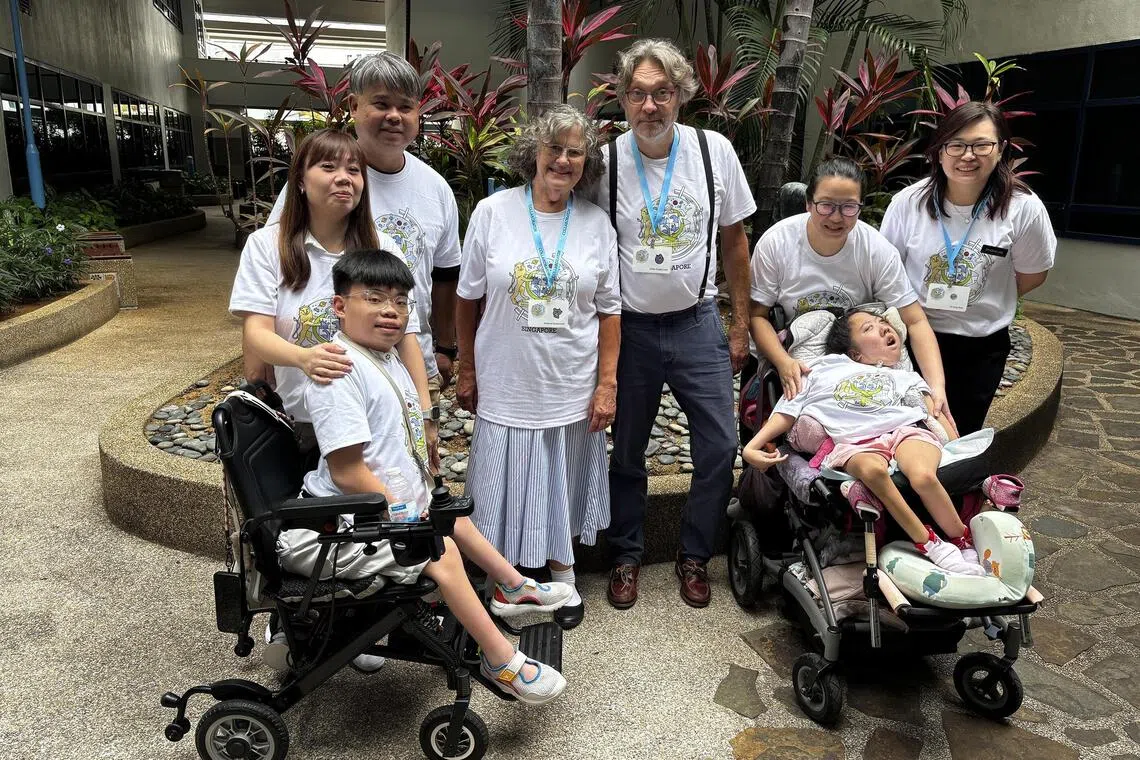
At the Undiagnosed Hackathon from Sept 19 to 20 were Helene and Mikk Cederroth (centre), founders of the Wilhelm Foundation, and geneticist Koh Ai Ling (far right), from Department of Genomic Medicine at KK Women’s and Children’s Hospital. Supporting Sarah Swee and her mother Jasmine Lee (second from right) are Dawn Lee (left), Ng En Le and Jarren (in wheelchair).
ST PHOTO: JUDITH TAN
The first Undiagnosed Hackathon was held at the Karolinska Institutet in the founders’ home country of Sweden in June 2023 where four PLWUD were diagnosed.
It was inspired by the experience of Helene Cederroth and her husband Mikk, who lost two young sons, Wilhelm and Hugo, and a daughter, Emma, to undiagnosed conditions.
Wilhelm was only a few months old when he suffered severe stomach pain and was diagnosed with epilepsy.
After consulting a geneticist and going through a battery of tests, the Cederroths were told their son’s illness “was a coincidence and that the condition was not hereditary”.
Six hours after their second son Hugo was born – eight years after Wilhelm – the younger boy too experienced seizure and was also diagnosed with epilepsy.
“Having had an elder daughter who was born healthy, we were told that if we had another girl, she would be healthy. But Emma had her first seizure just 30 minutes after her birth,” Helene Cederroth said.
Despite the early onset of symptoms in three of their children, there was no diagnosis for their condition, which remained unexplained 30 years on.
Wilhelm died in 1999 at the age of 16, followed by Emma a year later at the age of six. Two years after Emma died, Hugo died at age 10.
The couple turned their grief into a call to action, starting a foundation named after their son Wilhelm to help find answers for those without a diagnosis.
Only about 40 per cent of an estimated 350 million people worldwide affected by rare diseases and conditions know the root cause.
“We want to help the remaining 60 per cent,” Helene Cederroth said.
For the past 20 years, the Cederroths have built a global network of scientists, clinicians and advocates committed to finding answers to undiagnosed and rare diseases and conditions.
They turned to the hackathon format to break through traditional medical research boundaries and accelerate answers for families living with ultra-rare, unsolved conditions.
During the working sprint, experts compare symptoms with gene findings, search medical literature, review variant data, test hypotheses and identify the strongest diagnostic leads.
A bell is rung when experts feel they have reached a threshold for possible diagnosis that fit the clinical picture and available molecular evidence. These findings must be clinically confirmed before they become diagnoses.
A total of 27 cases had been pinpointed and diagnosed as a result of Undiagnosed Hackathon.
One such rare condition was the DNA2-related Rothmund-Thomson Syndrome (RTS-4), an ultra-rare condition affecting the eyes, skin and bones, due to mutations in the DNA-2 gene. The finding ended the diagnosis odyssey of the PLWUD.
The hackathon at KKH had not yielded a diagnosis on Sept 19 and 20 for any of the 25 cases.
These cases, like the other unresolved ones from the hackathon, are funnelled through the wider international network, and the work continues.
This is especially important for South-east Asian families, because genomic reference databases have historically been less representative of Asian populations, Koh said.
Lee is still waiting for the answer to Sarah’s condition.
“I hope the teams are able to tell me what my daughter has, what we are and will be facing so we can give her the best possible care,” she said.
KioskNews shows a cleaned-up reading view extracted from the publisher’s page — the original always lives on their site, not ours.