Metro-themed shirts, ‘We love public transport’ signs and a kiss at Bankstown: Sydney’s newest train line opens

Hundreds of rail enthusiasts and a handful of bewildered commuters have ridden the first service on a long-awaited extension to Sydney’s metro line, bringing an end to more than two years of replacement buses.
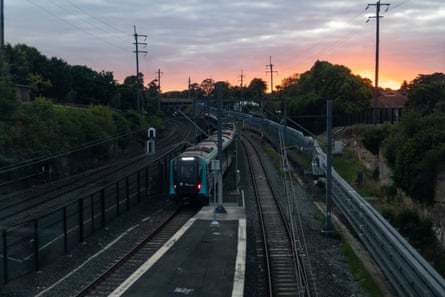
The 4.31am train on the south-west metro extension left Bankstown on time on Friday, arriving at Sydenham, where the line previously terminated, just over 20 minutes later. It carried on to Tallawong in the city’s north-west at the end of what is now a 66km continuous, high-speed, driverless line.
Early at Bankstown, hundreds of rail enthusiasts were already queueing for a spot on the first service an hour before it departed. The New South Wales transport minister, John Graham, arriving late at 4.20am, only just made it on.
Angus Higginbotham, 14, and his father, Tim, who missed the opening of the wildly popular metro city extension in 2024, were among those who did as well.
“My start of school was at 8 o’clock and I couldn’t go to that [2024] opening,” says Angus, who wants to be a Sydney trains driver.
“But, for some reason, I was able to convince my dad here to come along for this day – this awesome day actually – on the metro.”
The crowd was a sea of Sydney metro-themed T-shirts, badges, caps, earrings and sequined jackets. Enthusiasts held signs declaring “We love public transport” and “First to Ride SW Metro 30.10.26”. One waved his passport around, exclaiming “I have the same birthday as the Sydenham to Bankstown extension!”
The crowd cheered as the train arrived and as the doors opened and closed. As the train left Bankstown on time, full to bursting, they cheered again. One couple kissed.
Moving through the early stops on the line at speeds of up to 100km/h – Punchbowl, Wiley Park, Lakemba – a few brave families, and the odd stunned commuter, shouldered their way on, while passengers disembarked, worried they might faint in the heaving mass of bodies. A standard six-car metro has a capacity of 1,100 people.
One man, Lee Anderson, ran the entire length of the line overnight from Tallawong, making it in time for the first train out of Bankstown.
The ecstatic reception to the extension comes more than two years after the former T3 heavy rail line, which serviced 10 stations in Sydney’s inner west and south west – Marrickville, Dulwich Hill, Hurlstone Park, Canterbury, Campsie, Belmore, Lakemba, Wiley Park, Punchbowl and Bankstown – closed in September 2024 to be converted to the driverless rapid transit system.
Tens of thousands of people live on the line, which will now provide capacity for 17,000 people during the peak hours.
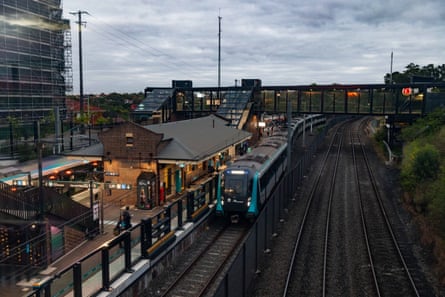
Isaiah Daylight, 8, and his mother, Jen, live near Belmore station and have been relying on the infamous pink replacement buses. “I’m so happy to see the back of them,” Jen says. “I’ve missed our train”.
How does Isaiah, who also rode the first service on the city metro extension, feel about the early start? “Great,” he says.
after newsletter promotion
“He’s been waiting patiently for this day,” Jen says. “We were up at 3am this morning and out the door, and then he’s going to have a little nap and go to school.”
The project to connect the stations to the city metro, which opened in August 2024, was estimated to take 12 months at that time, while the former Coalition government, which announced the project in 2014, predicted it would take three to six.
Abdullah Balkhi, 19, who Guardian Australia previously spoke to when he rode the final Blue Mountains V-set service in January, lives in Sydney’s north-west.
He says the metro will open up areas of the city’s south-west, including Bankstown itself. “I love the food here, so I’ll come down after uni when I don’t want to go home.”
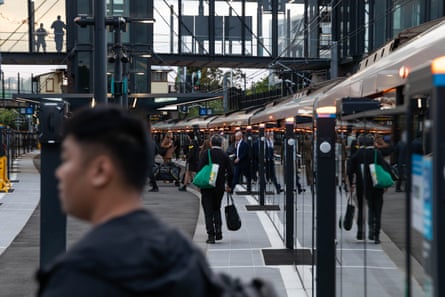
A journey from Bankstown to Central station now takes 28 minutes – a six-minute saving compared with the former heavy rail line. Longer journeys are expected to yield greater savings, such as Lakemba to Victoria Cross, which will take 37 minutes – a 24-minute saving on previous travel times.
Replacement bus services were still arriving and departing empty at Sydenham, early on Friday morning. They are running in the metro’s opening weekend while communities adjust.
Balkhi says he has friends on the line who have been complaining “endlessly” about the pink buses.
“I feel really happy for them now that they have more reliable and frequent public transport.”
KioskNews shows a cleaned-up reading view extracted from the publisher’s page — the original always lives on their site, not ours.